
Young intellectual volunteers participating in the Project to increase the number of young intellectuals who volunteer to work in economic-defense zones, known as Project 174, brought knowledge gained at universities and colleges, together with their enthusiasm, to support residents in border communes.
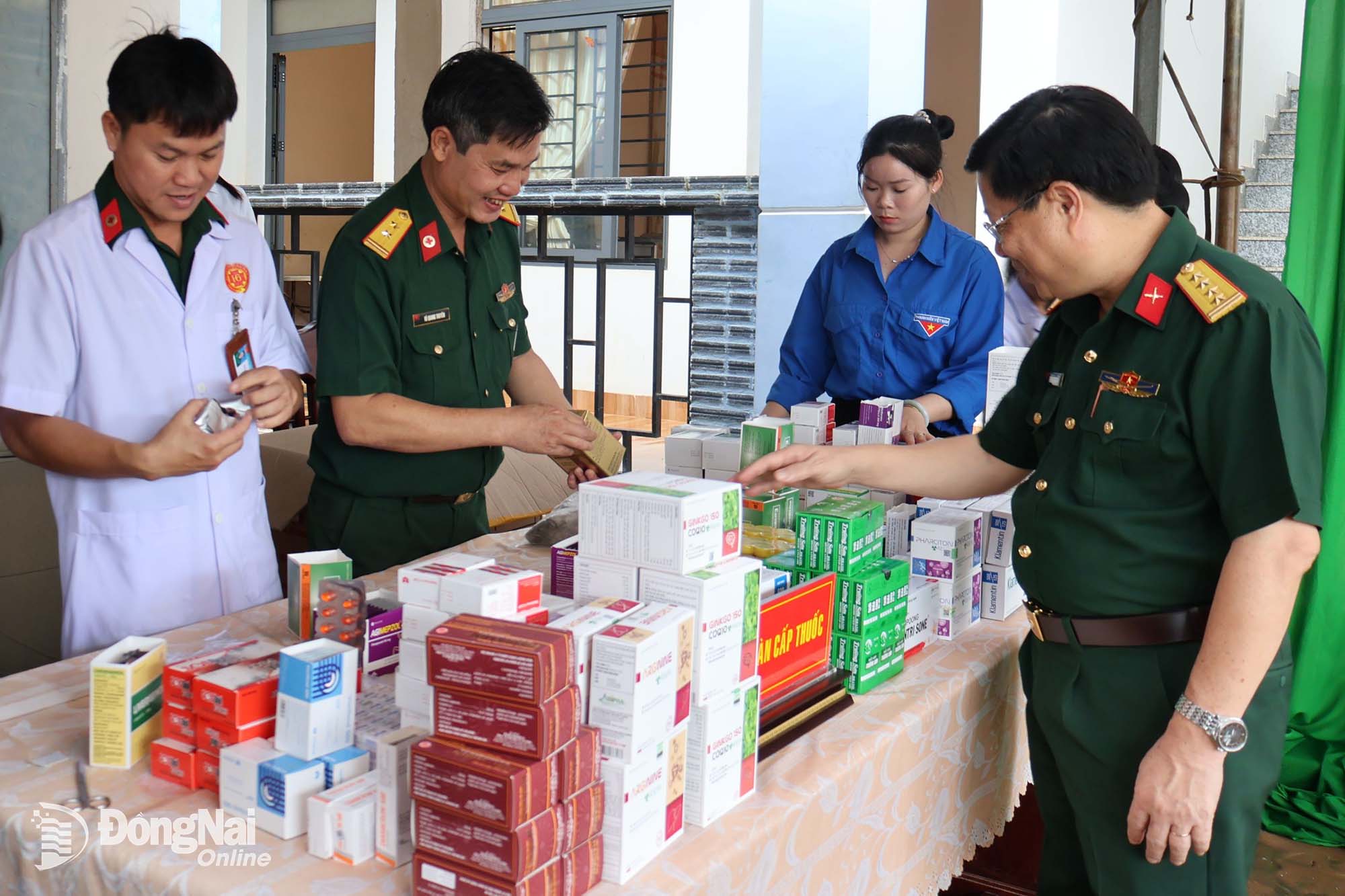 |
| Officers from Army Corps 16 and young intellectual volunteers provide free medicine and medical examinations to local ethnic minority communities. |
Bringing joy, sowing the seeds of knowledge
Across Army Corps 16’s economic-defense zones in various provinces and cities, the most evident change is the shift in the production mindset of ethnic minority residents. Young intellectual volunteers have made a significant contribution to this transformation. They include agricultural and forestry engineers and graduates in socioeconomics, information technology, healthcare, and other fields. Away from the office, they chose “staying close to the villages, farms, and people” as the guiding principle for their youth.
Through hands-on guidance, the volunteers organized technical training courses and helped residents cultivate more than 110 hectares of coffee, macadamia, rubber, and cashew trees. They also contributed hundreds of workdays to help farmers harvest their crops. As a result, more than 4,000 square meters of “youth vegetable gardens,” along with livestock farming models and organic propagation nurseries, have taken shape on once-barren land across the economic-defense units, inspiring hope for a prosperous, sustainable life among border residents.
“The Party Committee and Command of Army Corps 16 have consistently identified the implementation of Project 174 as an important political mission aimed at promoting the pioneering role of young intellectuals in building a strong all-people national defense posture.”
Colonel Trinh Pham Hoa, Secretary of the Party Committee and Deputy Commander of Army Corps 16
Phun Van Ba, a graduate of the Faculty of Journalism and Communication at the University of Social Sciences and Humanities, Vietnam National University Ho Chi Minh City, now serves at Economic-Defense Unit 720 under Army Corps 16. “Recently, we called for donations and collected more than 2,000 sets of clothes for disadvantaged ethnic minority residents, organized free English classes for children at Hoa Sim Kindergarten, and carried out numerous social welfare activities for the community. These actions are small, yet meaningful,” said he.
Colonel Doan Manh Nghia, Secretary of the Party Committee of Economic-Defense Unit 720, Army Corps 16, said the young intellectual volunteers serve as “an extended arm” connecting the unit’s troops with local people. Through their knowledge and dedication, they have helped residents change their mindset and production practices while serving as a core force in eradicating illiteracy and sharing legal and cultural knowledge. Their presence has strengthened military-civilian solidarity and firmly reinforced the people’s trust in the Party, the State, and the military.
An aspiration to serve
Beyond contributing to economic development, the volunteers have left a lasting mark on the roads that open up access to remote villages. Working with local forces, they cleared 120 kilometers of roads linking villages, built 10.6 kilometers of concrete roads, dredged 33 kilometers of irrigation canals, and installed solar-powered lighting along dozens of kilometers of the border. Notably, in response to the new development requirements, the volunteers also took the lead in proposing and implementing a model to guide residents through the “Digital Literacy for All” campaign, helping them become digital citizens and bringing technological literacy directly to every stilt house.
Alongside economic and infrastructure development, social welfare and public healthcare programs have been implemented effectively. The volunteers participated in providing free medical checkups and medicine to people on more than 3,200 occasions, donated 35 units of blood to save lives, presented numerous gifts to policy beneficiary families and people with meritorious services to the revolution, and sponsored and supported hundreds of disadvantaged children. Across Army Corps 16’s economic-defense units, numerous free English classes have been organized, while bilingual Vietnamese-M’nong legal communication programs have helped bring legal knowledge closer to residents.
According to Captain Ha Long Tan, Youth Assistant of Army Corps 16, the young intellectual volunteers under Project 174 have become a source of high-quality personnel, bringing fresh vitality to economic-defense zones. They lead efforts in digital transformation, agricultural extension, and social welfare while serving as a core force in youth emulation movements across the corps. Their growth through each project and undertaking has demonstrated the project’s substantial practical effectiveness, reaffirming the spirit of “where there is a need, there is youth; where there are difficulties, there is youth” across the nation’s borderlands, the protective shield of the Fatherland.
In addition to excelling in meeting socioeconomic development targets, the volunteers at Army Corps 16 have grown considerably through practical service. A total of 47 volunteers joined Party-awareness training courses, and 15 comrades had the honor of being admitted to the Communist Party of Vietnam. Since completing their assignments under the project, many have maintained a long-term commitment to the unit, serving as high-quality young personnel who actively contribute to the nation’s borderlands, the protective shield of the Fatherland.
By Nguyet Ha – Translated by Minh Hong, Thu Ha

Thông tin bạn đọc
Đóng Lưu thông tin