
>>> Part 1: New vision paves the way for development
>>> Part 2: Innovating leadership methods, turning vision into action
Final Part: Breakthroughs begin with contingent of cadres
A development vision has been set, the administrative apparatus has been streamlined, and authority has been decentralized more decisively. Yet one decisive link stands between vision and results: the contingent of cadres. Ultimately, no matter how sound a guideline may be, it must be implemented by specific individuals and translated into tangible results on the ground.
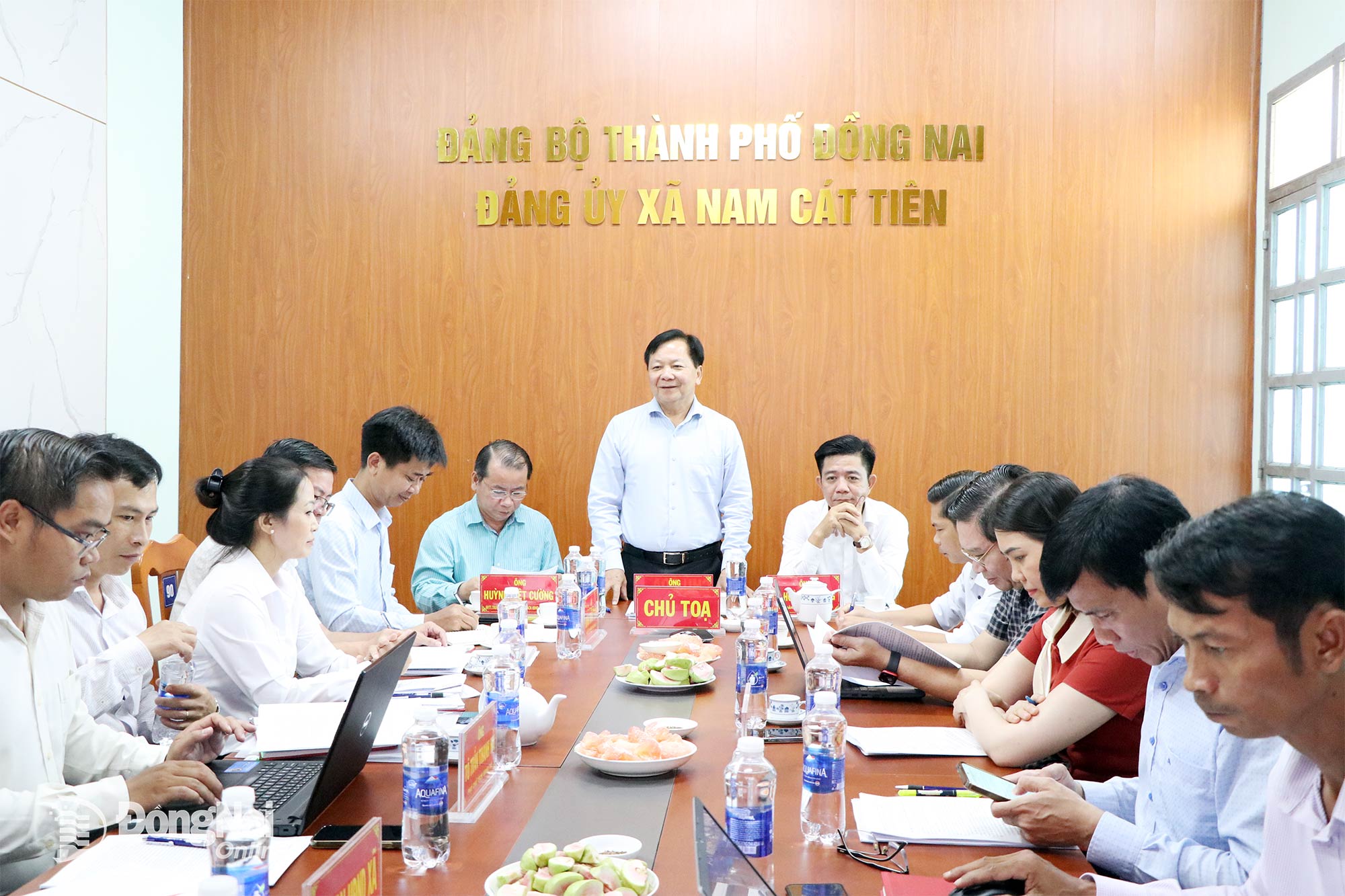 |
| Tran Van Mi, Member of the Dong Nai City Party Committee and Vice Chairman of the City People's Council, leads a field survey to assess the operations of the Nam Cat Tien Commune People's Council on May 22, 2026. Photo: To Tam |
This requirement was also clearly underscored in the Party General Secretary and State President To Lam’s conclusions at his working session with the Party Central Committee's Organisation Commission on August 26, 2026, concerning the drafting of a new resolution on cadres and cadre work. The top leader emphasized that Party building and rectification constitute the foundation; leadership and governance methods serve as the mechanism; the organizational apparatus provides the structure; and cadres are the decisive factor.
Taking the lead through forward-looking thinking
The Dong Nai City Party Committee has thoroughly grasped these requirements and placed them within the context of the locality's need to accelerate development. The task is not simply to have sound guidelines or open mechanisms but also to build a cadre contingent with the vision to understand, the capacity to implement, the courage to make decisions, and the sense of responsibility to see tasks through to completion.
Development space has expanded, growth drivers are changing, and emerging challenges increasingly extend across sectors and regions. In this context, a parochial mindset will restrict development space; a term-based thinking will limit long-term vision; and a reactive approach will leave the administrative apparatus constantly struggling to keep pace with reality.
Thinking in advance means being able to place each specific task within a broader development goal. An investment dossier is not merely a set of documents awaiting processing; behind it may be a project, capital inflows, jobs, and development opportunities. A road is not simply a transportation project; it can open up an entire urban development space and create a new value chain for each locality, while also contributing to regional and national development.
Politburo Resolution No. 24-NQ/TW, dated August 22, 2026, calls for promoting the pioneering spirit, exemplary conduct, innovative thinking, and willingness to think, act, and assume responsibility among cadres and Party members in the new era. Politburo Directive No. 07-CT/TW, dated July 13, 2026, on promoting the study and practice of Ho Chi Minh’s thought, morality, methodology, and style in the new development phase, also links political steadfastness and innovative thinking with the ability to remove bottlenecks, act for the common good, and fulfill assigned tasks effectively.
Therefore, renewing mindsets must go hand in hand with changing working methods and practices: moving from passively awaiting assignments to proactively addressing problems; from routinely handling emerging issues to development-oriented governance; and from focusing solely on individual responsibilities to pursuing overall development goals.
If the vision extends far into the future while cadres' mindsets remain unchanged, the cadres themselves may become a bottleneck to development.
Demonstrating competence and accountability
A sound mindset has value only when translated into the capacity to act. Cadres must do more than identify difficulties. Their capabilities must be demonstrated through their ability to recognize problems, formulate solutions, choose appropriate courses of action and take responsibility for their decisions.
As Dong Nai has entered a new development space, the requirements for cadre competencies have changed accordingly. In addition to mastering their assigned areas of responsibility, cadres must be capable of addressing cross-sectoral and inter-regional issues; proficient in using data, technology, and modern governance tools; skilled in coordination, persuasion, and implementation; and sufficiently resolute to make decisions when confronting new, difficult, and complex challenges. The Dong Nai City Party Committee and municipal leadership have recognized these requirements and consistently given them close attention.
In his conclusions on August 26, 2026, General Secretary and State President To Lam explicitly pointed out that some cadres continued to demonstrate limitations in forecasting capacity, strategic thinking, modern governance, digital transformation, innovation, and implementation. Meanwhile, blame-shifting, work avoidance, fear of making mistakes, and evasion of responsibility persisted.
These shortcomings are far from minor issues in an era when speed is critical. A cadre's hesitation to make a decision can delay the processing of a dossier. A leader's lack of decisiveness can slow down the operations of an entire agency. If the fear of responsibility becomes widespread, it can hinder the functioning of the entire administrative apparatus.
Consequently, "not making mistakes" cannot be the ultimate goal of public service performance. Making no mistakes but refusing to make decisions, violating no regulations but allowing work backlogs to accumulate, or protecting one's own position but allowing development opportunities to pass cannot be considered acceptable standards for the contingent of cadres in the new era.
In the same conclusions, General Secretary and State President To Lam also stressed that strategic-level cadres must possess a far-reaching vision, leaders must make sound decisions, and grassroots cadres must carry out tasks thoroughly. All must be assessed through tangible outputs, concrete results, work efficiency, and the people's confidence.
Screening cadres based on performance results
Dong Nai has substantial development opportunities, but these opportunities can become a driving force only when translated into reality through sound policies and a cadre contingent capable of implementing them. During his lifetime, President Ho Chi Minh affirmed, “The success or failure of any undertaking depends on whether the cadres are good or poor.” Accordingly, the current requirements go beyond filling every position. More importantly, it is necessary to select the right people, assign them appropriate tasks, and rigorously evaluate them based on their performance results.
When every cadre performs their duties effectively and the entire system operates toward concrete outcomes, the Party's leadership strength will be most clearly demonstrated through Dong Nai's development achievements.
Cadre work must undergo a strong shift from evaluations that place excessive emphasis on procedures, paperwork, and the completion of administrative processes toward assessments based on tangible outputs, quality, and practical effectiveness. Performance results must clearly distinguish those who effectively accomplish their tasks, those who require additional training and development, and those who no longer meet the requirements of their positions. This is not about introducing another scoring system for cadres, but about establishing clear criteria for personnel deployment, placement, and screening.
Directive No. 07-CT/TW requires that "tangible outputs, quality, work efficiency, and the satisfaction of citizens and enterprises" serve as measures of performance. At the same time, it calls for eliminating blame-shifting, work avoidance, and reluctance to make decisions, take action, or assume responsibility for the common good. In Dong Nai, implementing these requirements means linking every assigned task to individual accountability, completion deadlines, and specific deliverables.
Results-based evaluation must provide substantive answers to key questions: Who has fulfilled their duties effectively? Who is capable of undertaking difficult tasks? Who deserves further opportunities? Who requires continued guidance and training? And who is no longer suited to their current position? Only when performance results become the direct basis for personnel deployment can evaluations genuinely influence working attitudes, accountability, and the quality of public service delivery.
At the National Conference to study, disseminate and implement the Resolution of the 14th National Congress of the Communist Party of Vietnam on February 7, 2026, Party General Secretary and State President To Lam emphasized that those who make promises without delivering results, or take action without achieving results, must be considered for replacement or reassignment. This requirement reaffirms the fundamental principles of cadre work: task assignment must be accompanied by inspection; evaluation must be linked to personnel deployment; and performance results must serve as the basis for training, making effective use of capable cadres, and reassignment or replacement.
Screening cadres based on performance results must also be accompanied by mechanisms to protect and encourage those who achieve results. Proactive and innovative cadres who dare to assume responsibility must be empowered to perform effectively. Those who remain stagnant, evade responsibility, or delay work must be reviewed and promptly reassigned. Only when excellent performance is recognized and poor performance has consequences can cadre work truly generate the motivation needed for the entire administrative apparatus to act toward achieving Dong Nai's development objectives.
Leading the way through forward-looking mindsets, demonstrating competence and responsibility, and screening cadres based on concrete results constitute three closely interconnected requirements for building a cadre contingent capable of meeting Dong Nai's new development demands. The Party's recent policies on reforming personnel work, encouraging and protecting those who dare to think and act, and evaluating and appointing cadres based on tangible outputs and work effectiveness reflect an increasingly clear direction: cadre work must be firmly grounded in substance, with results that advance development and serve the people as the basis for evaluation.
For Dong Nai, this requirement must be translated into specific responsibilities throughout the political system, particularly among Party committees, Party organizations, heads of agencies and units, and every cadre and Party member. The development vision has been established, while the Dong Nai City Party Committee and municipal authorities have demonstrated strong determination, thereby fostering aspirations for breakthrough development toward a civilized and modern Dong Nai amid the emerging development space and opportunities of the new era. The remaining task is to translate guidelines into action, accountability into tangible outputs, and opportunities into development achievements that are visible, measurable, and genuinely felt, shared, and supported by the people and the business community.
By Dr. Ta Van Soat, Dr. Nguyen Van Phuong – Translated by Minh Hong, Thu Ha



Thông tin bạn đọc
Đóng Lưu thông tin