
“Going to every alley and knocking on every door” to remove obstacles to the initial issuance of certificates of land use rights (referred to as “red books”) for residents has become a breakthrough task for Bu Dang Commune in implementing Resolution No. 05-NQ/TU of the Dong Nai City Party Committee on the special 500-day-and-night emulation campaign themed “Unity – Discipline – Efficiency – Breakthrough, building a civilized and modern Dong Nai” in the commune. This is not merely an administrative procedure but also a key solution to promote socio-economic development and consolidate the “people’s heart and mind posture” at the grassroots level.
Creating breakthroughs from the grassroots
As the country in general and Dong Nai City in particular accelerate efforts toward rapid and sustainable development in the new era, the Party Committee and People's Committee of Bu Dang Commune have remained focused on removing “bottlenecks” and putting forward solutions to realize the goals and tasks set by the City Party Congress, Resolution No. 05-NQ/TU of the City Party Committee, and the resolution of the Commune Party Committee.
Land, in particular, is an extremely important production resource and a major asset for the people, especially poor households and ethnic minorities. Therefore, solutions are needed to prioritize the settlement of backlogged land dossiers. This is not merely an administrative procedure. Resolving the issue will also help reduce petitions and feedback submitted by residents to Party committees and authorities, contribute to sustainable poverty reduction, and consolidate the “people’s heart and mind posture” at the grassroots level.
Data collection shows that the commune currently has 2,117 land plots for which initial “red books” have not yet been issued. Most of these cases are difficult to resolve because of legal obstacles, including multiple transfers made through handwritten papers, measurement errors, or overlapping planning boundaries. More importantly, the majority of these dossiers involve vulnerable groups, including poor households, near-poor households, and ethnic minority households facing numerous difficulties and having limited legal knowledge. Evaluation and data analysis show that the most significant barrier lies not only in the complexity of the dossiers but also in residents' hesitation due to limited access to legal information and concerns over costs, prompting many households to avoid or disregard the procedures.
This impasse has led to paradoxes in which people possess assets but cannot mortgage them to obtain bank loans for reinvestment or crop restructuring, nor can they subdivide land for their children when they start their own families. As a result, the lack of a “red book” can easily trap households in a vicious cycle of poverty or constrain household economic development.
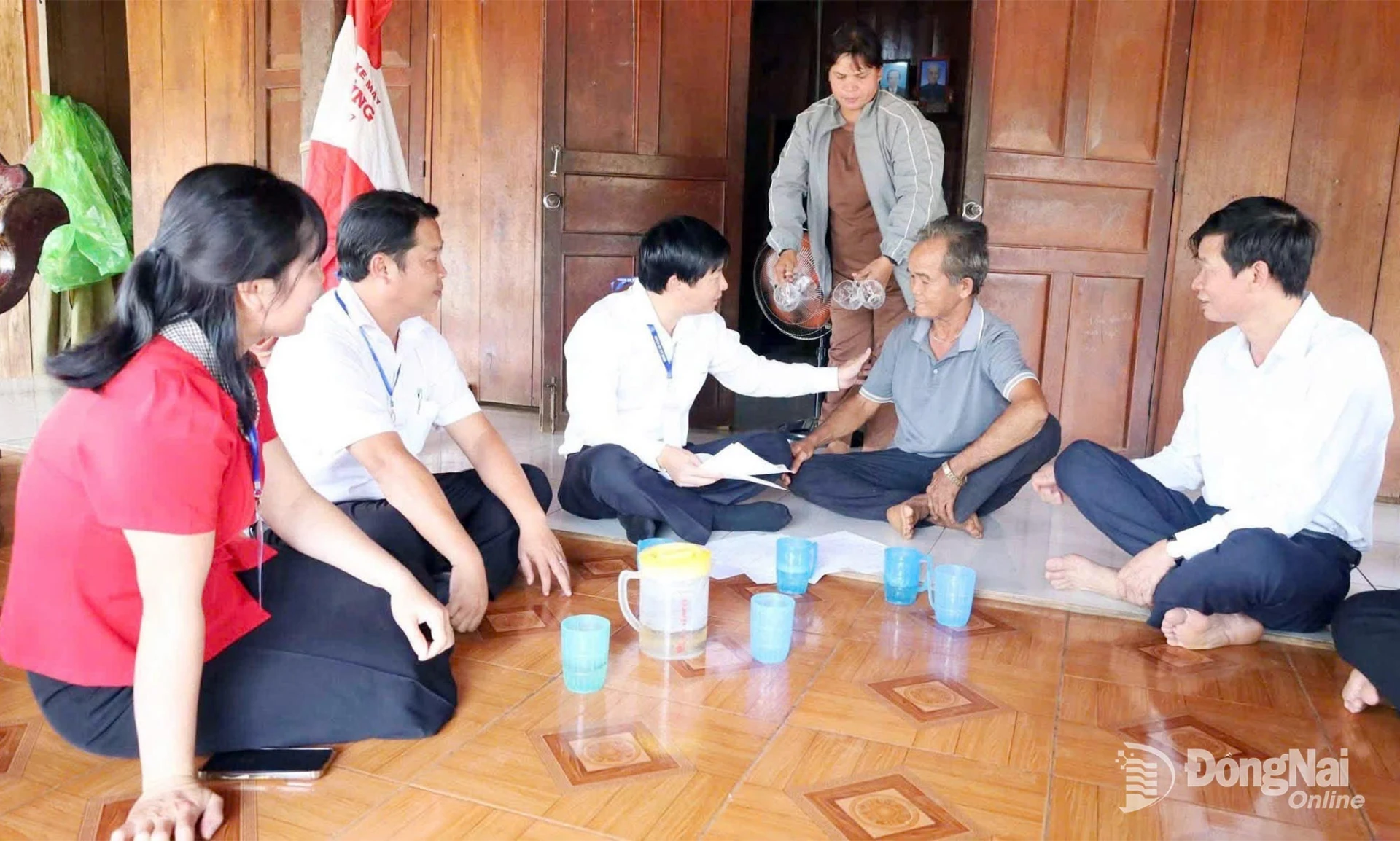 |
| Vu Luong, Member of the Dong Nai City Party Committee, Secretary of the Bu Dang Commune Party Committee and Chairman of the Commune People's Council, and Nguyen Thanh Tung, Deputy Secretary of the Commune Party Committee and Chairman of the Commune People's Committee, join the working group at a meeting with residents of Bu Dang Xa Ray Hamlet, Duc Tho Village. |
When the commune's working group visited and met residents of Bu Dang Xa Ray Hamlet, Duc Tho Village, village elder Dieu Kim said, “The land in this area was either inherited from our ancestors or has been cultivated for a very long time, but because of limited understanding, many residents were hesitant to go to the commune office to complete the necessary procedures.
For many years, some households needing “red books” to borrow capital or subdivide land for their children have also asked around for information, but they heard that it required a lot of money and many procedures and documents. So, despite wanting to do it, many households could not get it done. For more than a month now, commune officials have come directly to survey and measure the land, prepare forms, and visit each household to obtain signatures on documents, which has received strong support and brought immense joy to the residents. After the survey was completed, I thought it would take several months to receive the “red books”, but to our surprise, we had our “red books” in hand in just over a month. The residents hope that having “red books” in hand will transform their lives.”
Creative, decisive action and “telling” numbers
To create clear changes as required by the City Party Committee, leadership and implementation must be synchronized and effective. To improve land use efficiency and, in particular, definitively resolve the situation of households using eligible land for which a “red book” has not yet been issued, the Commune People's Committee determined that the issue could not be resolved through movements or sentiment alone. Before launching the “going to every alley, knocking on every door” campaign to prepare “red books” for residents, the Commune People's Committee implemented the “30 days and nights of cleaning land data” plan to accurately answer three questions: Which land plots have not been issued “red books”? Who is using those land plots? What are the legal obstacles?
On the basis of the “accurate, complete, clean, and live” data collected, the Commune People's Committee issued Scheme No. 1247/QD-UBND and Plan No. 314/KH-UBND to launch the “180-day campaign to support the people in carrying out procedures for initial “red book” issuance.” To ensure effective implementation, the Commune People's Committee established seven working groups in seven villages to “go to every alley and knock on every door” to support residents. It also developed a system of forms and organized training for group members.
Recognizing the necessity and humanistic nature of the scheme, immediately after the plan was implemented, everyone, from commune leaders and working groups to the residential community, worked with urgency, enthusiasm, and responsibility. Rather than waiting for residents to come to the headquarters, the working groups brought computers, positioning and measuring equipment, and relevant files directly to their homes to provide guidance and resolve issues. Officials patiently explained each regulation and measured each land plot so that residents could “see with their own eyes and hear with their own ears.” Alongside group members who are civil servants specializing in land, planning, and construction, mass organizations, village elders, reputable people in the community, and some teachers with experience and communication skills also participated actively, thereby promptly resolving disagreements and boundary disputes between households directly in the field.
The scheme set the campaign duration at “180 days,” but after just over a month of implementation with a scientific, persistent, and decisive approach, it has produced impressive “telling” numbers.
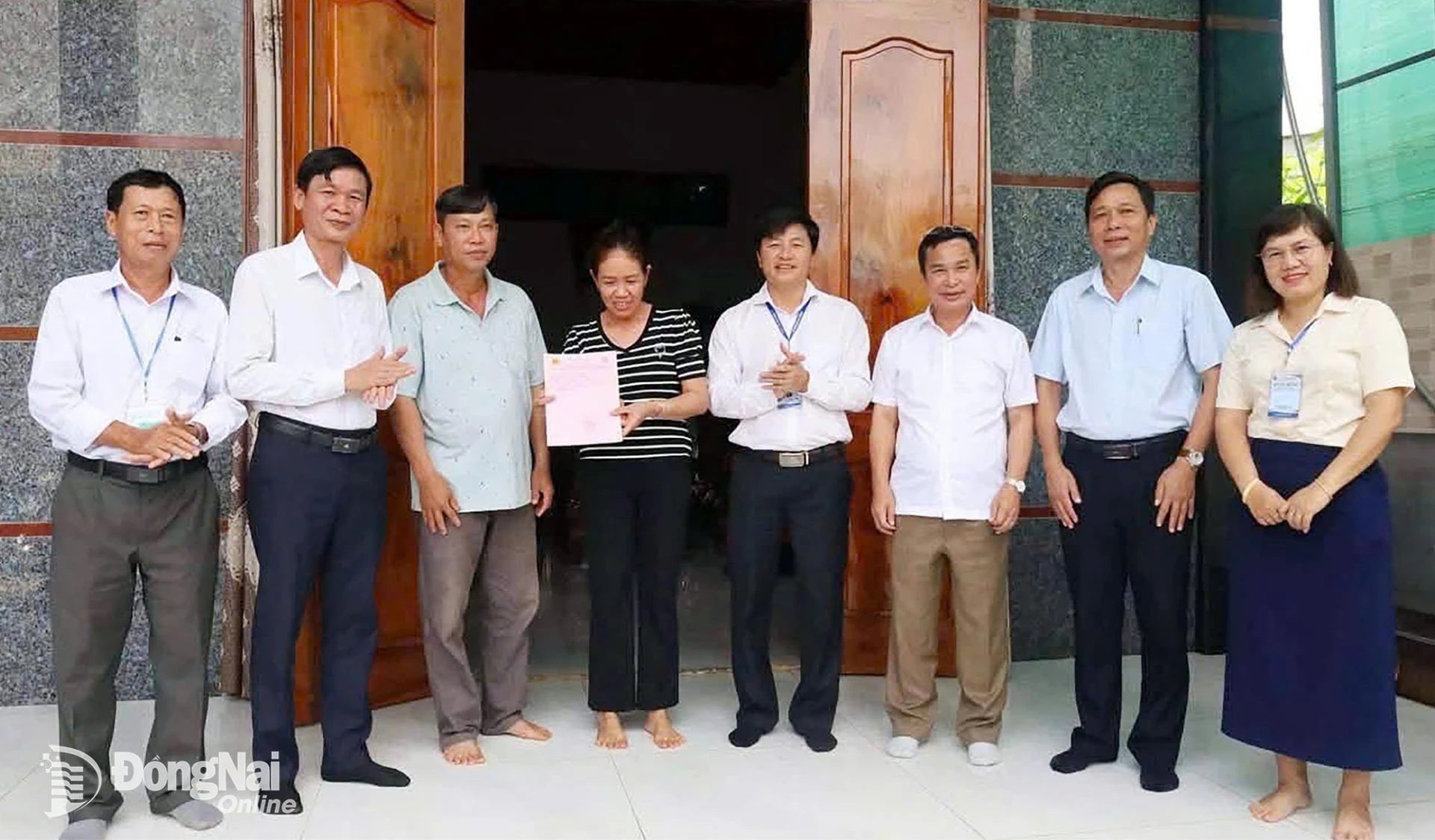 |
| Leaders of the Commune Party Committee and the Commune People's Committee hand over an initial land use rights certificate to the household of Tran Van Vinh in Duc Phong Village, Bu Dang Commune. |
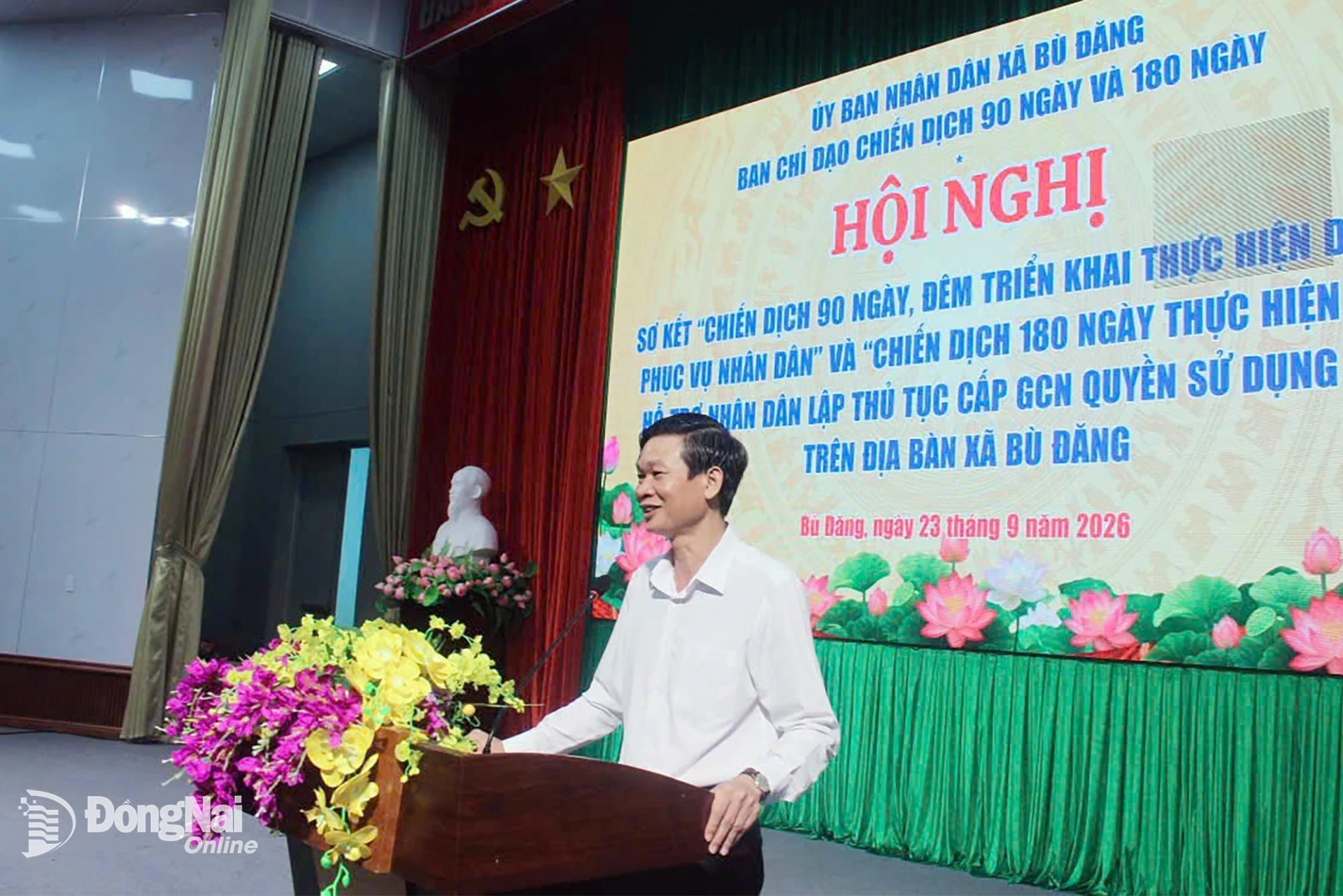
More than 1,000 land plots have been reviewed, surveyed and geolocated, while residents have been provided with guidance on origin declaration and classification. Of these, 805 plots have undergone initial checks by professional staff, and the related cases are being resolved step by step according to the principle of “easier cases first, more difficult ones later.” On September 23, 2026, the Bu Dang Commune People's Committee went to individual households to hand over 38 “red books” to 28 households. It completed 120 dossiers in preparation for the second phase of “red book” issuance and is striving to issue “red books” for 100% of eligible plots by the first quarter of 2027.
Holding the “red book” that officials had just delivered to his home, Tran Van Vinh, a resident of Duc Phong Village, said emotionally, “For several years, my family wanted to mortgage it at the bank to borrow capital for business, but we had no book. Thanks to the commune officials coming directly to measure the land and guide us through the procedures, my wife and I are thrilled. From now on, we can feel secure about investing in our business and stabilizing our lives.”
Governance based on database and results...
The process of removing obstacles and supporting residents in obtaining “red books” not only provides direct assistance to the people, but also gives the Commune People's Committee an opportunity to review and compare current land use conditions with planning. When infeasible planning locations are identified, particularly those that do not reflect the long-standing living and farming practices of residents, the Commune People's Committee will proactively report them to competent authorities and adjust plans within its jurisdiction to address and eliminate “inadequacies and overlaps in planning,” thereby creating favorable conditions for the people.
At the one-month preliminary review conference, Vu Luong, Member of the Dong Nai City Party Committee, Secretary of the Bu Dang Commune Party Committee and Chairman of the Commune People's Council emphasized, “Land is a major asset of farmers, so we are determined to ‘clean the land data’ and proactively support the people in obtaining initial “red books”. This is not only about resolving administrative procedures but also about removing land-related bottlenecks to promote social security and sustainable poverty reduction. When land-use rights certificates are issued and planning is clear, petitions, complaints, and disputes among the people will decrease, neighborly ties will increase, and the people's trust in the Party and State will be consolidated and strengthened.”
The process of reviewing and issuing “red books” for residents involves a combination of many related procedures and documents. Through this campaign, commune officials have integrated the appraisal of land dossiers with the review, renewal, supplementation, and synchronization of missing documents, including birth certificates, marriage certificates, death certificate extracts, and identity cards in cases where documents are missing or information is inaccurate. In addition, the working groups have encouraged residents to participate in health insurance and voluntary social insurance and have supported them in vocational training, job searches, and building a new life in residential areas.
The initial success of the “180-day” campaign in Bu Dang not only addresses legal issues related to land but also offers important lessons in state management at the grassroots level.
First, it represents a fundamental shift in leadership methods from “administrative management” to “management based on goals and products,” with people's satisfaction serving as a measure in the management process. The government's proactive approach of “going to every alley and knocking on every door” has demonstrated superior effectiveness compared with the passive mindset of waiting to receive dossiers.
Second, management based on the “accurate, complete, clean, and live” data platform has helped the locality precisely identify each bottleneck and propose accurate and effective solutions to generate “substantive – measurable – controllable – evaluable” results, as set out in Resolution No. 05-NQ/TU of the City Party Committee.
The campaign has achieved initial success thanks to the effective combination of administrative reform and government-led mass mobilization work. Each “red book” handed over is associated with an opportunity to remove difficulties related to capital, stabilize people's lives, and standardize civil status. The Party's policy has truly taken root in people’s lives, further strengthening the close relationship among the Party, the government, and the people. After more than one year of implementation, the two-tier local government model has demonstrated clear dynamism, effectiveness, and efficiency. Most administrative procedures for citizens are handled by the commune-level government, so the practice of shifting and avoiding responsibility has decreased significantly, while people’s trust in Party committees and authorities has gradually been strengthened.
Bu Dang Commune was established and began operations on July 1, 2025, under Resolution No. 1662 dated June 16, 2025, of the National Assembly Standing Committee, through the merger of the entire natural area and population of Duc Phong townlet and the communes of Minh Hung and Doan Ket. Bu Dang Commune currently has seven villages, with a total natural area of 15,614.06 ha and a population of 32,046, of whom ethnic minorities account for 17.34%.
By Thanh Tung – Translated by Minh Hong, Thu Ha




Thông tin bạn đọc
Đóng Lưu thông tin