
A miniature robotic arm capable of automatically picking up and arranging goods and a device demonstrating additive color mixing of light are among the innovative projects developed by students at schools in areas far from the center of Dong Nai City. These projects demonstrate the value of STEM lessons and the application of technology in teaching and learning. However, teachers and students have expressed the need for greater investment in specialized equipment and dedicated learning spaces to turn more creative ideas into reality.
Nurturing ideas through STEM lessons
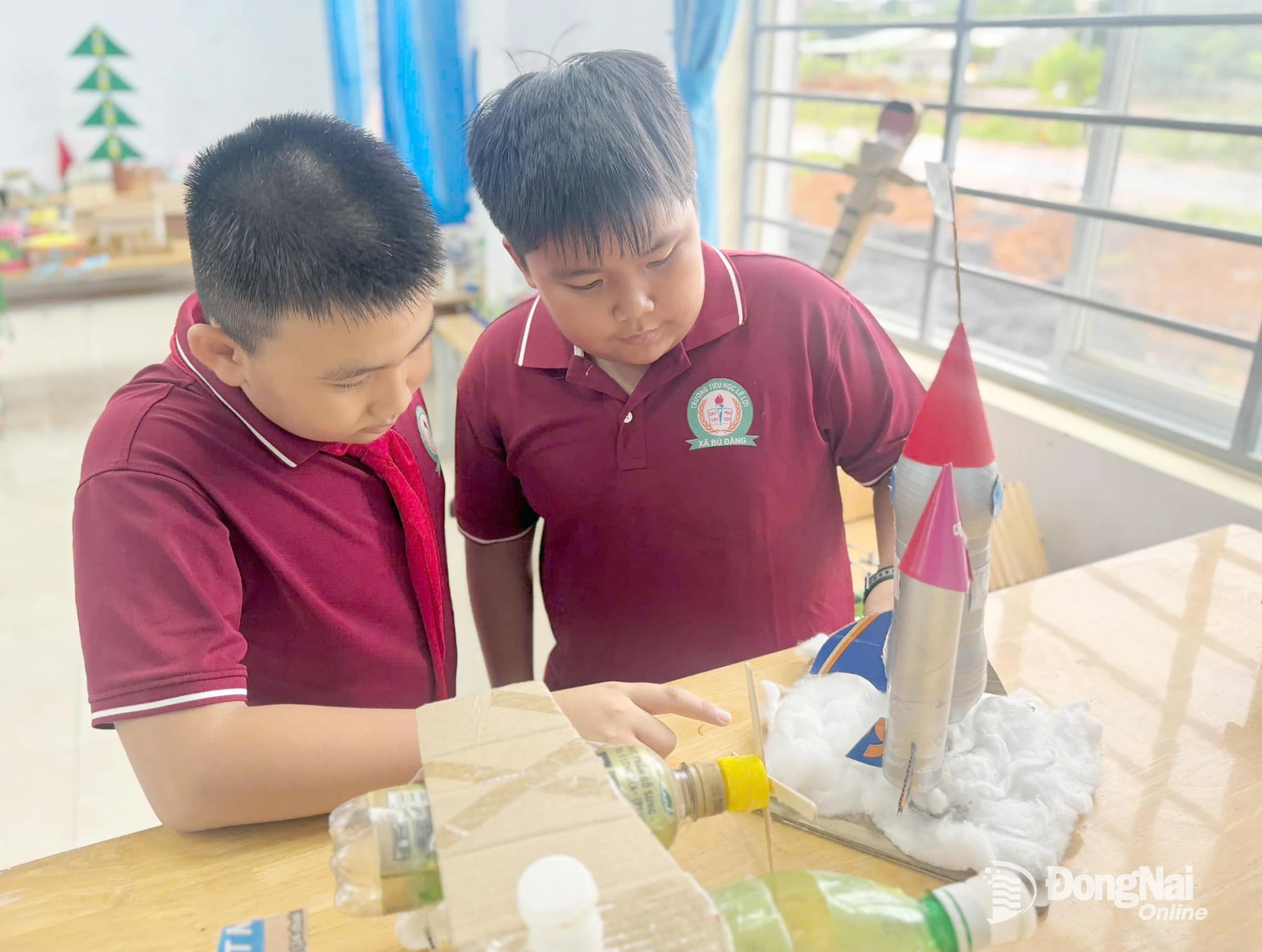
Applying knowledge acquired through STEM lessons, An Phuc Nhan, a student in class 4/3 at Le Loi Primary School in Bu Dang Commune, developed a miniature robotic arm capable of automatically picking up and arranging goods. His project won third prize at the 2026 Youth and Children's Innovation Contest (Cluster 10).
Phuc Nhan said, "I have a particular passion for assembling things and often experiment with motors, gears, electrical circuits, controllers, and batteries to explore how they work and turn my ideas into actual products. However, when I began building the robotic arm, my greatest challenge was figuring out how to coordinate the components so that it would operate smoothly. I also conducted research online, but in practice, the gears did not function as smoothly as I had expected. After five unsuccessful attempts, I applied the knowledge I had gained from STEM sessions and Technology and Science subjects and finally found a solution that enabled the product to work as intended."
 |
|
A STEM project developed by students at Le Loi Primary School in Bu Dang Commune, Dong Nai City. Photo: Bich Nhan |
"For primary school students, STEM education helps students hone their observation skills, develop ideas and spark their interest in learning through hands-on product creation. We therefore prioritize investment in dedicated STEM classrooms and organize robotics and youth informatics activities to give students opportunities to practice and gain hands-on experience, gradually develop the skills needed for learning in the digital age. However, the school also takes into account the specific conditions of each branch campus and satellite school site when planning how to integrate technology and STEM into teaching and learning, ensuring that students genuinely enjoy these activities without feeling undue pressure," emphasized Duong Thi Sen, Principal of Le Loi Primary School in Bu Dang Commune.
In early 2026, the "Additive Color Mixing Device (RGB)" project developed by Le Quoc Bao Minh, a student in class 8A1 at Minh Duc Primary and Secondary School in Minh Duc Commune, won fourth prize at the 2025–2026 provincial-level science and engineering competition organized by the Dong Nai Department of Education and Training. The project explored the principles of additive color mixing, helping students better understand the nature of light and color and their practical applications in teaching and learning.
Nguyen Viet Hung, a teacher at Minh Duc Primary and Secondary School who directly supervised Bao Minh's project, explained, "To develop the additive color mixing device, Bao Minh had to apply knowledge from subjects such as Natural Science and Technology, together with engineering principles, to assemble three LEDs – red, green, and blue – and adjust them so that their light beams intersected on a projection screen. By switching each light on and off, students can directly observe how colors are formed instead of simply viewing illustrations in textbooks. In addition to providing a visual demonstration, the project helps students understand light and color in the Fine Arts subject while illustrating the principles of pixel-based color displays in the Informatics subject. The judging panel rated the project highly for its scientific merit, creativity and educational effectiveness."
During the project's development, the school allowed the teacher and student to use its practical training room, make use of available tools and materials such as drills, water pipes and foam sheets, and set up a darkened space to test the product. However, some electronic components needed to build the product were still lacking, so they had to source and purchase additional parts. Their result in the competition therefore reflected the considerable efforts of both the teacher and student, particularly given the school's continuing shortage of computers and digital tools for teaching and learning.
Expanding access to technology for students in remote areas
Following a school consolidation in late August 2026, Le Loi Primary School in Bu Dang Commune now has 62 classes with nearly 2,000 students, approximately 25% of whom are from ethnic minority groups. The school currently has 125 computers for teaching informatics to students in grades 3, 4, and 5 under the 2018 General Education Curriculum. "However, two of our satellite campuses still lack sufficient computers and STEM facilities. We hope to receive further investment in equipment and STEM laboratories to provide students with more diverse learning experiences, ensuring that children living far from the city center have opportunities to access technology and develop digital skills from primary school onward," said Principal Duong Thi Sen.
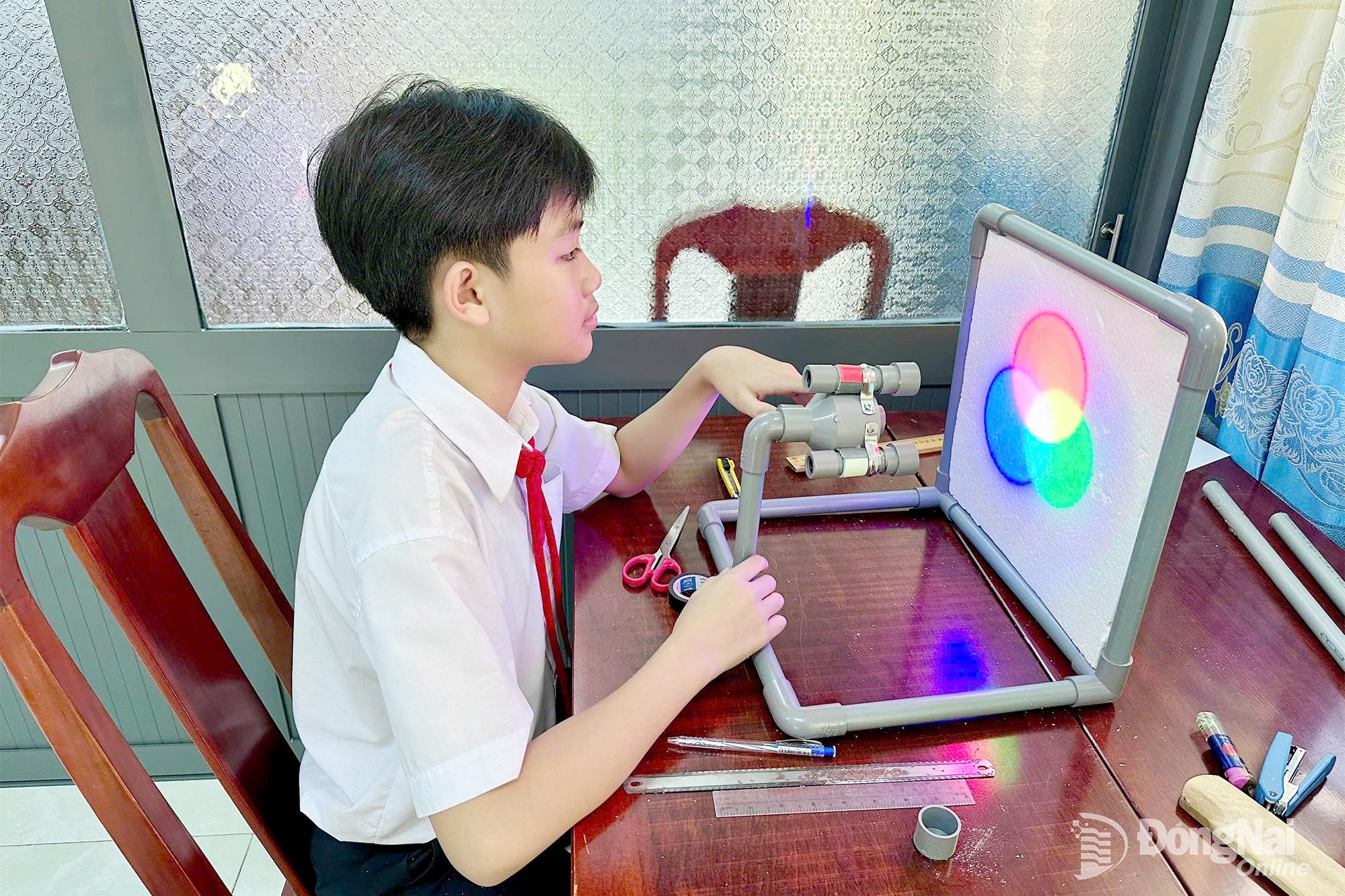 |
| Le Quoc Bao Minh, a student in class 8A1 at Minh Duc Primary and Secondary School in Minh Duc Commune, develops the "Additive Color Mixing Device (RGB)" using simple equipment. |
According to Nguyen Thi My Phuong, Principal of Minh Duc Primary and Secondary School in Minh Duc Commune, the school operates across five locations, comprising one main campus and four branch campuses and satellite school sites, and serves nearly 1,500 students, many of whom belong to ethnic minority groups. However, the school has only 47 computers across all five locations, leaving it with a significant shortage of equipment needed to integrate digital technology into teaching and learning and making it difficult to schedule practical sessions. When several students have to share a computer, each has less time for hands-on practice, reducing opportunities to work independently and correct mistakes. Meanwhile, dividing students into groups and arranging for them to take turns using the computer lab requires careful timetable coordination, limiting the school's ability to organize computer-based learning activities for multiple classes simultaneously. Despite these challenges, informatics teachers have proactively guided and supported students interested in technology, encouraging them to explore, learn and apply their knowledge to create products.
Phuong added, "To meet teaching and learning requirements, the school has submitted a proposal to the Commune People's Committee requesting an additional 90 computers to expand students' access to digital technology and opportunities to develop digital skills. With fully equipped computer laboratories containing 30 to 40 computers at each campus, depending on the grade levels served, students will be able to develop their digital competencies, while artificial intelligence (AI) can effectively support their acquisition of knowledge. At the same time, educational activities organized by the school will also help students develop their thinking skills and acquire life skills."
Investing in STEM education based on the needs of each school
Under Circular No. 86/2026/TT-BGDDT issued by the Ministry of Education and Training, which regulates integrated science, technology, engineering, and mathematics (STEM) education in general education, students engage in practical activities to explore scientific knowledge, drawing on and creatively applying their knowledge and skills to design, create, test and refine products.
The circular also requires equitable access to STEM education across geographical areas and student groups, with priority given to ethnic minority communities and students in mountainous, border, island, and exceptionally disadvantaged socioeconomic areas.
Tran Van Tu, Vice Chairman of the Minh Duc Commune People's Committee, said that following the consolidation of six local schools, the commune now has three educational institutions providing education from preschool through secondary levels. The Commune People's Committee has approved an adjusted plan and budget estimate for the procurement of school equipment throughout the area. In 2026, the committee authorized planned procurement expenditures totaling more than VND 2 billion for desks, chairs, laptops, televisions, and specialized equipment for music and physical education.
"We also require schools to accurately assess their actual teaching and learning needs to ensure that equipment is received, managed, and used efficiently and for its intended purposes. This approach will gradually enable students to access technology, apply theoretical knowledge to real-life situations, and develop their creativity from their earliest years at school," emphasized Tran Van Tu.
Innovative projects such as the miniature robotic arm and additive color mixing device highlight students' enthusiasm for exploration and creativity, as well as the support of their teachers. However, providing students with more opportunities for hands-on practice requires additional equipment tailored to the actual needs of each school campus. This would give students in remote areas greater opportunities to explore, experiment and use technology to support their learning.
By Bich Nhan – Translated by Minh Hong, Minho

Thông tin bạn đọc
Đóng Lưu thông tin