
In late September 2026, the Government issued a document assigning Dong Nai targets for social housing and rental housing development through 2030. Earlier, the Dong Nai City Party Committee and the City People's Committee had also issued resolutions and plans setting social housing development targets for the same period.
 |
| Residents inquire about a social housing project in Bao Vinh Ward. |
Meeting the target of more than 60,000 housing units will help ensure housing security, develop social infrastructure, and gradually improve the quality of life for approximately 5 million city residents.
Housing development must keep pace with growth
Under Government Resolution No. 303/NQ-CP dated September 30, 2026, on assigning social housing and rental housing development targets to localities for 2026–2030, Dong Nai has been tasked with developing more than 60,000 housing units.
Achieving this target will place significant demands on the city to secure land, develop infrastructure, and mobilize resources for project implementation. The Government has required the city to allocate sufficient land in convenient locations, supported by comprehensive technical and social infrastructure, for social housing and rental housing development. The city has also been directed to accelerate administrative reform to shorten the time needed to complete procedures related to investment, land, planning, construction, and environmental protection.
Under the Government's Resolution No. 303/NQ-CP, dated September 30, 2026, Dong Nai has been assigned a target of developing 60,054 social housing units during the 2026–2030 period. The Provincial (now Municipal) Party Congress’ Resolution No. 01-NQ/DH, dated December 1, 2025, set a target of completing at least 65,000 social housing units. Meanwhile, the Provincial (now Municipal) People's Committee‘s Decision No. 973/QD-UBND, dated March 23, 2026, set a target of developing at least 67,010 units.
In addition, the Government has requested that social housing and rental housing projects be included in the "green lane" or "priority lane" categories. This provides an important basis for Dong Nai to accelerate housing supply and meet the needs of a rapidly developing urban area.
Nguyen Van Ut, Deputy Secretary of the Dong Nai City Party Committee and Chairman of the City People's Committee, said Dong Nai is currently one of the country's leading industrial, logistics, and service centers, attracting a large number of workers to live and work in the city. The scale of production and the substantial workforce have generated corresponding demand for social infrastructure, with housing constituting an essential component.
According to the Chairman of the City People's Committee, alongside investing in economic infrastructure, attracting investment, and expanding production, the city attaches particular importance to improving workers' living conditions. Housing provides a foundation for workers to stabilize their lives, work with peace of mind, maintain long-term ties with their employers, and make lasting contributions to the locality.
In recent years, a gap has persisted between Dong Nai's economic and industrial development and its investment in social infrastructure. While industrial development has progressed rapidly, housing for workers, schools, hospitals, parks, and green spaces have not developed at a corresponding pace. Recognizing this gap, Dong Nai is stepping up the implementation of social housing projects, particularly in areas with large concentrations of workers.
According to Do Thanh Phuong, Deputy Director of the Department of Construction, the city has issued a housing development program that earmarks nearly 1,500 hectares of land for social housing projects. The city is also continuing to review and supplement its planning to secure land for social housing and rental housing development in areas with numerous industrial zones and large workforces, including Long Thanh, Nhon Trach, and Trang Bom. It has also established a steering committee on social housing development and is implementing housing support policies for eligible groups.
Recently, the City People's Council adopted a resolution approving a charter capital allocation of 3 trillion VND for the city's Housing Fund. According to Do Thanh Phuong, these measures provide important resources and foundations for leadership, direction, and the implementation of guidelines and policies on social housing development.
In June 2026, Dong Nai broke ground on a rental social housing project comprising 10,000 apartments in Long Binh Ward, an area with numerous industrial zones. Once completed and put into operation, the project will enable workers and urban residents to access affordable housing near their workplaces. It will help ease housing pressures, reduce commuting times and travel expenses, create conditions for workers to stabilize their lives, and help businesses maintain stable workforces.
Nguyen Thi Lich, a resident whose land was acquired for a project in Phuoc Tan Ward but who was ineligible for resettlement, said, "When I learned that my family was not eligible for resettlement, I was very worried. Fortunately, with support from the authorities and businesses, I was able to purchase a social housing unit in the ward in late 2025. In September, I received my 'pink book' (certificate of land use rights and ownership of assets attached to land). The apartment now has full legal status, and I feel delighted and reassured. This is an excellent policy for the people."
Investing in the city's future
Dong Nai has numerous important growth drivers, including Long Thanh International Airport, new-generation industrial zones, logistics centers, and a regional transport connectivity network. These drivers will continue to generate employment opportunities and attract people to live and work in the city. Therefore, securing an adequate housing supply for residents is one of the important tasks that lay the foundation for the city's sustainable development.
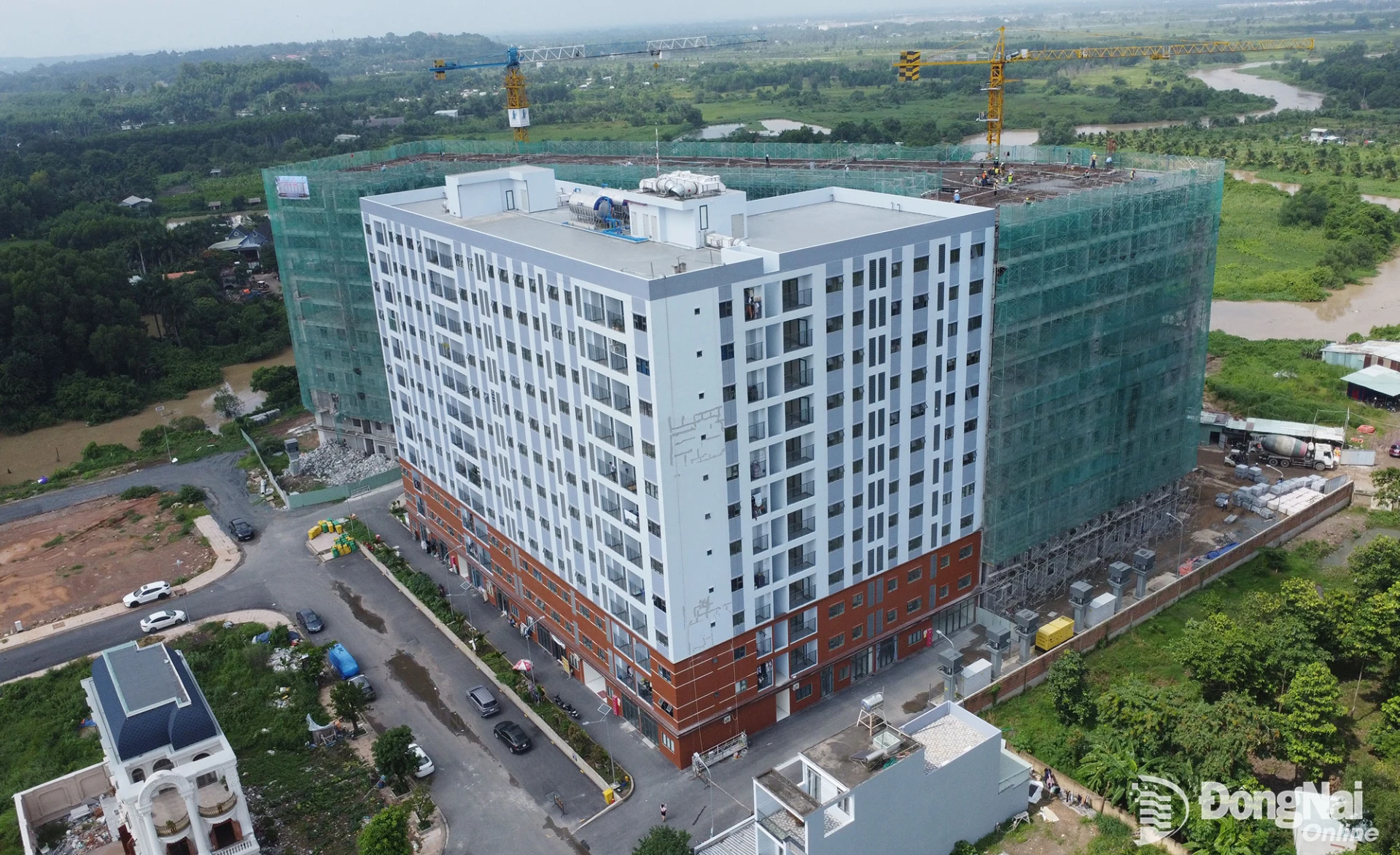 |
| A social housing project nears completion in Phuoc Tan Ward. Photo: Hoang Loc |
At meetings on social housing development, the Chairman of the City People's Committee has emphasized that housing projects must be developed in conjunction with essential infrastructure, including transport facilities, schools, healthcare services, green spaces, and public areas. He noted that without such infrastructure, projects comprising hundreds or thousands of apartments would make it difficult for residents to establish stable lives and would fail to fully achieve the projects' social welfare objectives.
Social housing development must be integrated into the city's overall planning. Accordingly, the targets assigned by the Government serve as the basis for planning, while land availability and infrastructure provide the conditions necessary for implementation. Administrative reform is a key measure for accelerating progress, and resources from the State, businesses, and other lawful sources of capital serve as driving forces for implementation, enabling residents to benefit from the policies and achievements of the city's development.
Nguyen Phi Long, a representative of Khang Nam Real Estate & Construction Environment Group Joint Stock Company, said the company is currently constructing a project comprising nearly 1,000 apartments in Trang Bom Ward. In support of the major policies of the central and municipal authorities, aimed at enabling residents, particularly workers, to gain early access to affordable housing, the developer has committed to topping out the buildings by late 2026.
Dong Nai currently has 12 social housing projects under construction, comprising more than 12,400 apartments. From now to the end of 2026, the Department of Construction aims to break ground on four additional projects with approximately 4,400 apartments.
"Although the project is facing difficulties due to shortages of fill material and prolonged heavy rainfall affecting construction progress, we will accelerate construction to ensure that the buildings are topped out in December 2026 as committed," said Nguyen Phi Long.
For Dong Nai, developing housing for low-income earners is not merely a measure to address immediate housing needs. It also represents an investment in human resources, competitiveness, and the quality of the city's development. This is because behind the city's large industrial zones, airports, seaports, highways, and modern urban areas are hundreds of thousands of workers and their families who need stable, long-term housing.
When residents have secure homes and opportunities to improve their quality of life, the benefits of development truly reach their daily lives. This approach also embodies the principle of placing people at the center of development, recognizing them as the subjects, driving force, goal, and beneficiaries, as outlined by the Politburo in Resolution No. 16-NQ/TW on building and developing Dong Nai City through 2035, with a vision to 2065.
By Hoang Loc – Translated by Minh Hong, Thu Ha




Thông tin bạn đọc
Đóng Lưu thông tin