
Linking humanitarian activities with the development of the collective economy and cooperatives is an approach aimed at expanding employment opportunities and improving incomes for disadvantaged people.
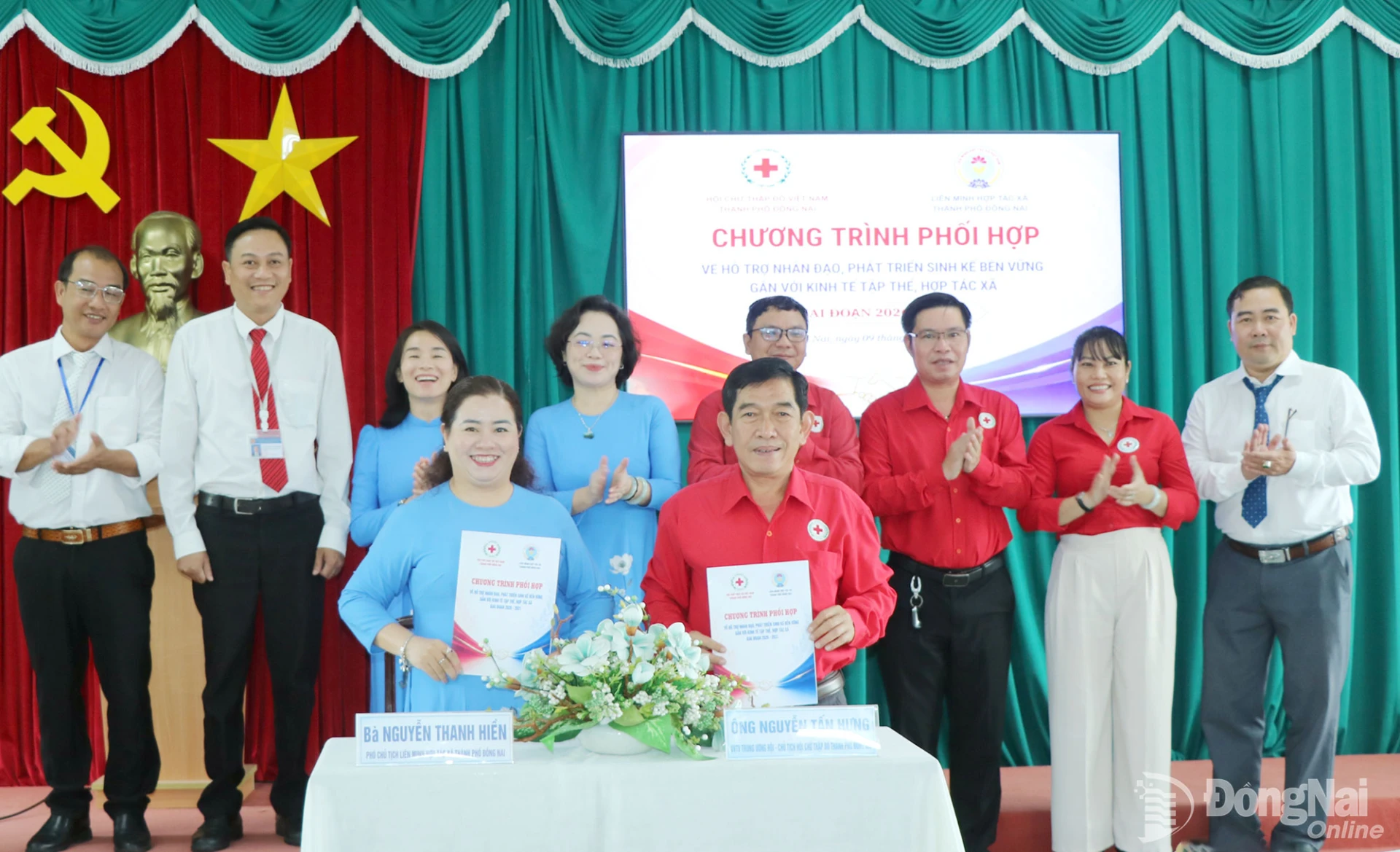 |
| President of the Dong Nai Red Cross Society Nguyen Tan Hung and Vice President in charge of the Dong Nai Cooperative Alliance Nguyen Thanh Hien sign a cooperation agreement on humanitarian assistance and sustainable livelihood development for 2026–2031. |
During the 2026–2031 period, the Vietnam Cooperative Alliance and the Vietnam Red Cross Society will strengthen coordination and cooperation to implement this initiative. From the joint program at the central level to its implementation plan in Dong Nai, a key requirement is to connect social resources with appropriate production and business models to help people gradually stabilize their lives.
Linking humanitarian activities with livelihood development
Providing timely assistance to disadvantaged people is an important task in social welfare efforts. However, achieving lasting improvements in living standards requires humanitarian assistance to be accompanied by measures to create jobs, develop production, and increase incomes. With their strong grassroots presence and close ties to local communities, collective economic organizations play an important role in implementing social welfare initiatives. This approach is also reflected in the cooperation program between the Vietnam Red Cross Society and the Vietnam Cooperative Alliance on humanitarian assistance and sustainable livelihood development associated with the collective economy and cooperatives for 2026–2031.
To implement this approach, the Dong Nai Red Cross Society and the Dong Nai Cooperative Alliance signed a cooperation agreement for 2026–2031 on October 9. The two organizations aim to capitalize on their respective strengths, combining the mobilization of humanitarian resources and community assistance with production organization, membership development, and market linkages in the collective economic sector.
Under the program, the two organizations aim to establish at least 15 cooperative models linked to humanitarian initiatives, including the "Tet of Compassion," "Humanitarian Market," and livelihood support programs. Each year, at least one or two communes or wards with existing cooperatives or favorable conditions for developing new models will be selected.
Priority beneficiaries include people with disabilities, vulnerable women, poor households, near-poor households, households that have recently escaped poverty, and others in need of humanitarian assistance. Models will be selected based on practical needs, local production conditions, residents' capacity to participate, and available resources that can be mobilized.
President of the Dong Nai Red Cross Society Nguyen Tan Hung emphasized that humanitarian activities in the new period require new approaches. The society will prioritize projects with clearly identified beneficiaries and objectives that aim to create a lasting impact, while paying particular attention to disadvantaged households, people with disabilities and children. He called on each unit to undertake a specific task and every individual to make a contribution so that resources can be coordinated and directed to where support is needed.
For those capable of working, receiving technical guidance, participating in production models or being connected with employers can provide additional opportunities to increase their incomes. Meanwhile, assistance for people with specific health conditions or special family circumstances must be tailored to their needs to ensure feasibility and long-term sustainability.
Expanding employment opportunities through the collective economy
To ensure the program's effectiveness, the Dong Nai Cooperative Alliance will not only encourage cooperatives to participate in charitable activities but also provide professional assistance in production organization and market linkages. Specifically, the alliance will offer consulting services for establishing cooperative groups and cooperatives, provide guidance on developing production and business plans, strengthen management capacity, and organize training and capacity-building programs for livelihood models.
Vice President in charge of the Dong Nai Cooperative Alliance Nguyen Thanh Hien said the planned assistance will focus on production organization skills, cooperative governance, quality standards, traceability, digital transformation, e-commerce, trade promotion, and market linkages. According to Hien, these are essential factors in ensuring that participants in the models not only gain employment but also acquire the necessary tools to maintain production, increase product value, and improve their incomes.
A notable area of cooperation involves linking programs such as "Tet of Compassion" and "Humanitarian Markets" with the supply and sale of products from cooperatives and cooperative groups. Under the plan, the two organizations will select at least four communes each year to carry out these activities. Cooperatives with suitable conditions will be encouraged to supply essential goods, products, and services while also introducing their products to consumers.
When organized to meet actual needs, humanitarian activities can create an additional channel connecting beneficiaries with producers. Local residents can access essential goods at affordable prices, while cooperatives have opportunities to introduce their products and expand their markets. In addition, the program seeks to mobilize well-performing cooperatives and people's credit funds to support members facing difficulties and contribute to social welfare activities. In the event of natural disasters, storms and floods, or disease outbreaks, agricultural and transport cooperatives can help supply staple foods, other food products, clean water, and vehicles for relief efforts, depending on actual conditions. The two organizations will also provide training on the collective economy and cooperatives for grassroots Red Cross personnel, as well as instruction in on-site first aid for workers at industrial, handicraft, environmental, and transport cooperatives to equip them with essential knowledge and skills and improve workplace safety.
By linking humanitarian resources with the collective economic sector's capacity to organize production, Dong Nai aims to broaden the ways it supports people facing difficult circumstances. On this basis, appropriate livelihood models can be developed to create more employment opportunities, improve incomes and help people gradually stabilize their lives.
By Vuong The – Translated by Minh Hong, Minho
Thông tin bạn đọc
Đóng Lưu thông tin