
With a series of breakthrough mechanisms, the Urban Development Law (UDL), passed by the 16th National Assembly on August 24, 2026, provides an institutional boost for Dong Nai City to accelerate its development as it aims to become a new national growth pole.
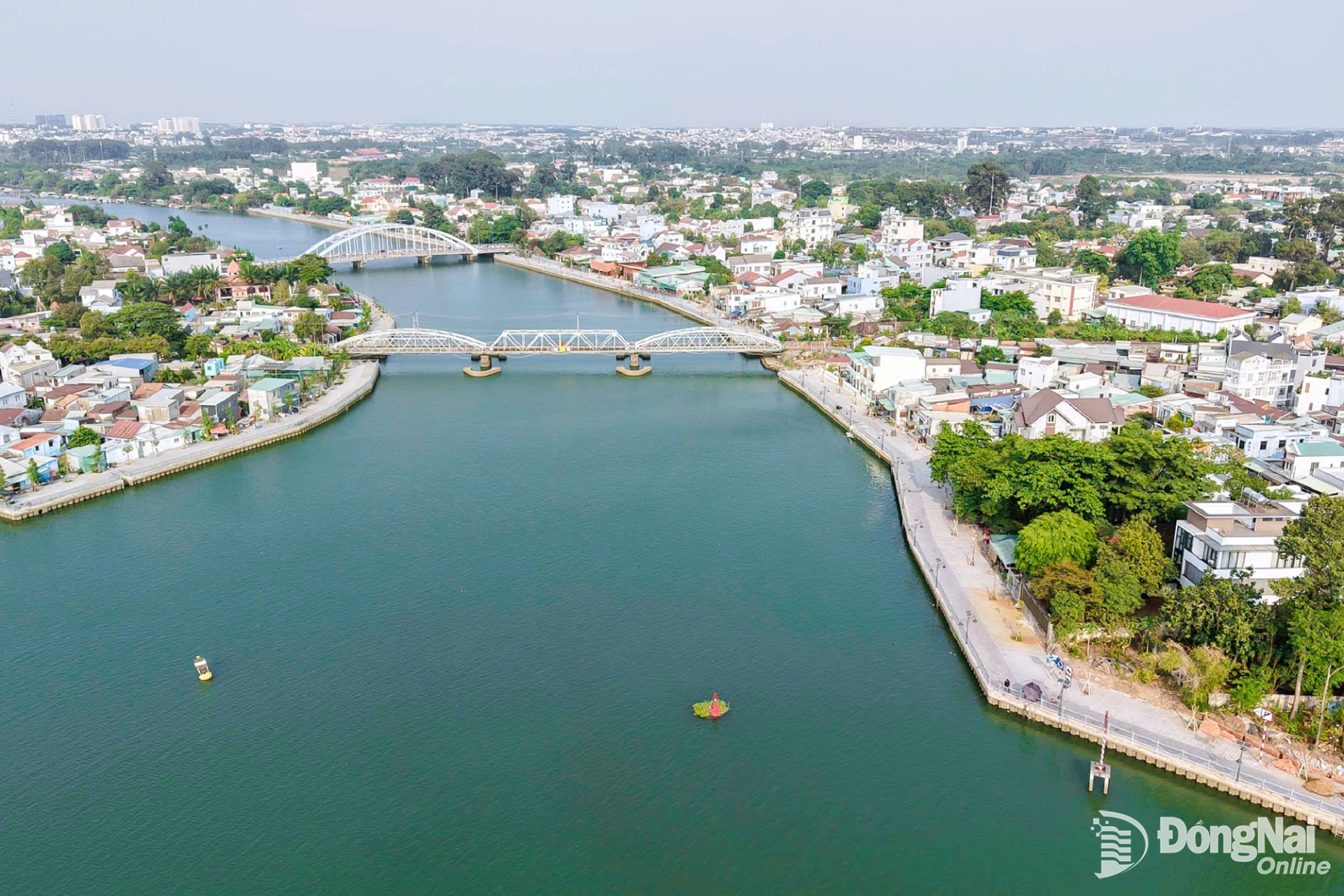 |
| A view of the urban area in Tran Bien Ward. |
The UDL broadens the scope for decentralization, resource mobilization, and the organization of new development models, while removing bottlenecks, strengthening governance capacity, and shaping new growth poles.
A series of breakthrough mechanisms
The UDL expands the city's authority to draft and issue legal documents providing detailed regulations, implementation guidance, and solutions to specific issues arising from the practical management and development of special urban areas. In addition, the law empowers the city to pilot mechanisms and policies and conduct controlled testing.
The law also promotes administrative procedure reform, allowing the city to adjust the sequence, procedures, and authority for handling administrative tasks. It also applies the socialization of professional and operational activities supporting administrative procedures, making them simpler and more convenient for citizens and businesses.
In addition to general mechanisms and policies, the law creates a legal basis for promoting key sectors that serve as drivers of and have spillover effects on the growth of the city and the entire country, including international financial centers, free trade zones, logistics, the maritime economy, sea-reclamation urban areas, energy infrastructure, education, healthcare, culture, and tourism.
Regarding planning, the UDL stipulates that only a single integrated master plan shall be formulated for the city, with legal validity replacing both the provincial plan and the general plan. The plan will shape the city's entire underground, low-altitude, and high-altitude space. Furthermore, the transit-oriented development (TOD) model is clearly legalized.
Huynh Ho Dai Nghia, a public policy expert at the University of Social Sciences and Humanities, Vietnam National University Ho Chi Minh City, said the UDL expands the ability to organize urban space, decentralize and delegate power, mobilize land resources, and link infrastructure development with urban development.
"This is particularly suitable for Dong Nai because the local challenge today is not a lack of major projects, but how to link major projects into a high-value-added development system. The UDL provides a foundation for the city to reorganize land, urban areas, infrastructure, and resources," said Huynh Ho Dai Nghia.
Meanwhile, Master of Urban Management Phan Thi An, Deputy Director of the Center for Architecture and Urban-Rural Planning at the National Institute of Architecture under the Ministry of Construction, assessed that establishing only a single integrated master plan to replace both the provincial and general plans offers the greatest benefit in enhancing the uniformity and consistency of planning while significantly shortening the time required for administrative procedures.
Shortening the time required for planning formulation and approval also presents a golden opportunity for the Long Thanh International Airport project, helping the city prepare for the airport's entry into operation without falling behind the pace of urban development.
Unlocking resources
One of the greatest challenges facing Vietnamese urban areas in general and Dong Nai in particular is resources. Capital demand for transport infrastructure development, flood prevention, wastewater treatment, urban renovation, and public space is enormous. Meanwhile, the state budget can hardly meet the entire demand.
For the city, according to calculations, total capital demand for infrastructure development in the 2026-2030 period is expected to exceed VND340 trillion.
The UDL No. 18/2026/QH16 consists of five chapters and 66 articles and will officially take effect on October 1, 2026.
Therefore, the UDL introduces an approach that views land, infrastructure, and private investment as parts of a more unified relationship. Notably, it introduces the TOD mechanism. Accordingly, areas around railway hubs can be organized with appropriate population, commercial, service, and office densities, while added value from land can be utilized to generate resources for reinvestment in infrastructure.
According to Assoc. Prof. Dr. Tran Quang Phu, former Vice Rector of the University of Transport, Ho Chi Minh City, breakthrough changes in the legal system, particularly the UDL and the amended laws on investment and bidding, will open up mechanisms for Dong Nai to remove "bottlenecks" in investment resources for the infrastructure system.
Specifically, the city will diversify capital sources from public investment, public-private partnerships (PPP), and other socialized sources. At the same time, research and application of specific mechanisms and policies in the fields of investment, finance, and land will create favorable conditions for implementing key infrastructure projects.
Along with that, the general trend of the amended laws is to promote decentralization, delegation of power, and reform of administrative procedures related to investment, finance, and the budget. This will give local governments such as Dong Nai greater autonomy in approving and implementing projects, thereby shortening the time required for investment preparation.
Assoc. Prof. Dr. Tran Quang Phu also said the fact that the TOD model has been clearly legalized for the first time will also help promote the development of this model in Dong Nai. This is because significant changes in the city’s transport structure and development space are creating favorable conditions for Dong Nai to develop the TOD model in a fairly evident way in Vietnam.
By Pham Tung – Translated by Minh Hong, Thu Ha



Thông tin bạn đọc
Đóng Lưu thông tin