
Starting a business in agriculture is by no means easy. Yet, with the courage to think and act and the aspiration to prosper, two young farmers, Le Dinh Tuan Kiet, Director of the Tam Viet Chicken Farming Cooperative in Song Ray Commune, and Trieu Van Tu, Leader of the Tan Tien Purple Blossom Lime Cultivation and Care Professional Group in Tan Tien Commune, have boldly ventured into entrepreneurship.
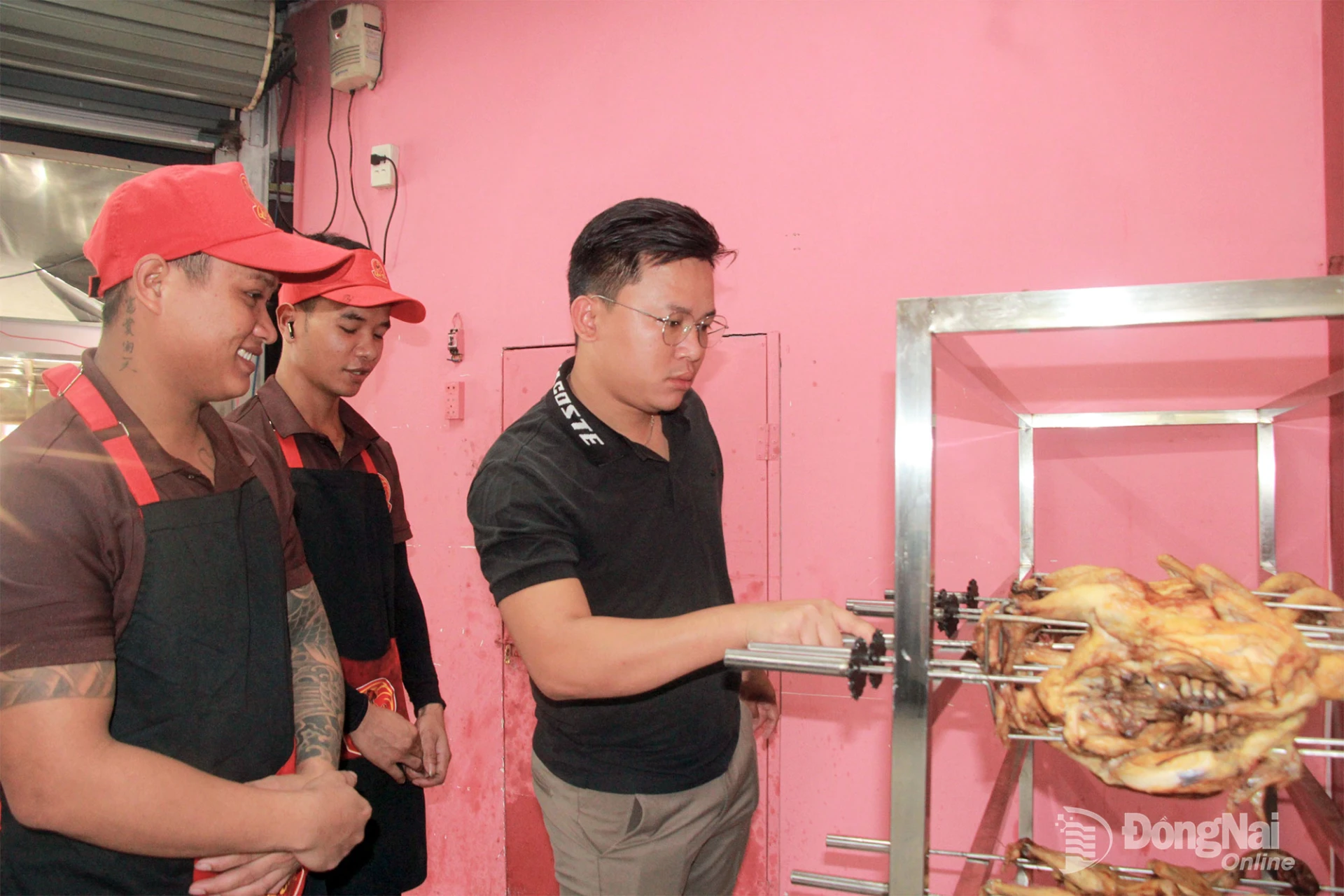 |
| Le Dinh Tuan Kiet checks products at the Que Tui grilled chicken system in Tran Bien Ward. |
The entrepreneurial journeys of these two young farmers are not only stories of overcoming difficulties, creating value, and contributing to local development but also demonstrate the vitality of the entrepreneurial spirit among rural youth in the new era.
From automotive engineer to cooperative director
After graduating with a major in automotive engineering technology from the Faculty of Automotive Engineering Technology at the Industrial University of Ho Chi Minh City, Kiet took a job with a salary many would envy. However, he decided to leave the position and embark on an entrepreneurial path.
Kiet said that, at the time, his career was progressing well and provided a high, stable income, but the work was repetitive, lacked creativity, and offered little opportunity for him to make his own mark. He felt bored and constantly longed for a change.
"In 2019, I resigned from my job and returned home to Song Ray Commune, intending to take a break before starting a new journey. During this time, I continued helping my parents raise chickens and sell them to traders. I realized that farming was inherently arduous, with unstable market outlets that often left farmers in a weak bargaining position and vulnerable to traders forcing down purchase prices. This drove me to take action so that my family's chicken farming business and those of many other local households could develop with more stable outlets," said Kiet.
True to his word, Kiet proactively approached restaurants in Ho Chi Minh City to survey demand and seek markets, while opening a shop there to supply fresh chicken to customers and restaurants. At the same time, he established the Tam Viet Chicken Farming Cooperative with 10 members, comprising chicken-farming households both within and outside Song Ray Commune.
Cooperative members receive support throughout the process, from sourcing chicks and feed and applying farming techniques to collecting, slaughtering, and distributing products. The cooperative sets specific requirements for breeds, farming processes, and rearing periods to ensure quality control. The chickens are raised in accordance with VietGAP standards, with strict controls on the use of medicines and antibiotics and proper withdrawal periods before slaughter.
The technical team frequently visits farming households to provide guidance, conduct inspections, assist with disease prevention and control, and monitor the development of chicken flocks.
After operating for some time, the shop in Ho Chi Minh City closed. Kiet then rented land in the centralized slaughterhouse area in Long Binh Ward to invest in and establish a systematic slaughtering process. There, chickens from the cooperative's farms are slaughtered, packaged and transported to customers through a closed-loop process.
The Tam Viet Chicken Farming Cooperative currently supplies about 8,000–10,000 fresh chickens to the market each day. However, for Kiet, the journey is not the end. Recognizing consumers' increasing focus on quality and convenience, he has continued to expand into deep processing.
More than two months ago, he launched the Que Tui grilled chicken chain in Tran Bien Ward, marking a new step in his journey to increase product value and bring products closer to consumers.
Kiet added that, in the coming period, he will continue applying technology to further improve the production process. At the same time, he plans to vigorously expand the Que Tui grilled chicken chain, with the goal of opening one new location each month and adding steamed chicken products to its offerings to meet the diverse needs of consumers.
Applying professional knowledge to practice
Born and raised in Tan Tien Commune and trained in plant protection at the Faculty of Agronomy of Nong Lam University, Ho Chi Minh City, Trieu Van Tu previously worked at a plant protection products company in Ho Chi Minh City. He always wanted to apply his accumulated knowledge and experience to contribute to local development. So, in 2018, Tu began preparing for his journey back home.
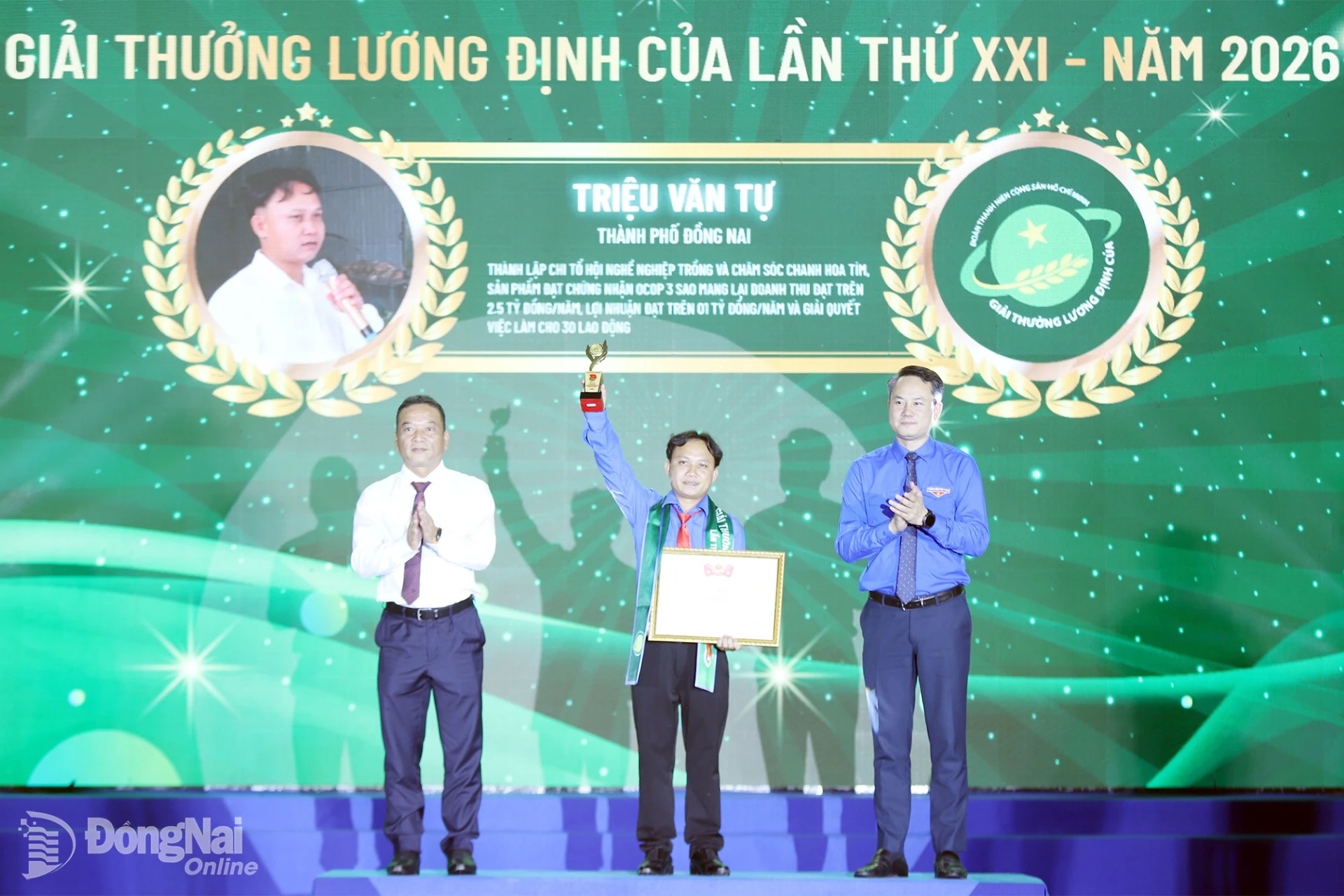 |
| Trieu Van Tu receives the 21st Luong Dinh Cua Award at the National Rural Youth Festival in 2026, recently held in Dak Lak Province. |
According to Tu, before returning to his hometown of Tan Tien, he had accumulated experience and some capital and, most importantly, had researched and developed a specific startup model of his own. He had traveled to many places and explored various crops. Among them, he identified the purple blossom lime as well-suited to the soil and climatic conditions of Tan Tien and chose the crop for his startup.
In 2020, he returned home, and by 2021, he began planting purple blossom limes on more than 1 hectare of family land. At that time, the COVID-19 pandemic intensified, creating numerous difficulties for his startup. However, thanks to his preparations, the purple blossom lime orchard continued to be tended and grew steadily.
Initially, while the lime trees were not yet ready for harvest, he intercropped short-term crops to generate income while waiting for the lime trees to bear fruit. Many people were curious about the agricultural engineer's purple blossom lime model and came to learn more. After hearing him explain the economic value of purple blossom limes, many trusted him and wanted to follow his model. This became the basis for his proposal to establish the Tan Tien Purple Blossom Lime Cultivation and Care Professional Group. To date, the group has about 20 members.
With about 1 hectare under purple blossom lime cultivation, the yield exceeds 60 tons. After deducting costs, the estimated profit is about 400 million VND per hectare. The purple blossom lime trees produce about two to three harvests a year.
According to Tu, purple blossom lime products from the group currently reach consumers through traders. This distribution method leaves growers vulnerable to price fluctuations at different times and across seasons. Therefore, he is pursuing deep processing to increase the value of the products rather than selling them in raw form.
Despite choosing different paths, the two young farmers share common ground: they dared to leave their comfort zones and boldly sought new directions in their native land. Starting a business in agriculture is not easy, but with knowledge, perseverance, and the courage to think and act, they have created valuable products, helping inject new vitality into the agricultural sector and opening up new development directions in their localities.
Le Dinh Tuan Kiet and Trieu Van Tu are two of the 30 young farmers nationwide who recently received the Luong Dinh Cua Award from the Central Youth Union. This prestigious award is presented to rural youth with outstanding achievements in production and business, the transfer of technical advances and agricultural technologies, environmental protection, and new-style rural development.
By Nga Son – Translated by Minh Hong, Minho


Thông tin bạn đọc
Đóng Lưu thông tin