
From 1990 to 1994, the Cha Rang area, covering Groups 17 to 26 of Cay Da Hamlet in Xuan Thanh Commune, was still sparsely populated. Those who arrived first warmly invited newcomers to settle nearby so they could support one another in times of need.
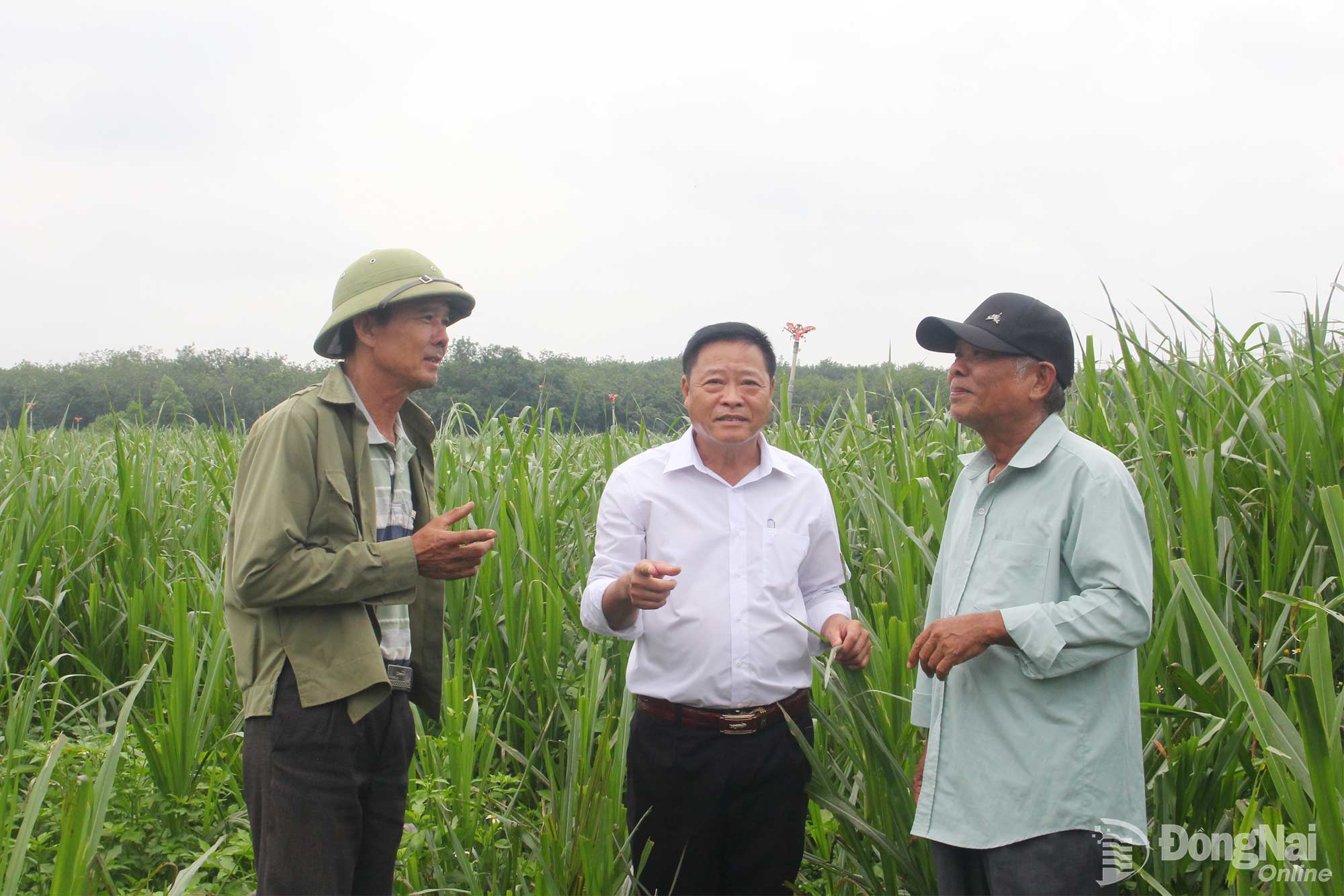 |
| In low-lying, sandy areas, farmers in Cha Rang grow grass to raise cattle. |
Forging bonds of brotherhood in a new land
The Vietnamese saying “A close neighbor is better than a distant relative” rings particularly true for Doan Duy Vui, Head of the Fatherland Front Working Committee of Cay Da Hamlet, Doan Duy Mung and several others who have since passed away, when they first met in the Cha Rang area. They came from different hometowns and still spoke with strong regional accents, but they were in sync with one another in both words and actions. Perhaps they were united by a shared aspiration to improve their lives and find a new place to settle and build their livelihoods.
Between 1990 and 1994, much of the unused land in Cha Rang was cleared and cultivated by ethnic minority groups, including the Cho-ro, Muong and Nung, as well as Kinh households who came from other areas. Many of them came only to make a living, while only a few stayed. As night fell, the area was often plunged into darkness.
When Doan Duy Vui arrived in Cha Rang to settle and build a livelihood, a small community of four houses had already taken shape, with several hundred meters between them as the crow flies. Understanding the loneliness of people who had left their hometowns to start anew, they gradually grew close, sharing both the joys and hardships of those early days.
Today, all households who came to Cha Rang to build a new life have achieved relatively good economic conditions, with each family owning between 3 and 10 hectares of productive land. Pepper, coffee, rubber and melaleuca are identified as the main crops here. What makes us happy and proud about coming here is that we have always stood by one another through both good times and hardship.
Doan Duy Vui, Head of the Fatherland Front Working Committee of Cay Da Hamlet, Xuan Thanh Commune
Sharing the belief that “A close neighbor is better than a distant relative”, Nguyen Dang Cong, Head of Cay Da Hamlet, often encouraged people from the same or different hometowns to settle near one another. Whenever someone planned to start a new life in Cha Rang, he helped them find and buy land to build houses and cultivate crops.
Over the years, more thatched houses appeared around Cong’s farmland. The population grew, and Cha Rang gradually developed into a close-knit community.
We chose Cha Rang as the place to build our future and create a shared home. In addition to the hard work of each household, we received substantial support and favorable conditions from authorities and mass organizations, particularly in accessing capital for production and developing infrastructure such as electricity, roads, schools, healthcare and cultural facilities.
Tran Van Tham, Group 17, Cay Da Hamlet, Xuan Thanh Commune
When the authorities established Cha Rang Hamlet in what was formerly Suoi Cao Commune, Xuan Loc District, Cong was trusted by local residents to serve as Head of the hamlet. More recently, after Suoi Cao Commune was merged with Xuan Thanh Commune to form the new Xuan Thanh Commune, and Cha Rang, Bau Sinh and Cay Da hamlets were merged into Cay Da Hamlet, Cong was once again elected by local residents and trusted by the authorities to act as Hamlet Head.
According to Nguyen Dang Cong, Groups 17 to 26 of Cay Da Hamlet are home to Cha Rang Stream. The place name Cha Rang was given to the area by forest workers before Cong arrived to start his new life in the area.
Cha Rang is divided into two areas with different soil conditions. Groups 2, 7 and 9 are low-lying and prone to waterlogging, making them suitable for melaleuca, rubber and cashew cultivation. The remaining areas have higher, fertile land suitable for fruit trees and industrial crops such as pepper, coffee and durian. As a result, these areas have attracted a large population and developed strong economies.
The fruits of life
Today, Cha Rang is home to 330 households. In addition to about 1,300 hectares of cultivated farmland, local residents also farm nearly 100 hectares of land in other areas inside and outside Cay Da Hamlet.
Tran Cao Thang, originally moved from Hung Yen Province to Cha Rang in 1992 to start a new life. With only a small amount of capital, he bought nearly one hectare of land. Through hard work and with support from fellow settlers, Thang has become a relatively well-off farmer with 13 hectares of land, including 3.5 hectares of eight- to 10-year-old pepper trees. His annual income now reaches several billion VND.
Thang recalled that in the past, when harvest season came, he could not afford to hire workers, so he and his friends exchanged labor. Harvested farm produce was transported by bicycle. The roads were rough and steep, and whenever they reached a stream, everyone would help push the bicycles across. Looking back on those days, he said the memories still warmed his heart.
Nguyen Phuc Thinh, a Cha Rang resident, said that in 1994, his parents came here and bought 0.5 hectares of upland fields to start a new life. With six children and little productive land, his parents had to rent additional land from other households for cultivation. After several successful harvests of cassava, maize, beans and sugarcane, his father bought another 10 hectares to grow cashew, pepper, melaleuca, rubber and coffee. When his siblings and Thinh started their own families, their father gave each of them 2-3 hectares of land. Today, Thinh and his siblings each own between 4 and 12 hectares planted with pepper, coffee, rubber and melaleuca, enabling them to enjoy relatively good economic conditions.
Thinh said Cha Rang feels like one big extended family to his family. Although people from the North, Central and South still retain their distinctive regional accents, they treat one another with warmth and are always ready to help when needed.
The story of farmers building a new life in Cha Rang shares many similarities with that of settlers in other places, but it also has its own distinctive character. It is the warmth of friendship and neighborly bonds forged through years of overcoming hardship together and witnessing the transformation and development of the area.
From a handful of scattered homes in a once largely undeveloped area, Cha Rang has become a residential community with relatively prosperous living conditions today. Its achievements are measured not only in farmland or income, but also in an invaluable asset that cannot easily be quantified: the bonds among people who came to a new land, built homes and farms, and relied on one another throughout their journey to build a new life.
By Doan Phu - Translated by Mai Nga, Thu Ha


Thông tin bạn đọc
Đóng Lưu thông tin