
Part 2: Expanding welfare, supporting workers
Final Part: Supporting workers on new journey
As urban areas and industries develop and investment attraction increases, more job opportunities are created. At the same time, higher requirements are being placed on the quality of human resources and social security. In this context, stable employment, good incomes, housing, and trade union (TU) institutions are no longer issues concerning employees alone, but have become key factors in the city's sustainable development.
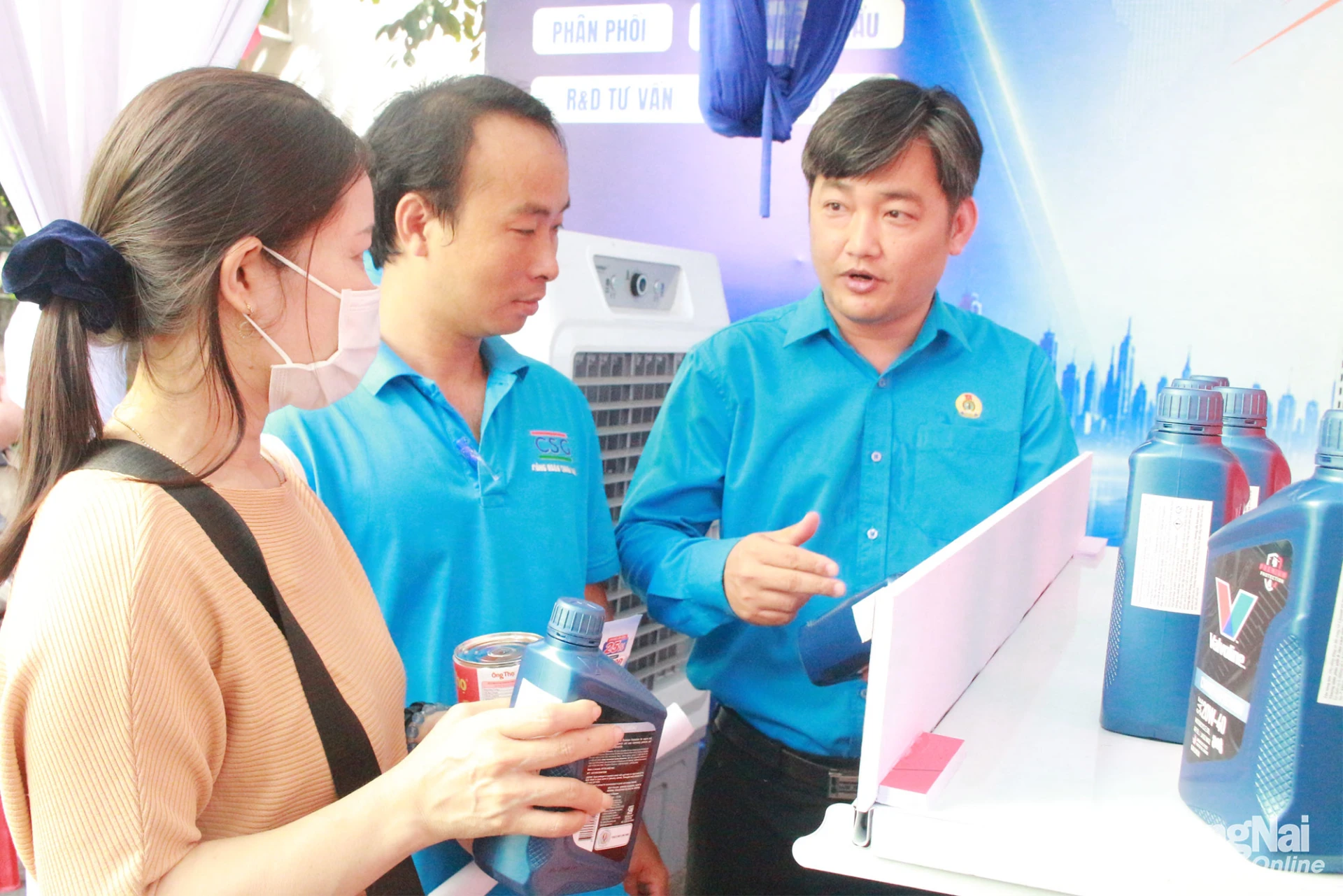 |
| Nguyen Quoc Dung, Member of the Dong Nai City Party Committee, Vice Chairman of the Dong Nai City Vietnam Fatherland Front Committee and President of the Dong Nai Labor Federation, talks with workers shopping at the 2026 Workers' Health Festival. |
Dong Nai is entering a new stage of development, with higher requirements for urban quality, infrastructure, industry, services, and human resources. Throughout this process, employees remain the force directly creating significant value for the economy. Caring for employees, therefore, must be regarded as an inseparable part of the development strategy.
Improving quality of human resources
In early 2026, Dong Nai issued Plan No. 70/KH-UBND on labor, employment and social insurance work for the 2026-2030 period. The plan clearly sets out the goals of promoting sustainable job creation, reducing unemployment, expanding opportunities to access the labor market, improving the quality of human resources, and strengthening links between labor supply and demand.
A notable feature of the plan is that its objectives go beyond "job creation" toward "sustainable employment." This is a long-term issue for an industrial locality such as Dong Nai. Le Thi Thu, who works at Long Binh Industrial Park, said that creating more jobs and increasing incomes are of decisive importance to employees' lives. This not only enables employees to proactively care for themselves and their families but also gives them the means to purchase social housing and feel secure in remaining in their jobs.
As enterprises focus on technological transformation, automation, and higher production requirements, employees also need training and skills upgrading to adapt and gain access to positions offering better incomes and working conditions.
Against this backdrop, Dong Nai issued Plan No. 105/KH-UBND, dated March 3, 2026, on training and developing human resources to meet the needs of building and operating key projects in the area during the 2026-2030 period. The plan identifies the training and development of high-quality human resources as essential to meeting the requirements for operating key projects and the accompanying economic ecosystem. In particular, Long Thanh International Airport is considered one of the projects generating high demand for personnel, with approximately 14,000 workers.
According to Deputy Director of the Department of Home Affairs Mai Xuan Tuan, the Resolution of the 1st Congress of the Dong Nai Provincial (now City) Party Committee for the 2025-2030 period sets a target of approximately 2.6 million workers by 2030. This is a major goal that places high demands on labor market forecasting, management and development. State management agencies, departments, sectors and localities need to proactively advise on and synchronously implement solutions on labor, employment, training and improving the quality of human resources, with the aim of ensuring that trained workers with degrees or certificates account for 40% of the workforce by 2030, in accordance with the resolution.
Supporting employees
In the new stage of development, Dong Nai is not only focusing on developing modern industrial parks, large urban areas and large-scale infrastructure projects, but also needs long-term policies to attract resources that can contribute to the city's development. A livable city is one where workers can return to stable homes after work, care for their families and remain confident that tomorrow will be better than today. This is the profound significance of these policies, which lay the foundation for workers to settle down, build stable livelihoods and join together in shaping the future of Dong Nai.
Alongside job creation, housing is one of the most urgent issues that must be addressed to help employees settle down. For the 2025-2030 period, the city aims to complete more than 67,000 social housing units to meet the housing needs of employees and policy beneficiaries. The city has also agreed on a policy to plan and develop social housing near industrial parks with large numbers of employees to make commuting more convenient.
Alongside care and support policies implemented by authorities at all levels in the city, the TU organization also needs to further promote its role as a bridge and accompany employees throughout the process of working and stabilizing their lives. In addition to representing and protecting the legitimate rights and interests of members, the TU also carries out many practical activities to support employees in employment, income, housing, health care, spiritual well-being and social security.
Dr. Vu Thi Nghia, Vice Principal of the City Political School, stated that effectively implementing social security policies is a practical way to protect the Party's ideological foundation. This is because the ideological foundation is most sustainably protected when the values pursued by the Party are demonstrated in practice through quality of life and public consensus. When employees see that they are cared for, share in the fruits of development, and have opportunities to build their futures in Dong Nai, their trust will grow into attachment, responsibility, and motivation to contribute to the development of enterprises and the locality. It is this trust, built through practical experience, that serves as an important safeguard against misinformation, distortions, and attempts to drive a wedge between employees and the Party, the State, and the TU organization.
At the same time, enterprises need to promote social responsibility, regarding their workforce as a valuable asset and a decisive factor in sustainable development. In recent times, one of the bright spots in efforts to stabilize labor relations has been the maintenance of periodic workplace dialogues and the implementation of grassroots democracy regulations. Through these dialogues, many recommendations from employees concerning wages, bonuses, shift meals, working hours, working conditions and welfare benefits have been heard, considered and addressed by enterprises in a timely manner.
With increasingly practical care policies and greater attention paid to their material and spiritual well-being, employees have greater trust and motivation to work with peace of mind and remain committed to their enterprises. As a result, the emulation movement among workers is becoming increasingly substantive, going beyond the completion of assigned tasks to focus on improving productivity, quality and work efficiency, thereby contributing directly to the development of enterprises and the locality.
Notably, in implementing the special 500-day-and-night emulation campaign themed "Solidarity – Discipline – Efficiency – Breakthrough, building a civilized and modern Dong Nai," TU organizations at all levels have stepped up communication and mobilization efforts to encourage members and employees to actively participate through specific actions suited to each industry, field and job position. The target is to have at least 30,000 initiatives proposed and applied in production each year. At factories and workshops, employees have embraced the spirit of emulation, as demonstrated by efforts to improve processes, save raw materials and proactively propose solutions to overcome difficulties in production.
The Politburo’s Resolution No. 16-NQ/TW, dated July 21, 2026, on building and developing Dong Nai City through 2035, with a vision to 2065, identifies many important tasks to create breakthroughs in the city's urban, infrastructure, and socioeconomic development. As industrial parks, urban areas, services, and transport infrastructure continue to expand, they will attract employees to Dong Nai for employment. Accordingly, social security needs to be ensured in a coordinated manner alongside urban development. This is an important factor in building a modern, civilized city where employees can work with peace of mind and remain connected to the locality.
According to Vice President of the Dong Nai Labor Federation Bui Thi Bich Thuy, caring for workers today is not merely about helping a family overcome immediate difficulties. In the longer term, it is a process of building a stable and skilled workforce with housing and suitable living conditions to accompany the development of enterprises and the locality. When employees have confidence in the city's social security policies, they will be able to work with peace of mind, establish their careers and build their futures in Dong Nai. Only then will the goal of sustainable development have a solid foundation.
By Nguyen Hoa, Thu Ngoc – Translated by Minh Hong, Minho


Thông tin bạn đọc
Đóng Lưu thông tin