
The Dong Nai Department of Education and Training is stepping up the application of information technology to carry out its digital transformation strategy across educational institutions. The effort aims not only to support innovation in management but also to transform teaching and learning methods and comprehensively improve quality.
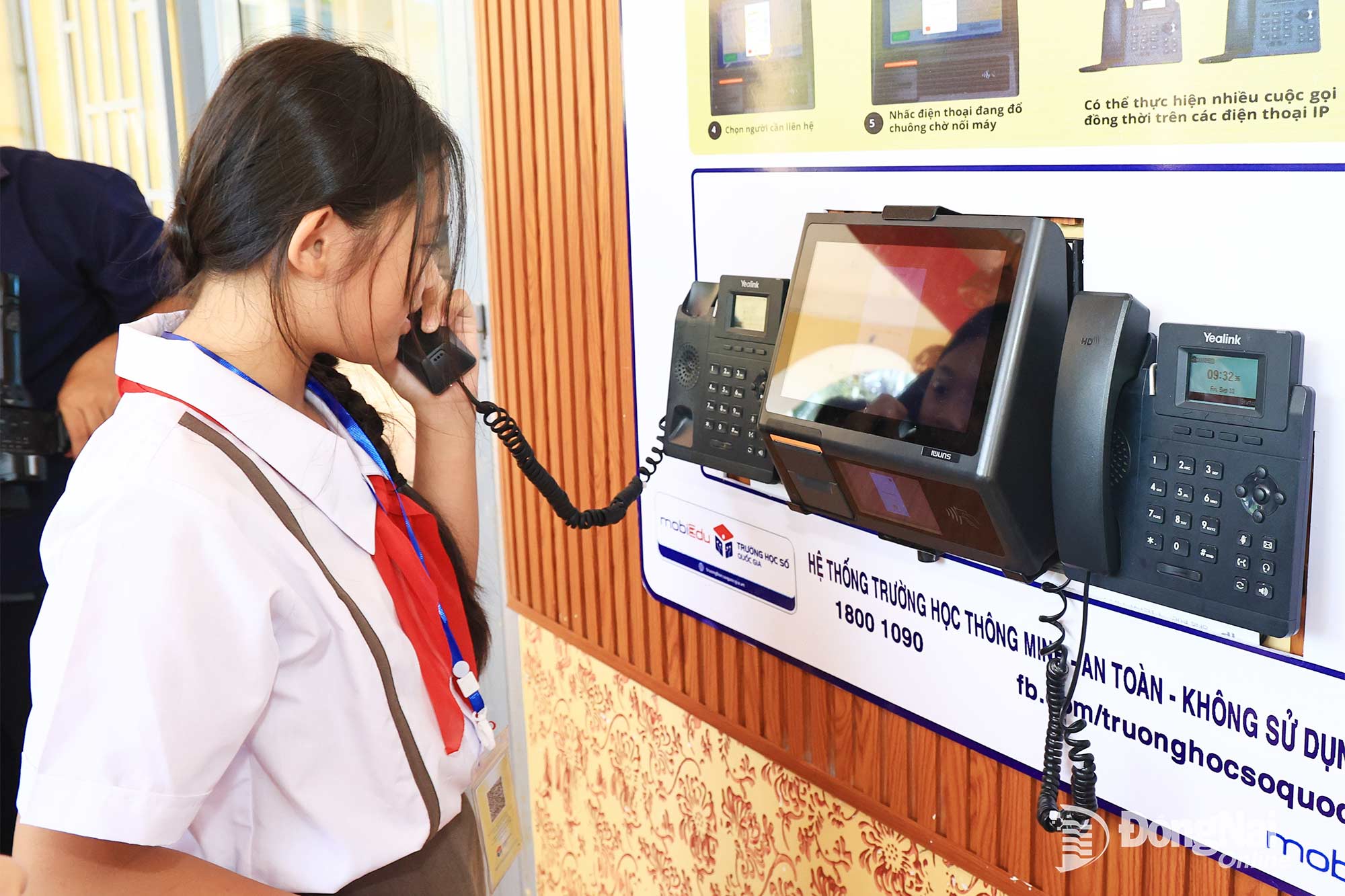 |
| A student at Hoa Binh Primary School in Long Khanh Ward uses a digital student ID card to call her parents. |
Pham Chuan, Principal of Hoa Binh Primary School in Long Khanh Ward, said, “In the 2026-2027 school year, our school was selected by the Department of Education and Training and MobiFone Corporation to pilot a “Digital School” model. We have high expectations that this new model, which differs significantly from previous approaches, will bring clear improvements in modern governance and advanced teaching and learning methods, while also strengthening connections between the school and families in the management and education of students.”
Adopting the "Digital School" model
In previous school years, Hoa Binh Primary School had already applied information technology to its activities. However, its application was limited to presentation software for teaching and learning, scheduling, management of academic results, and electronic contact books. The results fell short of expectations because the school used various software products from different providers, making integration and unification difficult.
Under the “Digital School” model comprehensively provided by a single telecommunications service provider, MobiFone, all technical components, from hardware to software, can be easily connected. School administrators can manage all teaching and learning activities, student records, and accounting in the digital space. Teachers can search for learning materials, develop lesson plans, and create tests entirely on the digital platform without having to rely on traditional paper records and lesson plans.
Students at Hoa Binh Primary School are also becoming active participants in the “Digital School” model, with every activity involving interaction with digital devices. Each student is issued an electronic card. When arriving at school, having lunch, or entering the library, students are checked in through facial recognition cameras. Every activity is updated in real time for homeroom teachers and parents, informing them of the students’ current activities.
Hoang Thi Lan, a fifth-grade homeroom teacher, noted that previously, without automatic attendance cards and real-time notifications, parents could not be certain whether their children had arrived at school or whether they were on time. During lunch, some children who were reluctant to eat would stay behind in the classroom to avoid lunch. Thanks to this automatically updated and accurate management system, both the school and parents can keep close track of the students’ situation.
In addition, students can use their digital student ID cards to easily call home using the school’s smartphones. With a simple swipe of the card on the phone, the device automatically displays the preset phone number of the student’s mother or father for the call. Parents do not have to worry about fraudulent calls because they have installed the integrated digital school app containing the school’s official information. Ho Thanh Sang, whose child attends Hoa Binh Primary School, said, “The digital school app is very convenient. Every day, besides knowing what activities my child is participating in at school, I can also keep track of my child’s conduct and personal development. Furthermore, parents can pay fees through the app without using cash.”
Information technology, digital transformation, and especially AI are indispensable in modern education, but the required investment is immense. Even with funding, difficulties remain because of the human factor—the need for people who have a good command of technology. Lac Hong University is ready to support schools in training teachers to use basic artificial intelligence (AI), provide essential software, and welcome teachers and general education students to experience its technology library to further inspire their passion for technology.
Assoc. Prof. Dr. Lam Thanh Hien, Rector of Lac Hong University
Mobilizing resources for digital schools
Digital transformation in educational institutions is a pressing requirement that demands significant investment in resources. In addition to investment in hardware and software infrastructure, it also requires information technology personnel with sufficient capacity to successfully carry out the digital transformation process. Digital transformation will not stop at the successful application of a few software products or isolated models; it must integrate all governance, teaching, and learning activities into a synchronized management system. Most importantly, AI must be applied to achieve efficiency many times greater than that of traditional management methods.
Pham Thi Nam, Principal of Phuoc Tan Secondary School (Phuoc Tan Ward), said that, driven by a passion for Microsoft’s “Global Digital School” model, the school sent dozens of teachers to participate in information technology application training courses offered by the corporation, and they were recognized as Microsoft Innovative Educator Experts. Thanks to this core team, the school developed its global “Digital School” model, in which lesson planning, grade management, and reporting are all conducted in a digital environment. Building on these exemplary individuals, the school will continue to expand the digital transformation movement across its branch campuses, especially after Phuoc Tan Ward completes the merger of three local schools into a single entity.
Meanwhile, at Thong Nhat A High School in Trang Bom Ward, since the school received sponsorship from Vietnam National Industry – Energy Group for a modern STEM laboratory, its activities in information technology application, digital transformation, and AI have made a breakthrough. Nguyen Van Phuong, a Technology and Engineering teacher at the school, said students are highly engaged in scientific and technical innovation activities, but the school previously lacked a laboratory. Therefore, when the school was given a 5-billion-VND STEM laboratory fully equipped with modern devices such as robots, 3D printers, programming practice equipment, and electron microscopes, it became very convenient for students to conduct research and apply theory to practice.
Nguyen Van Phuong added, “Thanks to the modern STEM laboratory as a stepping stone, students at the school now know how to use AI and how to draw details on a computer before connecting to a 3D printer to print the product directly. Furthermore, they use AI to mine data for learning and research, create video clips for lessons, and develop communication materials. This is a crucial condition for them to implement technical and technological learning projects to participate in competitions.”
The construction of digital schools and the application of AI were piloted by the Ministry of Education and Training in the 2025-2026 school year, with nationwide implementation planned to begin in the 2026-2027 school year. Accordingly, in this school year, basic AI content will be introduced to students in general education schools. However, for Dong Nai City, whose student population of nearly 1.1 million ranks third nationwide after Hanoi and Ho Chi Minh City, investment in digital schools and the rollout of AI-integrated teaching pose a major challenge in terms of both financial and human resources.
By Cong Nghia – Translated by Minh Hong, Thu Ha





Thông tin bạn đọc
Đóng Lưu thông tin