
Resolution No. 16-NQ/TW, recently issued by the Politburo on the construction and development of Dong Nai City by 2035, with a vision to 2065 (referred to as Resolution 16), has attracted widespread attention from residents across the city.
 |
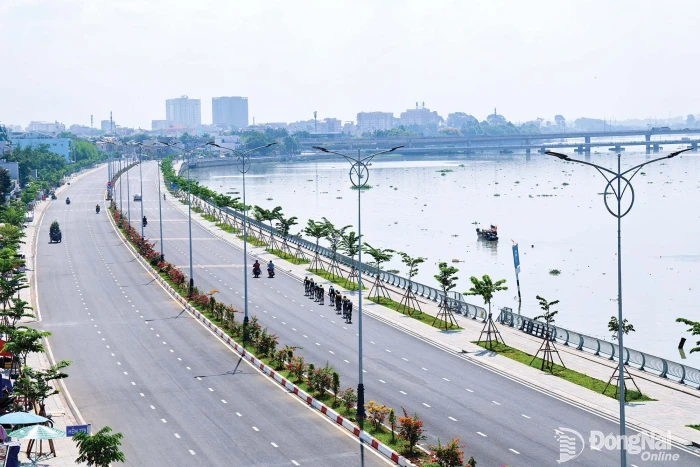
| The Dong Nai riverside zone in Tran Bien Ward is slated for redevelopment into an eco-urban area. Photo: Cong Nghia |
Beyond its objectives for economic growth, infrastructure development, and urban planning, Resolution 16 addresses issues closely related to the daily lives of citizens, including employment, housing, education, healthcare, and the living environment.
Residents' well-being is the benchmark of development
Resolution 16 sets the goal of developing Dong Nai into a key growth pole of the Southeast region and a center for high-tech industry, logistics, and innovation, supported by an integrated and modern infrastructure system that will gradually integrate with major urban areas in the region and internationally.
These objectives are essential to shaping a modern city. However, the value of development is not reflected solely in growth rates, investment capital, or large-scale projects. At the heart of the resolution is the goal of serving the people and improving their quality of life.
 |
| An art performance at the ceremony announcing the National Assembly's resolution on the establishment of Dong Nai City. |
Infrastructure projects, industrial parks, urban areas, and social housing projects are ultimately intended to make people's lives more convenient, safer, and of higher quality. The planning and construction of railways, expressways, and ring roads, for example, are designed to facilitate travel for residents. Likewise, the development of industrial parks and the promotion of investment attraction are aimed at creating stable employment opportunities and improving workers' incomes.
A notable feature of Resolution 16 is that, alongside its objectives for economic, scientific, technological, and infrastructure development, it places clear emphasis on areas that directly affect people's quality of life, including social housing, education, healthcare, culture, environmental protection, human resource development, and social welfare. This distinguishes sustainable development from growth alone.
On July 21, 2026, the Politburo issued Resolution No. 16-NQ/TW on the construction and development of Dong Nai City by 2035, with a vision to 2065. The resolution is of strategic significance to this key growth pole of the Southeast region and the country. It also conveys the message that all guidelines and policies are people-oriented, with citizens identified as the center, the subject, and the beneficiaries of development achievements.
Nguyen Le Ngoc, a second-year student at Dong Nai University, said, "What interests me most about Resolution 16 is the opportunity to build a career. The resolution outlines the development of special economic zones, free trade zones, concentrated digital technology zones, innovation hubs, and higher education zones linked to the Long Thanh Airport urban area. Once these directions are implemented, Dong Nai will require a large pool of high-quality human resources. I hope that after graduation, I will have the opportunity to find a job here in Dong Nai, with a good income and a modern working environment."
Meanwhile, Le Ba Dao, a worker at Amata Industrial Park, expressed his hope that the goals for education, healthcare, culture, and social welfare set out in Resolution 16 will soon become reality. "What workers need most is stable housing, schools close to home for their children, convenient access to medical examination and treatment, and spaces for cultural activities. When these needs are met, workers will feel secure in making a long-term commitment to their companies and will regard Dong Nai as their second home," said he.
Nguyen Van Tri, a resident of Quang Vinh Neighborhood in Tran Bien Ward, said older people rarely remember what the locality's economic growth rate is or how many billions of USD in investment capital have been attracted. Instead, they notice whether there is a park near their homes for exercise, whether streets remain free from flooding after rainfall, and whether the urban landscape has become more attractive. Those seemingly modest improvements, he said, best reflect the achievements of the development process.
These views demonstrate that citizens expect tangible improvements in their daily lives. This is also the consistent spirit reflected in Resolution 16.
Citizens serve as the center and the subject of development
One of the six key viewpoints of Resolution 16 is not only the goal of building Dong Nai into a "Civilized - Modern - Happy" city but also the clear identification of people as the center, the subject, the driving force, and the beneficiaries of development achievements.
Resolution 16 has opened up new opportunities and established a clear development direction for Dong Nai. However, these opportunities can only deliver results through the concerted efforts of the entire political system, the business community, and every citizen. The government is tasked with fostering a favorable development environment through appropriate mechanisms and policies, synchronized infrastructure, and a service-oriented administration. Officials are required to innovate their thinking, dare to think, dare to act, and dare to take responsibility. Businesses need to proactively innovate, improve their competitiveness, and work alongside the locality in its development. Every citizen is encouraged to cultivate a civilized lifestyle, comply with the law, protect the environment, and preserve shared public spaces.
 |
| The Dong Nai riverside zone in Tran Bien Ward is slated to become an eco-urban area. Photo: Cong Nghia |
From a religious perspective, Dr. Venerable Thich Dat Ma Toan Hanh, Member of the Central Committee of the Vietnam Fatherland Front, Deputy Head of the Legal Department of the Vietnam Buddhist Sangha, and Deputy Head of the Executive Board of the Vietnam Buddhist Sangha in Dong Nai City, said the central message of Resolution 16 is its people-centered approach to development. According to him, this viewpoint is also consistent with the Buddhist spirit of compassion, encouraging every individual to take responsibility for building a compassionate, civilized, and sustainably developed city.
Representing the business community, Duong Van Bac, General Director of Novaland Group, said the guidelines of the Central Government and the locality on the construction and development of Dong Nai City consistently place people at the center, identifying them as both the subject and the goal of the development process. According to Bac, a modern city should be measured not only by its growth rate or investment scale but also by the quality of life of its citizens, reflected in its infrastructure systems, healthcare services, education, green spaces, and continually improving social amenities.
By 2035, or with a vision to 2065, Dong Nai will undoubtedly have more modern infrastructure and a new development landscape. However, the most enduring value of Resolution 16 will not lie in bridges, roads, or growth indicators, but in every citizen experiencing a better quality of life. When the aspirations of each citizen are aligned with the city’s development aspirations, Resolution 16 will become not only a strategic document but also a source of inspiration and motivation for the entire community to join hands in building a civilized, modern, safe, and happy Dong Nai.
By Hoang Loc – Translated by Minh Hong, Thu Ha


Thông tin bạn đọc
Đóng Lưu thông tin