
A more convenient road, a residential area with better drainage, more green spaces and public spaces suited to people’s daily lives — these are changes residents can directly feel and also requirements that must be addressed in the process of urban development.
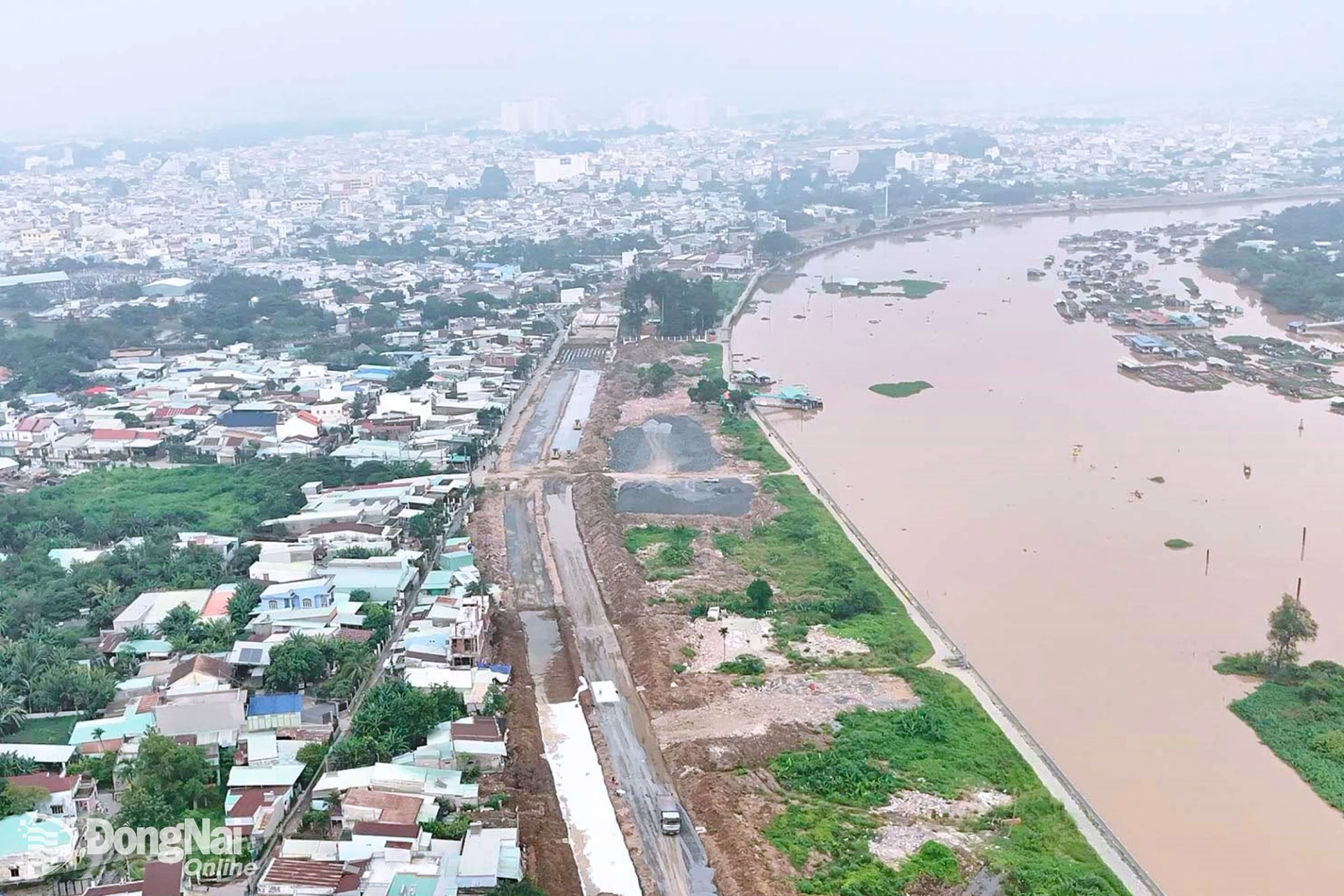 |
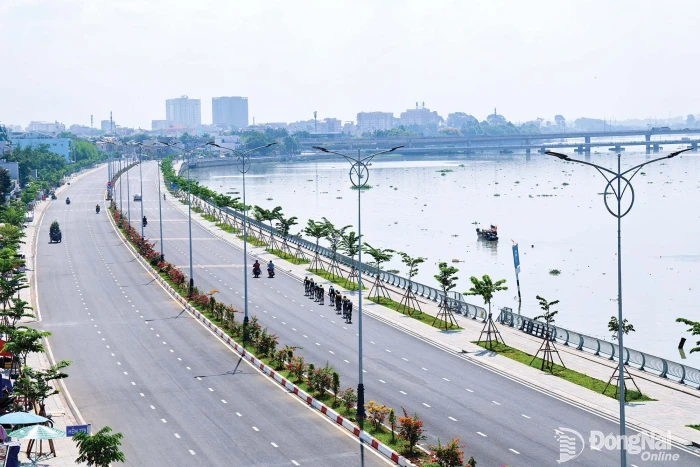
| The Cai riverside road project helps complete the space for socio-economic development along the river. Photo: Pham Tung |
The Urban Development Law, which will take effect on October 1, 2026, provides an additional legal foundation for urban development and management. As for Dong Nai, this requirement is also framed by Politburo Resolution No. 16-NQ/TW on building and developing Dong Nai City through 2035, with a vision to 2065. From the perspective of people’s daily lives, this requirement is first reflected in issues of direct concern to residents, such as transportation, drainage, the environment and spaces for community activities.
Addressing practical needs
During rush hours, roads with heavy traffic volumes often come under significant pressure. For workers, employees and residents who commute every day, convenient and safe travel and shorter travel times are practical requirements of urban development process.
Nguyen Thi Lieu, a worker in Long Binh Ward, said she travels to work every day along roads with heavy traffic. She hopes these roads will be upgraded and expanded to accommodate the growing number of vehicles, making travel more convenient and safer for residents.
Alongside addressing specific traffic bottlenecks, the city is accelerating transport projects that play a key role in improving connectivity. On September 9, Deputy Secretary of the City Party Committee, Chairman of the City People’s Committee Nguyen Van Ut personally inspected the implementation of five road projects, namely 25B, 25C, 769, 770B and 773, and called for outstanding difficulties to be resolved and and cleared sites to be handed over continuously so contractors can carry out construction along the full length of the routes..
On September 15, at a working session with the City Land Fund Development Center, Deputy Secretary of the City Party Committee Vo Tan Duc called for concentrated efforts to resolve site-clearance obstacles and build a Gantt-chart for each project, with specific completion deadlines and assigned responsibilities. Resolving site-clearance issues and accelerating key projects and works will also help create more convenient and safer roads for residents as soon as possible.
Along with transportation, the city is proactively taking drainage capacity into account in its urban development process. On June 16, 2026, the city People’s Committee issued Plan No. 98/KH-UBND on addressing flooding caused by heavy rainfall in the city during the 2026–2030 period. The plan calls for reviewing flooded areas and locations at risk of flooding, assessing drainage capacity and identifying areas where capacity remains limited in order to develop appropriate solutions.
Rather than waiting for flooding problems to arise before taking action, the city is gradually reviewing and identifying priority areas, proactively investing in and upgrading drainage systems and addressing existing shortcomings. This approach aims to develop infrastructure that can better meet current needs while proactively responding to increasingly unpredictable weather conditions.
Turning the urban vision into reality
Politburo Resolution No. 16 sets the goal of developing Dong Nai City by 2035 as an airport city featuring a riverside, polycentric, multifunctional, green and smart urban model, with a view to building a civilized, safe and happy society and an improved quality of life for residents.
To translate Resolution No. 16 into reality, the City Party Committee’s Plan No. 179-KH/TU on implementing the resolution calls for urban planning with a strategic, 100-year long-term vision. It also requires development space to be organized in an open, flexible and highly adaptive manner based on a polycentric, multipolar and multilayered model, ensuring synchronized connectivity among land, water, airspace, underground space and digital space.
More convenient roads, flooding hotspots addressed, more trees and suitable public spaces — changes that begin with practical improvements are gradually creating a better quality of life in the city.
At a conference held by the City Party Committee on August 29 to study, disseminate and implement Resolution No. 16, Deputy Secretary of the City Party Committee, Chairman of the City People’s Committee Nguyen Van Ut emphasized that economic development must go hand in hand with environmental protection and cultural, social and human development, ensuring harmony and sustainability towards the goal of building a “Civilized – Modern – Happy” city. He stressed that programs and projects must focus on improving people’s quality of life so that residents can enjoy the fruits of development.
Based on this orientation, issues of daily concern to residents, including transportation, drainage, the environment, greenery and community spaces, are being incorporated into the overall urbanplanning, investment and management. This is also a way to translate the goal of improving people’s quality of life into reality, turning development orientations into tangible changes in everyday life.
Nguyen Thi Loan, a resident of Long Thanh Ward, said that as urban areas expand, environmental requirements need to be incorporated into planning from the outset. New residential areas, roads and facilities should be developed alongside greenery, parks, drainage systems and waste collection and treatment facilities that are appropriate to residents’ needs.
The effectiveness of urban development, therefore, should not be measured solely by the scale of urban space or the number of projects and facilities, but also by the tangible changes it brings to people’s daily lives.
By Ho Thao - Translated by Mai Nga, Thu Ha

Thông tin bạn đọc
Đóng Lưu thông tin