
Many businesses across Dong Nai City are currently facing significant worker shortages. However, a paradox has emerged: despite a large labor supply in the market, many companies are still struggling with severe labor shortages.
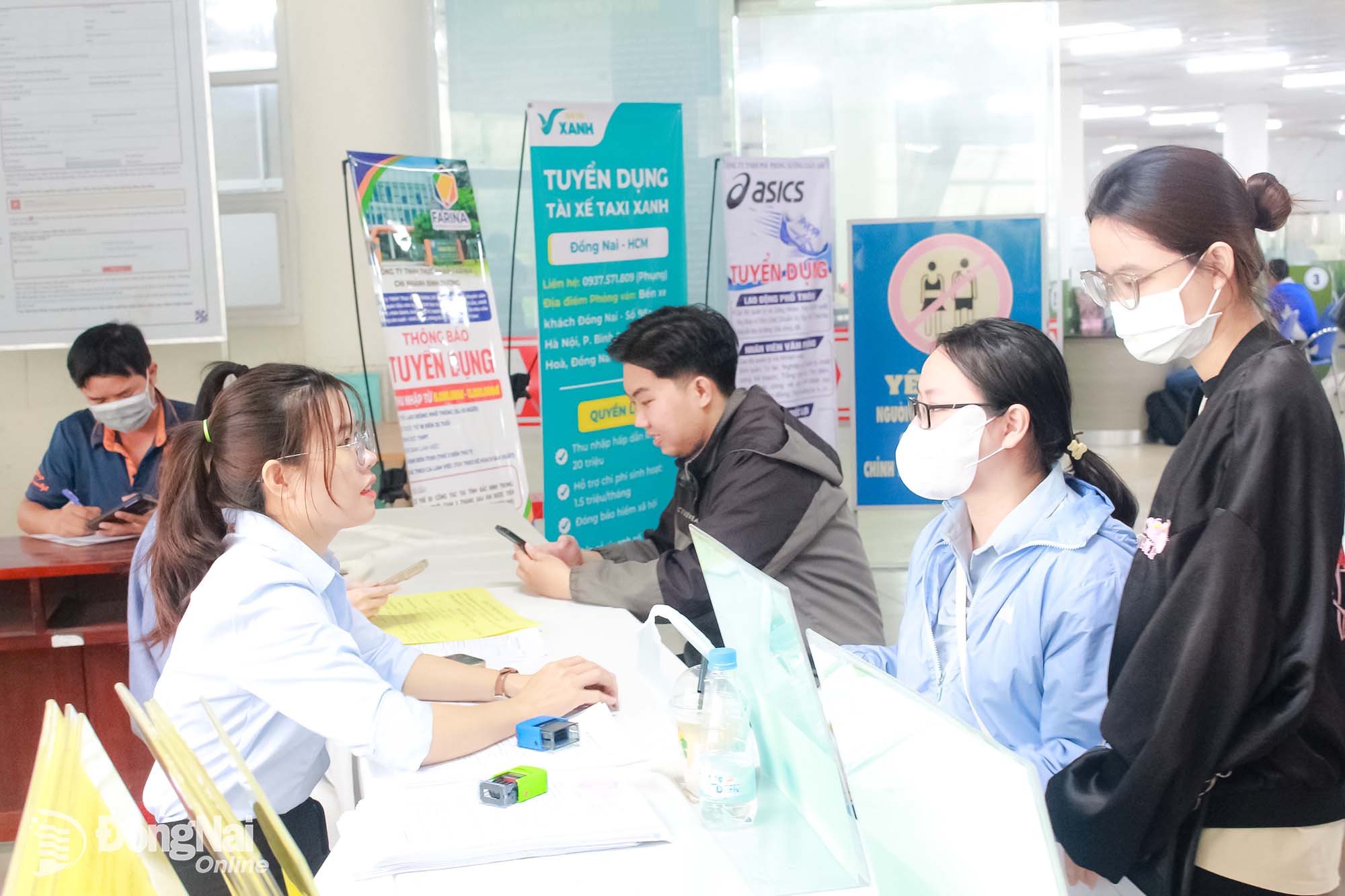 |
| Businesses participate in recruitment at the Dong Nai Employment Service Center (Tam Hiep Ward). Photo: Thao My |
Many enterprises are grappling with workforce shortages, particularly in manufacturing, technology, logistics, footwear, and garment industries.
Generous benefits still fail to attract workers
These days, recruitment banners hanging outside factories in many industrial parks across Dong Nai have become a familiar sight. From electronics manufacturers and garment factories to footwear and wood-processing companies, businesses are facing persistent labor shortages. Despite continuously expanding recruitment campaigns and offering attractive incentives, many firms are still desperately searching for workers.
Despite continuous recruitment across multiple channels since early 2026, Elite Long Thanh Co., Ltd., located in Long Thanh Ward, remains short of workers to maintain production. The company is currently seeking around 1,000 sewing workers. According to Van Thi Hien, a company HR staff member, the business has shifted from traditional recruitment methods to livestream recruitment sessions on its Facebook page. “Through livestream recruitment, job seekers can directly learn about available positions, benefits, and policies before submitting applications and starting work immediately. We also offer referral bonuses of VND5.5 million for skilled sewing workers and VND4 million for unskilled sewing workers,” she said.
To address workforce challenges, many businesses in Dong Nai have proactively adjusted recruitment strategies and labor management practices. Some companies have invested in dormitories and community living spaces to create stable living conditions for migrant workers, a strategy aimed at retaining talent and ensuring sustainable growth.
Meanwhile, Goodwood Viet Nam Co., Ltd., a wholly foreign-owned company specializing in kitchen cabinets and furniture manufacturing in Chon Thanh Ward, has continuously recruited both unskilled and technical workers. For employees relocating from other areas, the company provides housing support and a VND800,000 per person allowance for the first month of employment, along with transportation assistance. In addition to fixed salaries, employees can also receive technical bonuses ranging from VND500,000 to VND6 million per month. Despite these benefits, the company still struggles to recruit enough workers to meet production demands.
The footwear industry is also continuously hiring. For example, Hwaseung Vina Co., Ltd., located in Nhon Trach 1 Industrial Park, needs to recruit 1,000 unskilled workers with monthly incomes ranging from VND6.7 million to VND10 million. According to Deputy Head of Human Resources Nguyen Dac Vinh, the company has partnered with the Public Administration Service Center in Phuoc An Commune to organize local job interviews and recruitment events while distributing flyers detailing job opportunities, particularly targeting unemployed workers seeking to return to the labor market.
Solutions to attract and retain workers
Clearly, as orders recover and production expansion accelerates, workforce shortages are becoming a major pressure point for the business community. Recent job fairs have shown that many companies, both inside and outside the city, are actively seeking workers. Industries such as electronics, garments, food processing, e-commerce, and information technology all have substantial recruitment needs to support production growth and business expansion.
However, rising recruitment demand contrasts sharply with the reality of shrinking labor supply. Many companies seeking hundreds or even thousands of workers receive only a limited number of applications. Beyond manufacturing, logistics firms, e-commerce businesses, and industrial support service providers are also competing fiercely for talent. In particular, skilled workers, technicians, and employees with foreign-language capabilities have become increasingly scarce.
Businesses are not only facing shortages of general workers but also struggling to find high-quality talent. Rapid technological development, automation, and digital transformation are driving the rising demand for mechanical engineers, electrical engineers, automation specialists, and production management professionals. However, the supply of workers capable of meeting real-world requirements has not kept pace.
According to businesses, labor shortages are not merely a matter of workforce numbers but stem from a shift in workers' job preferences. In the past, many workers prioritized long-term, stable employment, but now they are choosing more flexible work environments, better income, and greater opportunities for personal development. Many have turned to freelance work, online businesses, or ride-hailing services, while others are considering changing jobs to return to their hometowns to live.
Nguyen Van Canh, Director of Dong Nai Employment Service Center, said recruitment demand in the second quarter of 2026 is expected to reach nearly 7,000 workers. “To improve job matching efficiency, the center has implemented various solutions to expand access to recruitment information. Employment support networks have now been expanded citywide through collaborator systems,” he said.
The center is also strengthening cooperation with schools and vocational institutions to establish career information corners and regularly update business recruitment needs. This endeavor allows students to access labor market information while still in school, helping them develop clearer career orientations and proactively search for suitable jobs after graduation. In addition, the center actively connects businesses with workers to help balance labor supply and demand in the coming period.
Clearly, in today’s increasingly competitive labor market, businesses can no longer rely solely on salaries to attract and retain workers. Instead, they need to build stable, professional working environments that offer long-term career development opportunities. A positive workplace culture that respects employees and promotes clear corporate values will become a major advantage in attracting talent, especially younger workers.
By Thao My – Translated by Mai Nga, Minho


Thông tin bạn đọc
Đóng Lưu thông tin