(ĐN)- More than 40,000 children in Dong Nai are benefiting from the school milk program which has been carrying out since last September with the purpose of reducing the weight and height malnutrition rates of children in the province.
(ĐN)- More than 40,000 children in Dong Nai are benefiting from the school milk program which has been carrying out since last September with the purpose of reducing the weight and height malnutrition rates of children in the province.
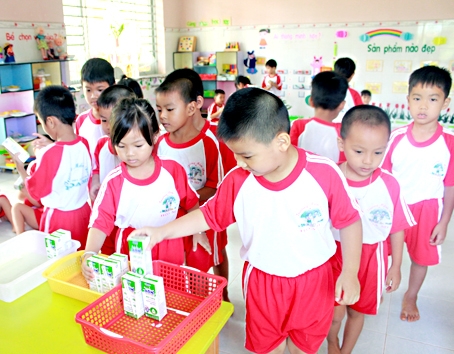 |
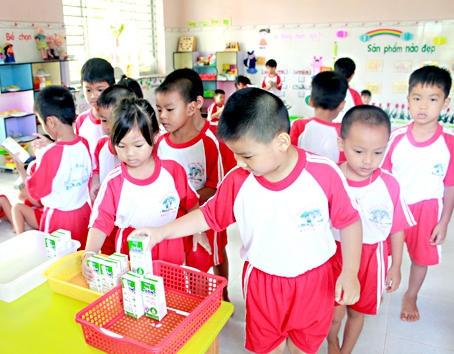
| Children receive milk to drink at Hoa Mi preschool in Cam My district |
The program has been implementing at at 104 pre-schools and 45 private nursery classes in the 5 districts of Xuan Loc, Cam My, Dinh Quan, Tan Phu and Vinh Cuu, and Pouchen Vietnam Company’s Green World Kindergarten in Bien Hoa city and Feng Tay Group’s Orient kindergarten in Trang Bom district.
The program has supplied free milk to all children between one and five years of age to the schools in the province. Each child will drink 180 ml of milk three times a week.
Each carton of milk costs VND6,000, of which parents have to pay only VND2,100 for each carton, thus they can save around VND50,000 per month for each child.
According to Tran Thi Khanh, Principal of Cam My district-based Hoa Mi preschool, the school kids’ parents are almost poor workers and farmers, adding that they are happy when their children could drink milk with origin and hygiene, and they only have to pay 35% of the money.
Hoang Thi Thuy Trang, whose two children are studying at the district-based Long Giao preschool, said that she can save around VND100,000 per month since the school milk program was deployed at the preschool.
As known, Dong Nai is the third localities in the country after Ba Ria-Vung Tau and Bac Ninh to implement the program.
The program costs more than VND1,300 billion in the 2014-2020 period, of which VND658 billion comes from the state budget, nearly VND197 billion from the milk supplier, Vietnam Dairy Products Joint Stock Company (Vinamilk), and the remaining from children’s parents.
The total cost of the project carried out at the two enterprise-funded kindergartens includes 50% from the enterprises, 15% from the milk supplier, and the remainder is from children’s parents.
Reported by H.D