Authorities in Dong Nai province have decided to stop licensing new business projects in five sectors to prevent pollution, according to the head of the local Department of Planning and Investment.
Authorities in Dong Nai province have decided to stop licensing new business projects in five sectors to prevent pollution, according to the head of the local Department of Planning and Investment.
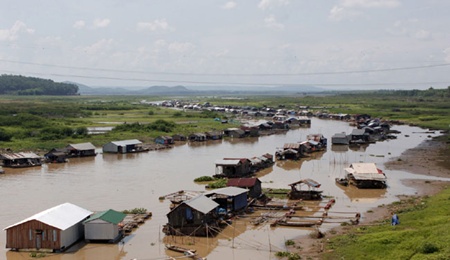 |
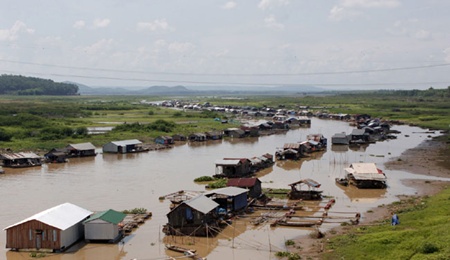
| La Nga River (an affluent of the Dong Nai River) is narrowed down due to water shortage in dry season. |
Bo Ngoc Thu listed them as pulp and paper production, tapioca processing, rubber processing, production of basic chemicals, and leather tanning.
"These five sectors are allegedly the chief culprits that have caused severe pollution in the province in recent years," Dau Tu (Investment) newspaper quoted her as saying.
"So the government is ready to accept a certain reduction in investments to protect people's living environment.
"We will have great difficulty in cleaning up the environmental pollution if we continue to allow investors to invest in these sectors."
A spokesperson for the Dong Nai Industrial Park revealed that recently dozens of foreign businesses sought to invest in the park but had to be refused since the investments were in the five banned sectors.
Dong Nai authorities have also announced a list of sectors to invest in which investors have to meet certain conditions.
They are plating, spraying, metal polishing, dyeing, fertiliser production, fisheries processing, and production of paints, additives, and industrial laundry detergents.
Enterprises seeking to invest in these industries would have to operate in industrial parks and comply with regulations.
The province also gives priority to green and energy-saving projects and those in sectors like technology and supporting industries, new materials, information technology, agriculture, and processing.
This year the province hopes to attract US$1 billion in foreign direct investment, much lower than last year's figure of $1.6 billion. Domestic investment in the province is estimated at nearly VND7 trillion (US$329,473), down from VND8 trillion ($376,541) last year.
Increasing pollution
Dong Nai now has 31 IPs spread over a combined area of 9,838 hectares, of which 27 are operational and house 1,201 projects worth a cumulative US$16.6 billion. Of these, 872 are foreign-owned projects with a combined capital of $14.61 billion by investors from 36 countries and territories.
But despite making an important contribution to the country's socio-economic development, many companies also cause an adverse impact on the environment.
For instance, Vedan Viet Nam Monosodium Glutamate, a Taiwanese seasoning powder producer, was caught red-handed after discharging untreated wastewater into the Thi Vai River for several years. It had contributed to alarming levels of contamination in the river.
Sonadezi Long Thanh, a waste treatment company in the province was fined VND405 million ($19,000) for releasing poorly treated wastewater into the Dong Nai River.
Severe air pollution has also been observed at many IPs in Dong Nai, with pollutants exceeding permissible levels by one to nine times.
Provincial authorities took a series of drastic measures to combat the problem.
As a result, 120 out of 150 companies that had been placed in a list of serious polluters now have proper wastewater treatment facilities and have exited the list.
(Source:VNS)