
Artificial intelligence (AI) is increasingly being integrated into almost every aspect of the tourism industry, from customer acquisition, tour design and promotion to product sales and visitor care services.
As travelers increasingly tend to “ask AI” before deciding where to go, destinations and tourism businesses need not only to maintain an online presence but also to ensure that they can be recognized, accurately understood and recommended by AI systems.
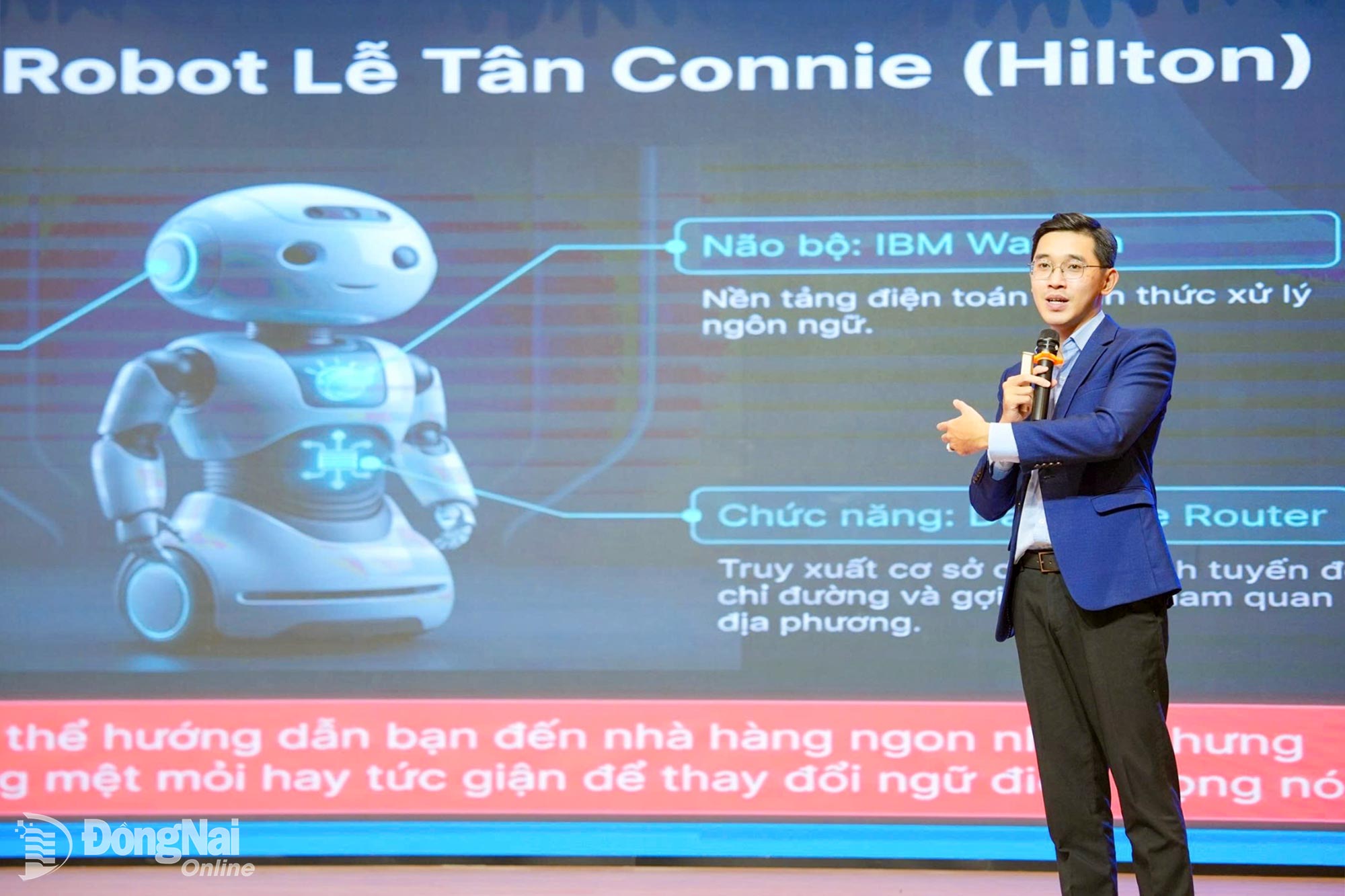 |
| Master Vu Nguyen Minh Tri, Secretary-General of the Vietnam Enterprise Club (VEC) and Business Director of ADAVIGO Travel & Events in Ho Chi Minh City, discusses AI applications in tourism sector at a scientific workshop. |
Applying AI to tourism activities is an inevitable trend in the digital era, and Dong Nai’s tourism sector cannot afford to stand outside this trend.
When AI becomes a “travel assistant”
Nguyen Thu Nguyen, a resident of Trang Dai Ward, was planning a two-day, one-night trip. Instead of entering keywords such as “tourist attractions near Saigon” or “two-day, one-night trip to Dong Nai,” Nguyen used ChatGPT and entered a detailed prompt: “I have two days on the weekend and am traveling with my family, including young children. I want to find a place that is close to nature, offers agricultural experiences and local specialties and is not too crowded. Please design a suitable itinerary.”
Unlike traditional search engines, which mainly provide lists of results, AI can synthesize information and directly suggest an itinerary. This represents a significant change for the tourism industry.
Master Vu Nguyen Minh Tri, Secretary-General of the Vietnam Enterprise Club (VEC) and Business Director of ADAVIGO Travel & Events in Ho Chi Minh City, said AI has been applied to almost every stage of tourism sector, from demand forecasting and personalized product recommendations to automated advertising, human resources management, visitor flow management at destinations and even hotel service robots.
According to Tri, the development of AI in tourism can be viewed in three levels. At the basic level, AI functions like a “recipe” provider, while humans still perform most of the work. At a higher level, AI can independently generate recommendations based on customer needs. At the level of Agentic AI, systems can handle a continuous chain of tasks, from searching and selecting to carrying out actions requested by users.
In Vietnam, most travel businesses are still operating at an intermediate level of AI adoption, using chatbots to respond to customers around the clock, automatically generating advertising content, or monitoring airfares and room rates to adjust selling prices. Meanwhile, some businesses around the world have begun experimenting with Agentic AI, which can independently book services or handle certain situations during a trip. This highlights a technology gap that Vietnamese businesses need to narrow soon.
Master Phan Van Hai, Head of the Department of Tourism and Travel Services Management at Lac Hong University, said that in the past, businesses often developed a single tour program and marketed it broadly to different customer groups. With AI, data on age, place of residence, preferences, spending capacity and search behavior can be analyzed to enable businesses to design products suited to specific customer groups. AI can also support the creation of advertising content, images and videos for multiple platforms; operate multilingual chatbots; advise on itineraries and provide quotations; receive service-booking requests; forecast visitor numbers; manage revenue; adjust room and tour prices; and analyze visitor feedback.
According to Phan Van Hai, one of AI’s most notable values is its ability to analyze data to connect the right product with the right customer at the right time. This is an area that Dong Nai tourism businesses should pay particular attention to. To do so, businesses need to build databases from websites, fan pages, booking platforms, existing customers and QR codes at destinations. Based on this data, AI can help segment customers according to their needs, such as family vacations, nature exploration, experiential travel, conferences, or cultural and historical tourism. It can also identify people who have shown interest but have not yet booked a service, allowing businesses to reach them with more relevant content. This approach also opens up many opportunities for small businesses.
Sharing the same view, Master Vu Nguyen Minh Tri said: “In the AI era, advantages do not necessarily belong only to new technology companies. Long-established businesses possess valuable assets, including customer data accumulated over many years, practical experience and partner networks at destinations. If they know how to bring these assets onto digital platforms, small businesses can still create their own competitive advantages.”
Getting Dong Nai tourism recognized by AI
For Dong Nai tourism, this issue is particularly important because the locality offers a wide range of products associated with nature, experiential travel, cultural and historical values, and community life.
According to Master Phan Van Hai, at the sector-wide level, Dong Nai needs to work toward a shared tourism data ecosystem connecting management agencies with destinations, travel businesses, accommodation establishments, restaurants and transport providers. An AI-integrated tourism information portal or smart tourism map could help visitors build itineraries based on available time, budget and preferences, while enabling the tourism sector to identify market needs and trends. This would mark a shift from simply digitizing tourism information to using data to manage and develop smart tourism.
However, Phan Van Hai also cautioned: “AI applications must be based on accurate data, capable human resources and effective protection of personal information. AI can help identify the right customers and provide services more efficiently, but it cannot replace hospitality, emotions and the authenticity of a destination.”
Master Vu Nguyen Minh Tri further explained that AI can replace many repetitive tasks, such as data entry, preparing guest lists and checking basic room rates. However, the essence of tourism remains the emotional connection between people. AI can process data, but it does not possess the human sensitivity and sincerity needed to recognize a guest’s anxiety or hesitation and respond appropriately. Therefore, the human resources challenge in the AI era is not simply about “how many jobs AI will take away,” but about how tourism professionals can upgrade their roles.
“In tourism, the hardest things to replicate are always service and brand — two things that depend entirely on people,” Tri emphasized.
Travelers’ habits are also changing rapidly. Customers now interact with various AI tools, from ChatGPT and Gemini for planning itineraries, and virtual assistants provided by airlines and hotels, to recommendation systems on tour- and hotel-booking platforms. However, even when they start their search with AI, travelers still tend to return to a business’s official website to complete their bookings. This shows that businesses cannot simply invest in an AI tool and wait for customers to find them. What they need to do is build clearly defined products, accurate data, and consistent websites and content so that both users and AI can understand what products and services the business offers.
For Dong Nai’s tourism sector, if destination data are standardized, businesses learn to leverage customer data, tourism workers are equipped with AI skills, and management agencies develop a shared data ecosystem, technology can help connect currently fragmented products into more complete travel itineraries.
Master Le Anh Tuan, Vice Rector of the School of Tourism and Health under the Van Hien University ecosystem in Ho Chi Minh City:
For the tourism industry, AI is no longer a story about the future. AI is already involved in many activities, from product development, itinerary design and demand forecasting to marketing, customer service, hotel and restaurant management, and enhancing visitor experiences. However, AI does not replace tourism professionals; rather, people who know how to use AI will have more opportunities to replace those who do not.
By Hai Yen - Translated by Mai Nga, Thu Ha


Thông tin bạn đọc
Đóng Lưu thông tin