
Digital services are becoming increasingly common in the daily lives of Dong Nai residents, from handling administrative procedures and making cashless payments to medical examination and treatment, education, and business activities.
The challenge is to ensure that all residents can access and effectively use these services. A digital society can only truly become part of daily life when technology becomes a familiar tool in people's daily activities.
Technology becomes part of daily life
Recently, many tasks traditionally carried out in person have gradually shifted to the digital environment, from handling administrative procedures and making payments to medical examination and treatment, education, and business activities, giving residents more options and greater convenience.
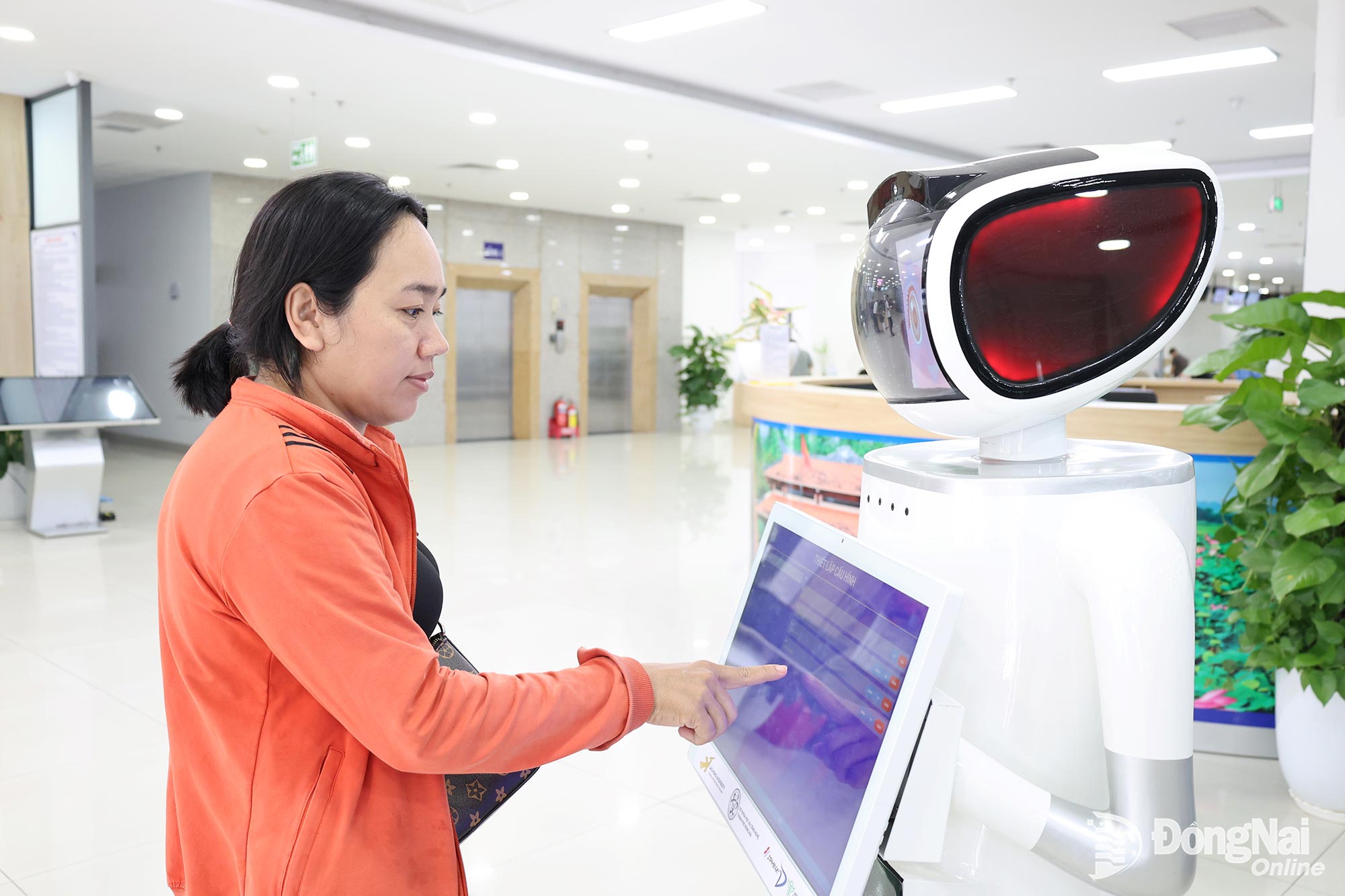 |
| A resident interacts with a robot to complete administrative procedures at the city's Public Administration Service Center. Photo: Ho Thao |
Nguyen Thi Hoa, a resident of Phuoc Tan Ward, said, "Paying with a QR code is faster and more convenient, especially since I don't have to carry a lot of cash. I use this method more and more frequently for daily shopping and payments."
Over the past year of operating the two-tier local government, numerous figures reflect how digital technology has been applied in daily life. According to a report by the City People's Committee, during the first year of the model's operation, from July 1, 2025, to July 1, 2026, all 144 medical examination and treatment facilities used chip-embedded citizen ID cards and the VNeID application for health insurance-covered medical examination and treatment, recording nearly 14 million successful lookups. Educational institutions implemented cashless payment for tuition fees, while electronic student records were introduced in 393 primary schools, 121 secondary schools, and 48 high schools. Approximately 1.4 million bank customer records were biometrically authenticated. In the field of social welfare, the proportion of one-time social insurance benefit payments made via bank accounts reached 100%. At the same time, payment rates for regular allowances, allowances for meritorious individuals, and allowances for social protection beneficiaries all reached very high levels. In handling administrative procedures, the online application rates reached 99.78% at the city level and 99.94% at the commune level.
These figures demonstrate the broad coverage of digital services. However, the measure of a digital society lies not only in the number of online applications or platforms developed but also in whether technology has become a familiar tool in people's everyday activities.
The Smart Market model at Dong Xoai Market in Binh Phuoc Ward is one example. This is the first market in Dong Nai City to implement the model, with 564 stalls operated by 342 small traders. The digital platform supports stall management, revenue management, reporting, statistics, and electronic invoicing. Small traders can introduce and sell products online, while consumers can search for products, view information, and place orders.
When small traders can sell online and people make cashless payments, technology becomes a tool for livelihoods rather than merely for administration. This is also how a digital society takes shape from specific needs in daily life.
Helping residents truly become digital citizens
Having digital infrastructure, platforms, and services is a necessary condition. The sufficient condition for a digital society to become integrated into daily life is for residents to be able to use these digital services, particularly the elderly, people with disabilities, ethnic minorities, and those with limited digital skills.
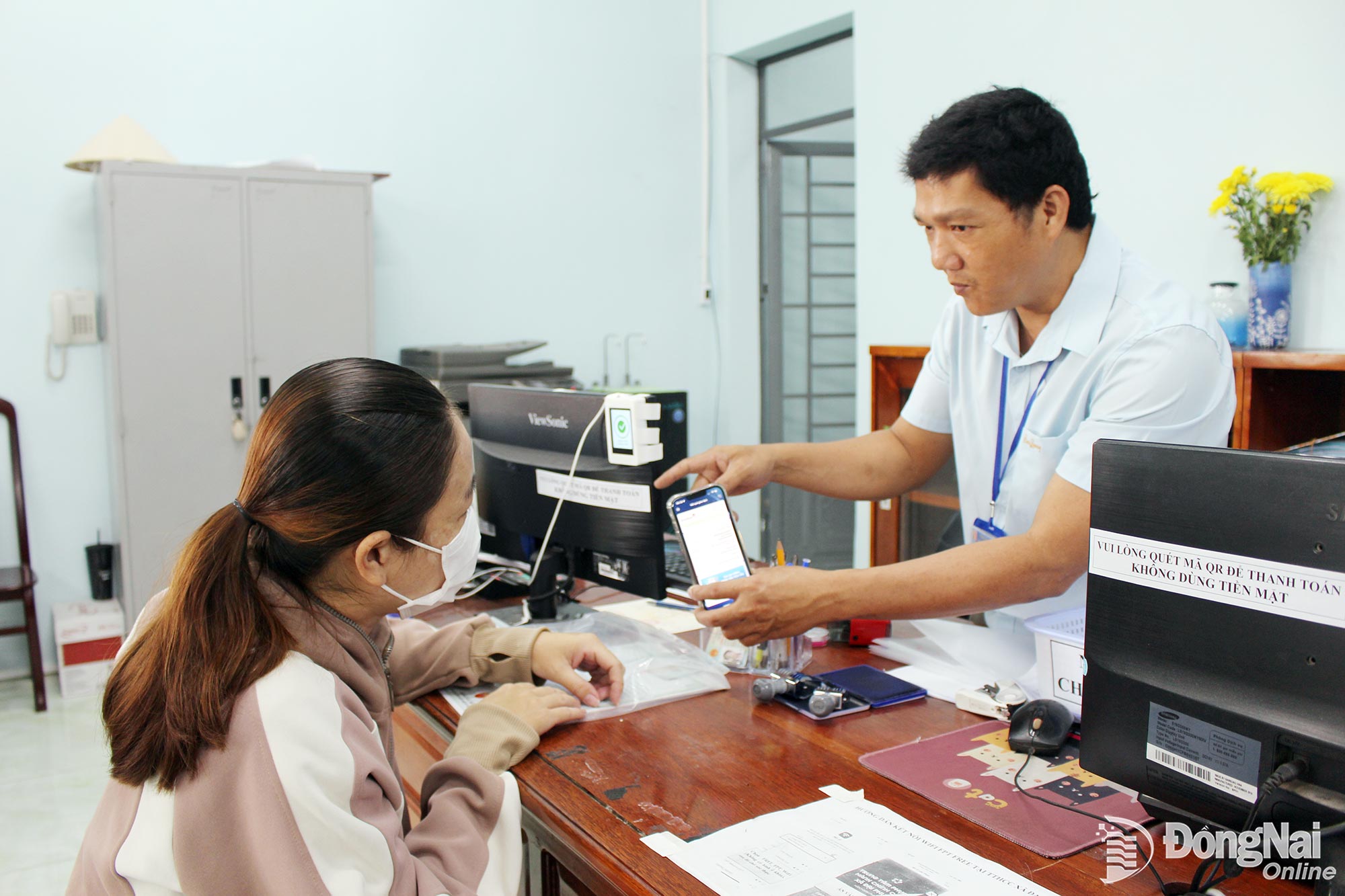 |
| A resident receives guidance from an official at the Dai Phuoc Commune Public Administration Service Center on completing administrative procedures online. |
In Loc Hung Commune, the Commune Public Administration Service Center assists approximately 50 residents each day with completing and submitting online applications. In An Vien Commune, police officers, Youth Union members, and the Community Digital Technology Team visit homes to assist the elderly, the sick, and people with disabilities with tasks related to citizen ID cards, the VNeID application, and registration to receive benefits via cashless methods.
Ha Anh Dung, Member of the Dong Nai City Party Committee’s Standing Board and Permanent Vice Chairman of the City Vietnam Fatherland Front Committee, stated that the goal is to build a digital government, a digital society, and digital citizens. It cannot be considered a success if residents do not know how to perform tasks and the work is still primarily carried out by officials. Drawing on the lesson of President Ho Chi Minh's "Binh Dan Hoc Vu" (Mass Education), it is necessary to empower young people, Youth Union members, and Party members to guide and mentor those who still face difficulties in accessing technology, gradually helping them independently use digital services.
The Politburo’s Resolution No. 16-NQ/TW, dated July 21, 2026, on the construction and development of Dong Nai City by 2035, with a vision to 2065, sets the goal of building a civilized, modern, and happy Dong Nai, taking people as the center, subject, resource, goal, and beneficiary of development, and developing a new growth model based on science, technology, innovation, and digital transformation as the main drivers.
Scheme No. 05-DA/TU of the City Party Committee, dated July 3, 2026, on promoting administrative reform, focusing on administrative procedure reform associated with digital transformation and the building of a digital and smart government for the 2026-2030 period, also sets specific targets for a people-centric digital society. The scheme strives to ensure that by 2030, at least 95% of people aged 15 and above will have transaction accounts; the proportion of residents with personal electronic signatures will reach at least 80% in urban areas and 50% in rural areas; at least 95% of residents will have electronic health records; and 90% of residents will have access to medical information and remote consultation, examination, and treatment services.
These goals show that building a digital society is not simply about developing platforms but, more importantly, about helping people use technology as a life skill. A digital society can only truly become part of daily life when residents can independently conduct transactions, access services, and handle tasks in the digital environment.
By Ho Thao – Translated by Minh Hong, Thu Ha


Thông tin bạn đọc
Đóng Lưu thông tin