
Many enterprises in Dong Nai have invested in automated production lines, robots, and smart control systems to improve productivity and product quality.
Technological innovation also helps enterprises increase productivity, meet order deadlines, ease pressure from labor shortages, and improve working conditions for employees.
 |
| A high-tech factory at Amata Industrial Park. Photo: Vuong The |
Replacing manual labor with automated machinery
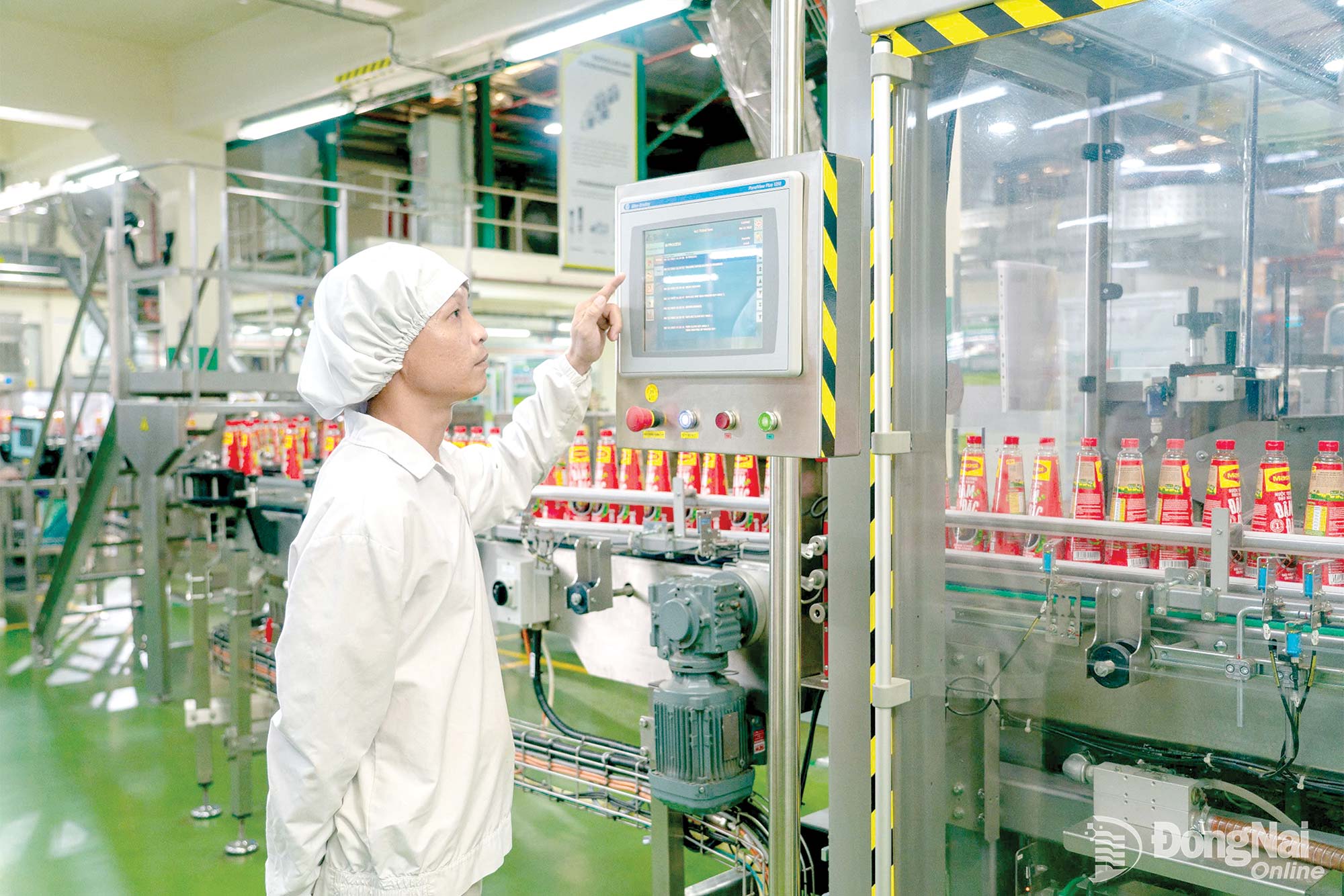
Observations at many enterprises show that repetitive, strenuous, or potentially hazardous tasks are gradually being replaced by automated machinery and equipment. Workers are shifting from directly performing production tasks to operating, monitoring, and controlling machinery.
On some automated production lines, employees only need to monitor and control the process via computers, while some lines require just two to three skilled workers to operate. This trend is being adopted by many enterprises in supporting industries, electronics, mechanical engineering, garment manufacturing, and other sectors.
For example, Yuen Foong Yu Paper Enterprise Dong Nai Co., Ltd. in Long Thanh Ward has introduced automated robots into the product transportation stage. Instead of relying on manual labor to move and arrange individual products, the robotic system transports goods to designated locations, improving speed, accuracy, and efficiency.
Do Nguyen Phuong, Chairman of the Trade Union at Yuen Foong Yu Paper Enterprise Dong Nai Co., Ltd., said that automating individual production stages not only helps the enterprise increase productivity and optimize storage space but also significantly reduces physical labor for workers. Notably, employees no longer have to perform repetitive and strenuous tasks, giving them opportunities to transition to positions that require higher-level skills and the ability to operate and control technological equipment.
The aforementioned model is an approach that is attracting the interest of many enterprises as they pursue technological innovation and production modernization. As machinery and robots gradually replace humans in strenuous and dangerous production stages, employees are increasingly taking on roles involving equipment operation and monitoring, as well as handling situations that arise on production lines.
This shift helps enterprises improve production efficiency and meet order deadlines while reducing physical strain and limiting the risk of workplace accidents for workers.
At Topband Smart Dong Nai (Vietnam) Co., Ltd. in Long Thanh Ward, workers have mastered modern production lines. The enterprise's investment in new technology is aimed not only at increasing productivity but also at encouraging employees to adapt to new production methods.
 |
| At Topband Smart Dong Nai (Vietnam) Co., Ltd. in Long Thanh Ward, workers adapt to modern production technology. |
Ho Nhat Tam, a worker at Topband Smart Dong Nai (Vietnam) Co., Ltd., said, “During my work, I have had the opportunity to work with many types of modern machinery and equipment and have received training and guidance from experts, engineers, and managers on operating procedures and techniques. These are valuable experiences that help me strengthen my skills and meet production requirements for high-end customers.”
Creating a safe working environment
In an industrial production environment, reducing physical strain on workers is not simply about reducing the number of tasks they perform, but also about minimizing factors that could affect their long-term health. This trend is in line with the city's orientation toward modern, green, and high-tech industrial development.
In particular, Dong Nai aims to selectively attract high-tech projects, prioritizing sectors such as automation, artificial intelligence, and fields with high value added. Consequently, requirements for the quality of human resources are also increasing.
For workers, a modern production line, when operated correctly, helps reduce unnecessary manual tasks, limit exposure to hazardous factors, and create a more professional working environment.
With thousands of manufacturing enterprises and a large workforce, accelerating automation, digital transformation, and technological innovation remains a key development direction for Dong Nai. The modernization of production not only boosts productivity and enterprise competitiveness but also helps foster a skilled workforce that is better equipped to adapt to the demands of the new industrial era.
Nguyen Thi Nga, a worker at Advanced International Multitech (Vietnam) Corporation Ltd. in Nhon Trach Ward, said that when machines take over labor-intensive production stages, workers no longer have to lift, pull, transport, or perform continuous manual operations for long periods. Employees have the opportunity to focus more on tasks that require skills, observation, troubleshooting, and mastery of equipment.
At Fujikura Electronics Vietnam Limited in Long Binh Ward, worker Pham Tinh Duc has carried out many improvement projects, including an initiative that saves more than USD 24,600 per year. This initiative shows that workers are not merely users of technology but can also become an important part of the production innovation process.
Modern machinery helps reduce physical labor, but employees need training to improve their skills to use technology effectively. When health is ensured, the working environment is improved, and professional skills are enhanced, workers will be able to adapt more quickly to technological changes.
In 2026, Dong Nai's industry and trade sector is supporting small and medium-sized enterprises in adopting digital transformation solutions, including production process automation, management software, and digital technology and AI solutions. The maximum annual support levels are VND 20 million for micro-enterprises, VND 50 million for small enterprises, and VND 100 million for medium-sized enterprises.
These policies create further conditions for enterprises to gradually access new technologies and meet the requirements of modern production. More importantly, this process helps reduce physical strain on workers in strenuous production stages, improve working conditions, and open up opportunities for employees to strengthen their skills and adapt to an increasingly modern production environment.
By Nguyen Hoa – Translated by Minh Hong, Minho


Thông tin bạn đọc
Đóng Lưu thông tin