
New regulations on the implementation of administrative procedures (APs) under the one-stop-shop and interconnected one-stop-shop mechanisms, which took effect on August 5, 2026, are placing clearer requirements on government agencies in the use and exploitation of data, while creating additional ways to help people access public services.
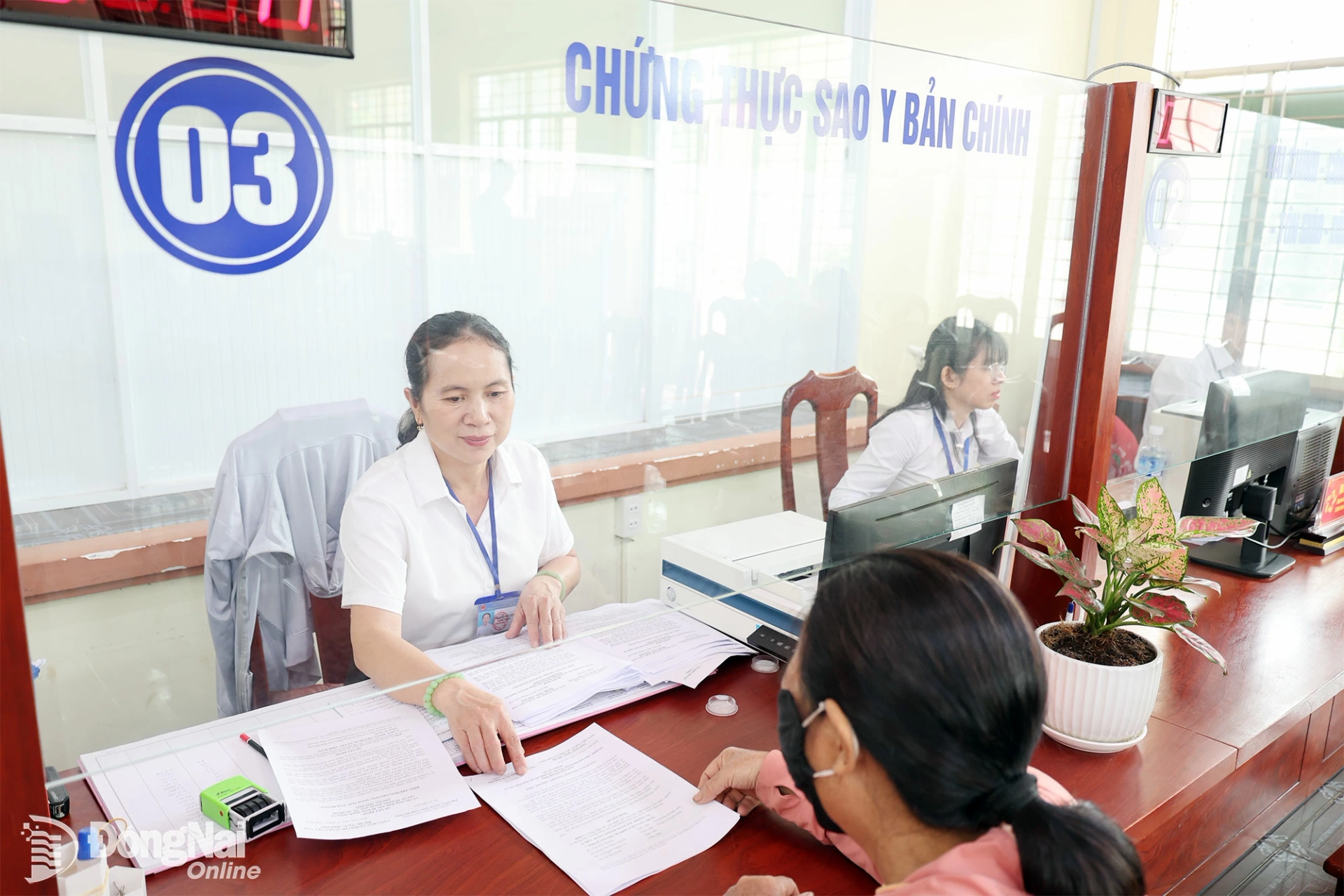 |
| Officials at the Bao Vinh Ward Public Administration Service Center process administrative documents and procedures for residents. Photo: Ho Thao |
For Dong Nai, this also provides a basis for continuing the shift from simply digitizing documents to exploiting and reusing data, thereby reducing paperwork, procedures and the time residents need to spend.
One-stop shop goes beyond simply receiving applications
On August 5, 2026, the Government issued Decree No. 309/2026/ND-CP amending and supplementing a number of provisions of Decree No. 118/2025/ND-CP on the implementation of administrative procedures under the one-stop-shop and interconnected one-stop-shop mechanisms at one-stop-shop divisions and the National Public Service Portal, as amended and supplemented by Decree No. 367/2025/ND-CP.
A key new provision of Decree No. 309 is a clearer definition of the responsibilities of agencies receiving and processing administrative procedures in exploiting data. Accordingly, government agencies are responsible for accessing and using information and data already available in databases to replace components of application dossiers. Organizations and individuals should not be required to provide information that agencies can obtain from publicly available, connected and shared databases. Only when data cannot be accessed due to incidents or disasters, or when the available information is inaccurate, may agencies require applicants to provide additional necessary information or documents.
Data should not merely be stored; it must be connected, accessed and reused. This will mean less paperwork, less form-filling and less travel for residents, while enabling them to handle more procedures on their own.
This regulation represents a significant change in the operation of the one-stop shop mechanism: when information is already available, government agencies must proactively access it instead of continuing to ask residents to provide it again. It also demonstrates that the value of digital transformation goes beyond simply transferring paper documents into an electronic environment. If data has been digitized but residents still have to provide the same information every time they carry out a procedure, the benefits remain limited. Data must be connected and reused to genuinely reduce documentation requirements and administrative steps.
The decree also encourages the installation of smart kiosks at one-stop-shop divisions, public administration service centers and document reception and return points to help residents and businesses access and carry out administrative procedures and online public services. These kiosks are support tools and do not alter the authority or responsibility of agencies and authorized officials in receiving, processing and returning administrative results.
In addition to these two provisions, Decree No. 309 amends several regulations concerning organizational structures and personnel working at one-stop-shop divisions and public administration service centers. It also adds provisions related to processing administrative procedures regardless of administrative boundaries and the application of technology to support document processing.
Thus, the new requirements for the one-stop-shop mechanism are not simply about greater digitization. They also require data to replace part of the paperwork and technology to make public services more convenient for residents.
Making data truly reusable
In Dong Nai, new practices at the grassroots level are gradually changing the way residents access public services.
At many public administration service centers in communes and wards across Dong Nai, smart kiosks, robots and other technology-based support tools have been introduced to serve residents. For those familiar with digital services, kiosks provide greater autonomy in completing procedures; for those who are still unfamiliar with them, officials can provide on-site guidance. This approach also helps reduce the number of tasks officials need to perform on behalf of residents when those tasks can be completed independently.
 |
| Residents receive guidance from youth volunteers on how to use a smart kiosk at the Trang Bom Ward Public Administration Service Center. |
Nguyen Thi Huong, a resident of Trang Bom Ward, said: “The device guides me step by step, so I find it easier to use. If there is anything I don't understand, I can ask the officials.”
At the Minh Hung Ward Public Administration Service Center, Center Director Nguyen Minh Hoa said that alongside receiving and processing applications, officials spend time guiding residents through online procedures, particularly those using digital public services for the first time.
Grassroots experience shows that technology devices and online services are making public services more convenient, allowing officials to shift from completing administrative procedures on behalf of residents to guiding and supporting them. At the same time, for this approach to deliver sustainable results, data among government agencies must be connected, shared and reused.
This is also the direction Dong Nai has identified in Project No. 05-DA/TU, dated July 3, 2026, issued by the Standing Board of the Dong Nai City Party Committee on accelerating administrative reform, with a focus on administrative procedure reform linked to digital transformation and the development of digital government and smart government during 2026-2030.
The project identifies administrative procedure reform as the central task, digital transformation as the breakthrough and data as the foundation. It emphasizes the development of shared databases and stronger connections, data sharing and data exploitation among agencies. By 2030, Dong Nai aims for at least 90% of digitized information and data to be exploited and reused in processing administrative procedures and providing public services. At the same time, 100% of administrative procedure applications and processing results are targeted to be digitized, while processing times are expected to be reduced by at least 30% compared with current regulations.
To achieve these targets, Plan No. 201/KH-UBND, dated July 31, 2026, issued by the city People's Committee to implement the project identifies tasks directly related to data, including standardizing, updating and cleaning data; strengthening connections, data sharing and exploitation among systems; and restructuring administrative procedure processes based on digital data.
The plan also requires clearly defined personnel, tasks, responsibilities, deadlines, outputs and results; stronger inspection and supervision through digital technology; and the linkage of administrative reform and digital transformation performance with the responsibilities of agencies, organizations and their leaders.
These tasks are directly relevant to the implementation of Decree No. 309. Data must be complete and accurate, while being connected and accessible; procedures must be reviewed and simplified; and officials must have the capacity to support residents during the transition. When these conditions are met, the effectiveness of the one-stop-shop mechanism will no longer be measured simply by the number of applications processed electronically. It will also be reflected in whether residents have to provide less information repeatedly, make fewer trips, complete fewer steps and are able to handle more administrative procedures on their own.
By Ho Thao - Translated by Mai Nga, Thu Ha




Thông tin bạn đọc
Đóng Lưu thông tin