
Following the April 30, 2026 milestone, Dong Nai entered a new chapter as a city.
 |
| Residents receive guidance on administrative procedures at Minh Hung ward Public Administration Service Center. |
Five months is not long enough to create a new look for the city, but changes in the way the administrative apparatus operates and the pace of project implementation are becoming increasingly evident. A new spirit is gradually taking shape – one that is more proactive, determined and focused on tangible results.
Creating momentum from the grassroots
On May 18, at Long Hung Square, the National Assembly (NA) resolution on establishing Dong Nai City was officially announced. The city covers more than 12,737sq.km, has a population of about 5 million and comprises 95 commune-level administrative units.
Dong Nai has a vast area with diverse terrain, population distribution and development space, encompassing urban areas, industrial and agricultural zones, border areas and major infrastructure projects that play an important role in inter-regional connectivity. Such a scale requires a more streamlined and efficient administrative apparatus, a more proactive approach and solutions tailored to the realities of each locality.
Speaking at the announcement ceremony, Vu Hong Van, Member of the Party Central Committee, Secretary of the Dong Nai City Party Committee (CPC), affirmed the determination to build Dong Nai into a dynamic, modern, civilized and happy city under the motto "unity from top to bottom, smooth coordination across the system." He stressed the need to build a contingent of officials with strong political will, competence and an innovative spirit who dare to think and act, turning aspirations into action, potential into momentum and advantages into strength for development.
In that spirit, shortly after the establishment of the city, the CPC’s Executive Board issued Resolution No. 05-NQ/TU on May 1, 2026, launching a special 500-day-and-night emulation campaign under the theme "Unity – Discipline – Efficiency – Breakthrough for a civilized and modern Dong Nai”, with the campaign to be maintained and further improved through 2030.
The resolution aims to bring about clear and substantive changes throughout the political system, unlock resources, remove bottlenecks and accelerate key projects, with the goal of achieving double-digit economic growth. The approach is centered on concrete, measurable, controllable and assessable results, with tangible outputs and the satisfaction of residents and businesses serving as key measures of performance.
This spirit is being translated into action during the first months of the city's urban administration, as the two-tier local administration model has gradually stabilized. Clearer decentralization and delegation of authority require the administrative apparatus to act more quickly, respond more closely to local realities and clearly define responsibilities. The city level focuses on coordination, inspection and supervision, while grassroots authorities take the initiative in handling matters within their jurisdictions without delays. The city is also shifting its focus from organizational consolidation to improving operational efficiency, with commune-level administration at the center of service delivery and data and performance serving as key measures.
In Long Thanh ward, which is home to numerous major infrastructure and transport projects, the workload has grown rapidly, along with the need to resolve issues directly at the grassroots level. According to Le Hoang Son, Party Deputy Secretary and Chairman of the People's Committee of Long Thanh ward, greater decentralization and delegation of authority have enabled the ward to address emerging issues more promptly, particularly those related to urban management, infrastructure, planning, land management and key projects. At the same time, the ward has instructed its officials, civil servants and public employees to adopt a work ethic focused on completing tasks rather than counting working hours, with priority given to addressing issues based on the actual needs of the locality.
The city needs not only an administrative apparatus that operates smoothly, but, more importantly, one that delivers clearer results in serving residents and businesses and using public resources effectively. Speaking at the National Conference reviewing one year of the overall organizational model of the political system and the three-tier government model on July 1, Secretary of the CPC Vu Hong Van said the city has focused on three questions as measures of grassroots performance: Are residents receiving faster services? Are businesses spending less time and money completing administrative procedures? And can the State budget reduce recurrent expenditure to free up resources for development investment?
In Loc Hung commune, this approach is being applied in a locality where ethnic minority people account for more than 20% of the population. Nguyen Thi Xuan Linh, Party Deputy Secretary and Chairwoman of the People's Committee of Loc Hung commune, said the commune consistently instructs officials to provide residents with clear and attentive guidance and handle work according to the principles of "clear responsibilities, clear tasks, clear deadlines, clear authority and clear results," with the satisfaction of residents and businesses serving as the measure of service quality.
Across many localities, alongside greater decentralization, flexible approaches are being introduced to bring government closer to the people. Officials make use of weekends to visit residential areas and help residents complete administrative procedures, while local leaders hold meetings and dialogues with residents in the morning before working hours. The digitization of records and wider application of technology are also being accelerated, helping reduce residents' travel and waiting times while making it easier for officials to process their work.
These efforts reflect a principle that is increasingly becoming a regular practice in Dong Nai: grassroots authorities must be more proactive, closer to the people and quicker in resolving issues.
Nguyen Van Son, a resident of Phuoc Tan ward, said Dong Nai’s elevation to city status was not merely a change in name, but was also reflected in the projects under construction and in the way residents interact with government agencies.
"All you have to do is step outside to see the sense of urgency and determination at transport construction sites. When I go to government offices to complete procedures, I also notice that services have become faster and more convenient," Son said.
Creating new development momentum
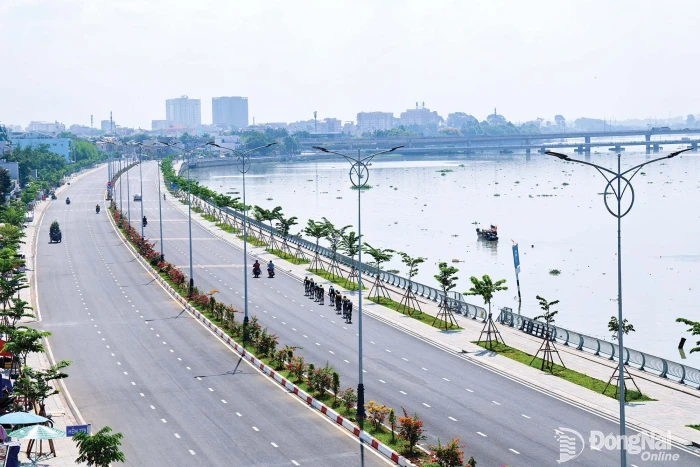
The changes are not limited to the administrative apparatus. In the first months of operating as a new city, Dong Nai has also seen increasingly brisk progress on projects and regional connectivity infrastructure.
In the first 8 months of 2026, Dong Nai's state budget revenue exceeded VND70 trillion, while the city ranked among the localities with the highest public investment disbursement rates nationwide. Across construction sites and areas undergoing site clearance, from the northern to the southern parts of the city, local authorities are working together to resolve obstacles and accelerate progress. Projects including Ho Chi Minh City Ring Road 3, Road 769, the Ben Luc - Long Thanh Expressway and the Bien Hoa - Vung Tau Expressway are being pushed forward and completed, gradually creating stronger links among urban areas, industrial parks, production zones and Long Thanh International Airport.
The transport routes and infrastructure projects being accelerated today will gradually complete the city's connectivity network, creating new momentum and greater development space in the years ahead. To turn these development drivers into tangible results, Dong Nai needs to continue speeding up project implementation, particularly public investment disbursement. At meetings, Nguyen Van Ut, Deputy Secretary of the CPC and Chairman of the City People's Committee, has repeatedly called for stronger direction and concerted measures in the remaining months of the year to accelerate public investment disbursement, especially for key projects. The city is striving to achieve its socio-economic development targets, including double-digit economic growth and state budget revenue of VND150 trillion. Alongside economic development, the city is pursuing more comprehensive urban development by protecting the environment, ensuring social welfare, preserving traditional values and promoting the development of digital government, the digital economy and digital society.
The first months of the new city's operation are only the beginning. Yet, from changes in the administrative apparatus to the pace of infrastructure development, a more proactive and determined Dong Nai is taking shape through concrete actions, projects and results. Much remains to be done, but the momentum generated in these early days is providing fresh impetus for Dong Nai to make further breakthroughs and build an increasingly dynamic, modern and prosperous city.
By H. Thao – Translated by M.Nguyet, Thu Ha


Thông tin bạn đọc
Đóng Lưu thông tin