
As local authorities shift from a governance mindset to a service-oriented approach, a wide range of innovative and people-centered initiatives have been rolled out across communes and wards throughout Dong Nai City. These efforts have helped remove bottlenecks in addressing administrative procedures while reaffirming a fundamental lesson: earning public trust and ensuring their well-being are the bedrock of strong local government.
 |
| From waiting for residents to proactively reaching out to them |
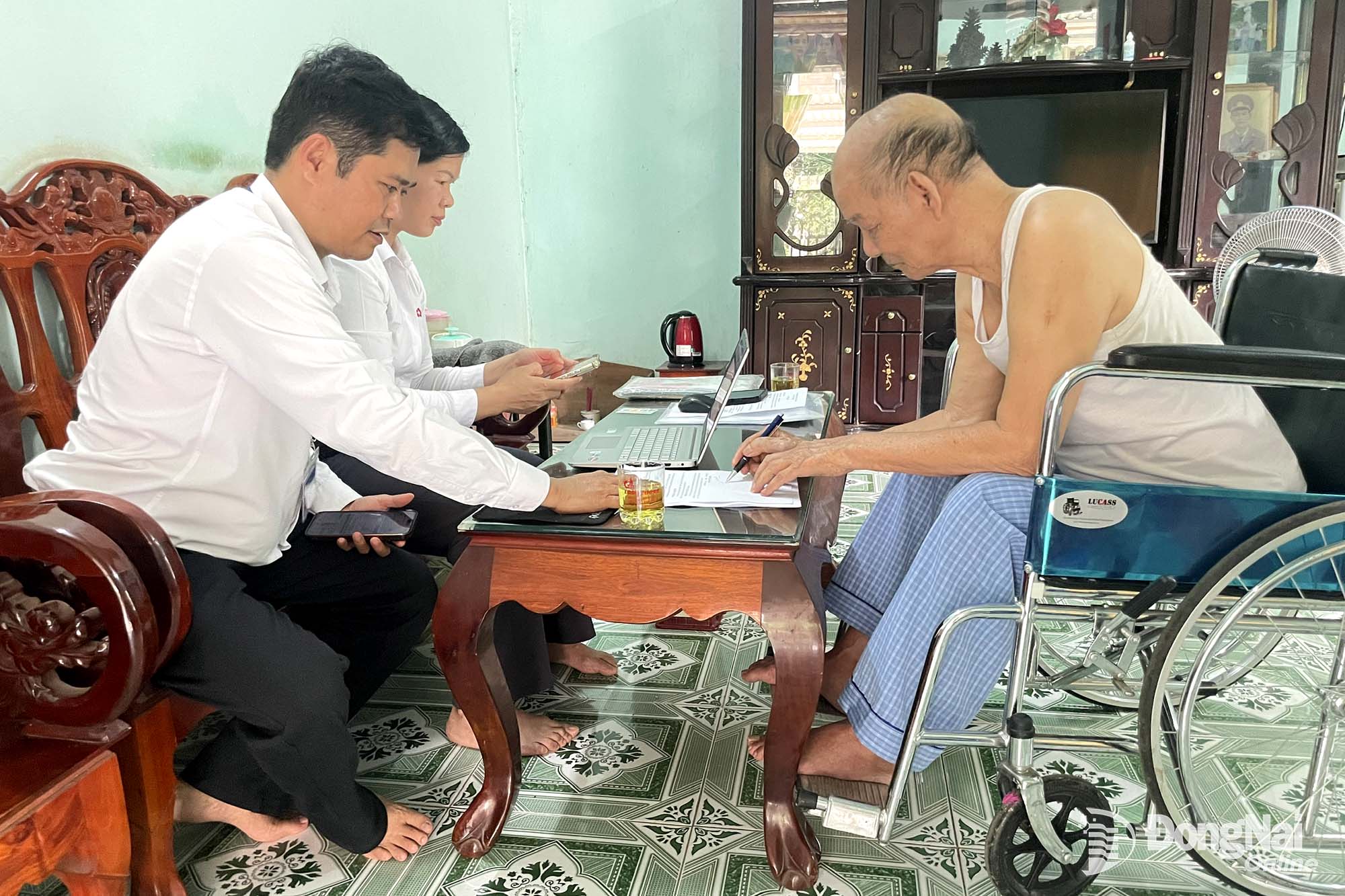
Unable to travel due to poor health but needing to complete a power-of-attorney procedure, Tran Khanh Duat, a resident of Binh Phuoc ward, called the ward's Technology and Professional Support Team for Administrative Procedures (support team). The team immediately assigned an officer in charge of the relevant field to visit his home and provide assistance. “It took only about five minutes to complete my procedure. Although the officers have a heavy workload, I am very pleased that they are willing to come to people's homes to handle administrative procedures. This is exactly the kind of public administration that people expect,” Duat said.
Members of the support team visit the home of an elderly resident who has difficulty traveling to provide assistance with administrative procedures.
The support team was established after the two-tier local government system became operational to provide “services on the spot and support at home” for people who are unable to travel or need assistance with administrative procedures at home.
Doan Thi Nhan, a civil servant at the Binh Phuoc ward Public Administration Service Center (PASC), said: “Our goal is to address any difficulties residents encounter when they need to complete administrative procedures, thereby improving the quality and efficiency of public services. By providing administrative services at people's homes, we also hope to promote digital literacy at the grassroots level.”
The special 500-day-and-night emulation campaign, themed “Solidarity – Discipline – Efficiency – Breakthrough for a civilized and modern Dong Nai,” calls for strong, visible and substantive changes throughout the political system, particularly in discipline, administrative order and public-service accountability. The resolution calls for emulation activities to be conducted in a manner that is “substantive, measurable, monitorable and assessable,” with concrete results, outputs and the satisfaction of residents and businesses serving as key measures. The campaign targets a satisfaction rate of at least 95% and requires 100% of petitions and feedback to be addressed on time with specific outcomes. Results in carrying out assigned tasks will serve as a basis for evaluating and assigning officials.
Nguyen Thai Son, Deputy Director of Binh Phuoc PASC, stressed: “We have moved from ‘waiting for residents’ to proactively reaching out to them. The ward has instilled this service-oriented mindset in every official and civil servant. This is also our goal in building a service-oriented administration that puts people at the center and continues to improve residents' satisfaction with the operation of the two-tier local government system.”
At 6:30 a.m. every day, the Phu Rieng commune People's Committee is already bustling with conversations. Residents freely share their concerns, ranging from orchards and crop prices to village roads, land issues and other matters affecting their livelihoods, while commune leaders listen to them. This is a familiar scene under the “Morning with Residents” model, which has been adopted by Phu Rieng commune and a number of other localities in recent years, creating an open forum for dialogue between local leaders and residents. The initiative aims to build a friendly, responsive administration that listens to residents and promptly addresses their concerns about production and daily life.
Tran Van Thao, Vice Chairman of the Phu Rieng commune People's Committee, said: “Through this model, we not only listen to what residents have to say but also hear their ideas and suggestions. As a result, many issues are addressed immediately after the meetings. For complicated cases, commune leaders assign specific tasks to relevant specialized divisions so that they can be resolved promptly, thereby strengthening people's trust in the grassroots administration.”
When service results become the benchmark
Residents' voices are being heard not only at morning coffee meetings. The Digital Mailbox for Listening to Residents, launched by the Thuan Loi commune People's Committee, has opened up another effective channel of interaction between local authorities and residents.
Following the administrative merger, Thuan Loi commune now covers a larger area and has a bigger population. The commune has therefore adopted various ways to stay informed of residents' concerns and aspirations. Among them is the Digital Mailbox for Listening to Residents, an initiative launched by the communal Vietnam Fatherland Front (VFF) Committee. Fifty QR codes have been installed at most village and hamlet cultural houses, making it easier for residents to submit their opinions. With just a few simple steps on Zalo, including scanning the QR code for the digital mailbox, Le Duy Chien, a resident of Thuan Hoa hamlet in Thuan Loi commune, was able to send photos and feedback about a deteriorating local bridge to commune authorities within minutes. “Residents no longer have to wait for voter meetings or go directly to the commune People's Committee office to voice their concerns as they did before. In particular, urgent issues reported through the system are promptly addressed at the commune's direction, which has won strong support from local residents,” he said.
Vuong Ngoc Toai, Chairman of Thuan Loi communal VFF Committee, said the QR-code system had received numerous reports from residents covering a wide range of issues. After being received, the feedback is compiled, classified and forwarded to relevant divisions and communal leaders. This allows authorities to identify problems arising at the grassroots level earlier, reducing delays in responding to residents and improving the effectiveness of public services.
Across communes and wards, officials and civil servants are shifting from “working until the end of the day” to “finishing the job,” and from “fulfilling their responsibilities” to “seeing tasks through to completion.” The shift from the mindset of “waiting for residents to come to government offices” to one in which “the government proactively serves residents” is being applied flexibly, with the goal of building a digital, smart and transparent public administration.
In Bu Dang, a remote commune with a large ethnic minority population, officials and civil servants not only perform their professional duties but also work directly with residents to help them submit applications through online public services. Initiatives include “Saturdays with Residents,” administrative procedure guidance through the Zalo Official Account (Zalo OA), and a program aimed at ensuring that every household has at least one member proficient in using online public services. The goal goes beyond simply processing administrative procedures quickly. It is also to build a local administration that stays close to residents, respects them and takes responsibility for serving them.
With ethnic minorities accounting for 30% of the commune's population, some residents still have difficulty navigating administrative procedures when visiting government offices. In a small number of cases, residents are even unable to read or write. Staff at the Bu Dang PASC therefore provide not only technological assistance but also help residents write applications, fill in forms and read out the contents of declarations for them to verify.
“Although the workload has increased and each case takes more time, the service mindset remains our top priority. We want every resident who comes here to feel that government services are convenient, accessible and genuinely effective,” said Nguyen Minh Sau, an officer at the Bu Dang PASC.
At present, 100% of administrative dossiers in Bu Dang commune are received and processed through the National Public Service Portal, with results also delivered through the system. The commune's public satisfaction index has reached the highest level, demonstrating the effectiveness of its administrative reform, digital transformation and efforts to improve the quality of public services.
The flexible administrative reform initiatives being implemented by communes and wards in line with their specific conditions have helped Dong Nai rank among the country's leading localities in administrative reform. The synergy between digital technology and the sense of responsibility and dedication of officials and civil servants has provided a solid foundation for the two-tier local government system. At its core is a responsive, people-centered administration that puts public satisfaction first, providing a solid foundation for Dong Nai's continued development on its digital transformation journey.
By N. Ha – Translated by M.Nguyet, Thu Ha




Thông tin bạn đọc
Đóng Lưu thông tin