
Dong Nai is entering a new stage of development, with the goal of becoming a modern, smart and green city offering a high quality of life.
Developing the healthcare system and ensuring social welfare are therefore regarded as important foundations for realizing the objectives set out in Politburo Resolution No. 16-NQ/TW on building and developing Dong Nai City through 2035, with a vision to 2065.
Strengthening healthcare capacity
Director of the Dong Nai Department of Health Do Thi Nguyen said the city's healthcare system is now relatively comprehensive, providing coverage from grassroots and preventive healthcare to specialized medical services. The system includes eight central-level and ministry- and sector-affiliated hospitals and institutes; three provincial general hospitals; three regional general hospitals; five specialized hospitals; six provincial specialized medical centers; 22 regional medical centers; as well as 95 commune-level health stations and 176 affiliated health station points under the management of commune- and ward-level People's Committees.
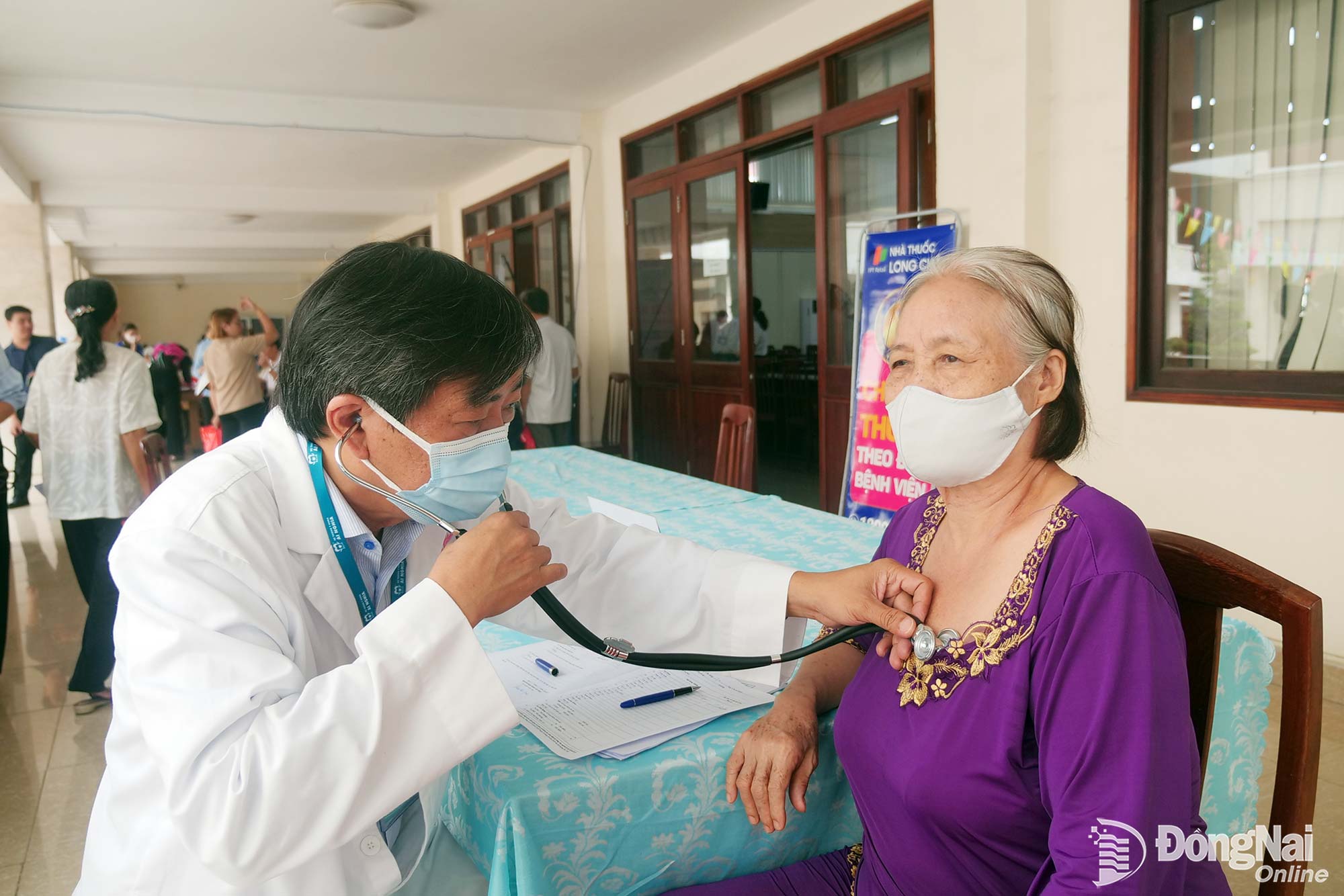 |
| An elderly resident in Tran Bien Ward receives a free health checkup. |
Alongside the public healthcare system, the private healthcare network has continued to expand strongly, with 13 private general and specialized hospitals, 114 private general clinics, more than 2,000 specialized clinics, and more than 4,000 pharmacies, drugstores and other healthcare service facilities.
In 2025, healthcare facilities across the city provided nearly 10 million patient visits, with an overall bed occupancy rate of 70%. Several hospitals recorded occupancy rates of more than 90%, including Dong Nai General Hospital, Thong Nhat General Hospital and Long Khanh Regional General Hospital. A wide range of advanced techniques, including open-heart surgery, endoscopic heart surgery, joint replacement, percutaneous kidney stone removal, endoscopic orthopedic surgery and laparoscopic general surgery, are now routinely performed, giving patients greater access to high-quality treatment locally.
Notably, Dong Nai General Hospital has been recognized as eligible to perform kidney retrieval and transplantation from living and brain-dead donors. The hospital recently signed an agreement to cooperate in implementing in-vitro fertilization (IVF) techniques with the My Duc IVF System under My Duc Hospital in Ho Chi Minh City. This marks an important step toward improving the quality of medical examination and treatment in the city.
“The Department of Health is currently developing a proposal to invest in and upgrade Dong Nai Children's Hospital into Dong Nai City Obstetrics and Pediatrics Hospital, with a capacity of 1,500 beds, for submission to the competent authorities for approval. At the same time, we are developing plans for specialized centers in emergency medicine (115), ear, nose and throat care, cardiology, oncology, stroke care, geriatrics, nephrology and urology, and infectious diseases, among others, under provincial-level general and specialized hospitals,” Director Do Thi Nguyen said.
Social welfare must keep pace with growth
If healthcare is a pillar protecting people's health, social welfare is the “safety net” protecting people against life's risks.
 |
| A doctor at Dong Nai General Hospital examines a patient. Photo: Hanh Dung |
To date, nearly 4.2 million people in Dong Nai are covered by health insurance, representing 93.8% of the population. More than 817,700 of them belong to groups whose health insurance premiums are partially subsidized by the State budget. Pupils and students make up the largest group. They are followed by people from households engaged in agriculture, forestry or fisheries with average living standards; members of grassroots security and public-order protection forces; people from near-poor households; part-time workers in hamlets and residential groups; hamlet health workers; and hamlet midwives, among others.
Director of Dong Nai Social Security Pham Minh Thanh said health insurance support policies have made it easier for vulnerable groups to access healthcare services, helping reduce poverty sustainably, prevent people from falling back into poverty due to medical expenses, and improve their quality of life. This is particularly significant for people with serious or rare diseases who require long-term treatment and face high medical costs. The social security sector is actively coordinating with departments, agencies and localities to implement comprehensive measures toward universal health insurance coverage in the coming period.
Alongside medical examination and treatment, a new challenge for Dong Nai City is the need for a social welfare system that can provide healthcare and improve the quality of life for elderly people. The city currently has nearly 5 million residents, including more than 671,000 elderly people. However, of the 21 social assistance facilities, only one is a non-public facility operating under a modern business model specializing in elderly care. This falls short of the city's needs and development potential.
To address the shortage of elderly care facilities, many communes and wards across the city have recently introduced daytime elderly care services at health stations. The city has also organized a conference calling on businesses to invest in nursing homes in Dong Nai.
Member of the City Party Committee’s Standing Board, Vice Chairman of the Dong Nai City People's Committee Le Truong Son emphasized that Dong Nai encourages the development of professionally planned elderly care facilities of appropriate scale to meet long-term demand. At the same time, the city will promote a variety of small- and medium-sized models to make such services more accessible to residents.
The Dong Nai Department of Health is reviewing and considering the dissolution or merger of regional medical centers and affiliated units that are operating ineffectively. It will also transfer all functions and responsibilities, medical equipment, finances, assets and remaining preventive-health personnel from regional medical centers, along with some other personnel from regional medical centers and healthcare facilities, to commune-level health stations. The transfer is expected to be completed no later than December 31, 2026.
The city will study ways to make use of surplus public facilities and offices left after the administrative reorganization, converting and repurposing them appropriately for healthcare and elderly care services. In addition, the city plans to develop elderly healthcare services in combination with resort and tourism activities, creating professional and diverse models suited to people's increasingly sophisticated needs.
The city will also strengthen connections between investors and departments, agencies, communes and wards, providing support during surveys, the completion of administrative procedures and the resolution of difficulties within its authority. The goal is to gradually establish a comprehensive and professional elderly care system in line with Dong Nai City's development orientation in the years ahead.
By Hanh Dung - Translated by Mai Nga, Thu Ha

Thông tin bạn đọc
Đóng Lưu thông tin