
Part 2: When radiation becomes a “weapon” against cancer
Nuclear energy is not only helping doctors detect lesions inside patients’ bodies but is also being increasingly applied in cancer treatment.
From linear accelerators and advanced radiation therapy techniques to nuclear medicine, radiation is being used in increasingly personalized approaches to achieve greater precision and effectiveness.
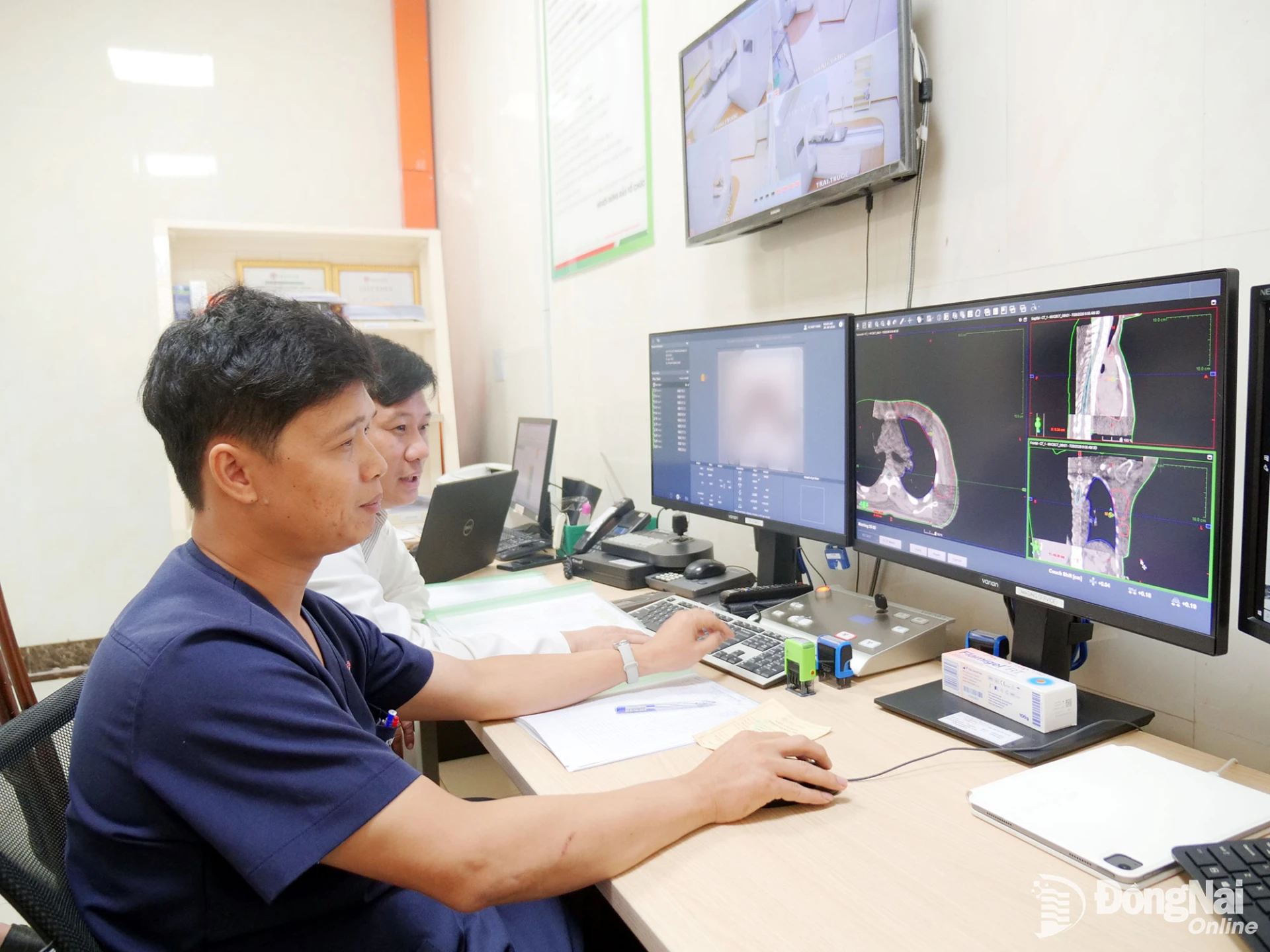 |
| Doctors and technicians at University Medical Shing Mark Hospital monitor radiation therapy for a cancer patient. |
Using radiation to treat tumors
Cancer is no longer treated with a single method. Depending on the type, location and stage of cancer and the patient’s overall health, treatment may involve surgery, chemotherapy, radiation therapy or a combination of these with targeted therapy, immunotherapy, hormone therapy and other approaches.
Within this multimodal treatment approach, radiation therapy plays an important role. Instead of using surgery to remove tumors or administering drugs throughout the body, radiation therapy uses high-energy radiation to target cancer cells in order to control or destroy tumors.
In principle, radiation can damage the DNA of cells. When the damage is severe enough and cannot be repaired, cancer cells lose their ability to divide or die. However, the greatest challenge of radiation therapy is not simply destroying the tumor, but delivering a sufficient dose of radiation to the treatment area while minimizing exposure to healthy organs.
Dr. Duong Thanh Tai, who is in charge of clinical affairs at the Abben Cancer Center of Spencer Hospital in the United States and is a specialist in medical physics and radiation therapy, said CT (computed tomography), MRI (magnetic resonance imaging), PET (positron emission tomography) and advanced radiation therapy techniques help determine the treatment area more precisely. This enables radiation beams to be directed from multiple angles to “hit” the tumor.
Dr. Tran Trung Kien, a Level II specialist and Head of the Department of Oncology at University Medical Shing Mark Hospital, said the hospital is using a linear accelerator system for cancer treatment. It is also applying advanced radiotherapy techniques such as volumetric modulated arc therapy, intensity-modulated radiation therapy, stereotactic body radiation therapy and radiosurgery, which help deliver radiation on lesions with greater precision.
According to Dr. Tran Trung Kien, radiation therapy can be used at various stages of cancer. In the early stages, it can be used to control or destroy tumors. When the disease has progressed locally, radiation therapy can be combined with chemotherapy or other treatments. At an advanced stage, it can help relieve pain and pressure, reduce discomfort and improve patients’ quality of life. Overall, radiation therapy can be used in approximately 70–80% of cancer treatment cases.
A precise “battle” at the cellular level
N.T.T., a resident of Phuoc Tan Ward, was diagnosed with colon cancer and prescribed 28 sessions of radiation. After 26 sessions, she said the treatment process had been relatively gentle and painless, contrary to what many people fear. During treatment, she experienced only some temporary side effects, such as nausea and dizziness, which quickly subsided and disappeared after a few days.
Dr. Tran Trung Kien added that helping cancer patients quickly reduce the side effects of radiation therapy requires a whole team working behind the scenes, including doctors, medical physicists, technicians and other relevant personnel to develop and carefully implement a detailed treatment plan. Doctors will determine the type of cancer, tumor location and stage, treatment area and total radiation dose. Medical physicists use treatment-planning systems to calculate and optimize dose distribution, assess doses delivered to healthy organs and verify whether the treatment machine can accurately carry out the plan.
Dr. Duong Thanh Tai explained that the core challenge of radiation therapy is ensuring that the tumor receives the required dose while surrounding healthy tissues receive the lowest possible dose. Therefore, before a machine is put into operation, numerous parameters must be checked and calibrated. Complex treatment plans can also undergo independent verification before treatment begins. This is particularly important when tumors are located near vital organs. The more accurately the location, shape and extent of a lesion can be determined, the more effectively the medical team can optimize the treatment plan, with the goal of controlling the disease while protecting healthy tissues.
Radiation-based approaches to cancer treatment include external beam radiation therapy, in which a linear accelerator outside the body produces high-energy beams directed at the tumor. Modern techniques allow radiation beams to be delivered from multiple angles and dose distribution to be optimized; radiopharmaceutical therapy, in which radioactive substances are administered orally or by injection and accumulate in specific organs or tissues for diagnosis or treatment; and targeted radionuclide therapy, in which radiopharmaceuticals are designed to recognize specific biological characteristics of cancer cells and deliver radiation close to the target inside the body.
When “radiopharmaceuticals” seek out tumors
While external beam radiation therapy directs X-rays from outside the body toward a tumor, nuclear medicine takes a different approach by introducing radiopharmaceuticals into the body. These substances can be administered orally or by injection and can accumulate in organs and tissues with specific characteristics, serving diagnostic or therapeutic purposes.
Kim Ngoc Si Ha, Specialist Level II Doctor, Head of the Department of Oncology and Nuclear Medicine at Dong Nai General Hospital, said the hospital is treating differentiated thyroid cancer with I-131 (radioactive iodine-131). This nuclear medicine treatment method uses radioactive iodine I-131 to destroy remaining thyroid cells or thyroid cancer cells that can absorb iodine. Once introduced into the body, I-131 behaves similarly to ordinary iodine and is therefore absorbed by thyroid cells. The beta radiation emitted by I-131 acts locally to destroy thyroid cells and cancer cells.
Nuclear medicine is also opening up another promising area that is targeted radionuclide therapy. According to Dr. Duong Thanh Tai, unlike external beam radiation therapy, targeted radionuclide therapy introduces radiopharmaceuticals into the body. These substances are designed to recognize specific biological characteristics of cancer cells and act as a “delivery vehicle,” carrying radiation close to the target inside the body. This represents an important development because the goal is not only to deliver radiation to a tumor but also to deliver the appropriate type of radiation to the right biological target.
Dr. Duong Thanh Tai added that another area receiving increasing attention in cancer treatment is personalized dosing. Even when patients have the same type of cancer, tumor location and size and the condition of healthy organs can vary from person to person. Therefore, administering the same amount of a radiopharmaceutical does not necessarily mean that every patient will receive the same radiation dose delivered to the tumor or healthy organs.
According to Nguyen Van Binh, Specialist Level II Doctor and Deputy Director of the Department of Health, Dong Nai City currently has two hospitals capable of providing radiation therapy and applying nuclear medicine to treat cancer, including Dong Nai General Hospital and University Medical Shing Mark Hospital. Dong Nai General Hospital, in particular, has established itself as a leading provincial-level center for nuclear medicine and is among the few provincial general hospitals nationwide with two specialized departments: Oncology and Oncology–Nuclear Medicine. As a result, many cancer patients can receive treatment locally without having to travel long distances.
By Hanh Dung - Translated by Mai Nga, Thu Ha

Thông tin bạn đọc
Đóng Lưu thông tin