
To achieve its goal of ensuring that 100% of residents across Dong Nai City receive at least one free periodic health checkup or screening by the end of 2026, the Dong Nai City Party Committee has issued Official Letter No. 2283-CV/TU, dated August 30, 2026, calling for accelerated implementation of periodic health checkups, free health screening, and the establishment of electronic health records for residents. The program is also intended to gradually enable lifelong health management and monitoring, with examination results updated in electronic health records and the Electronic Health Book on the VNeID application.
 |
| Medical staff from the Loc Quang Commune Health Station provide free at-home health checkups for elderly residents with limited mobility. Photo: Thi Tran |
To date, more than 2.3 million residents across Dong Nai City have received periodic health checkups or free health screenings, including health examinations and treatment covered by health insurance, representing 51.3% of the city's total population. Of these, more than 536,800 people have had their Electronic Health Books created or updated.
The official letter notes that the implementation of the universal health checkup program continues to face a number of challenges. Some residents do not yet fully understand the program's purpose and significance, while elderly people and those with illnesses in remote and isolated areas face difficulties traveling to healthcare facilities. Many commune and ward health stations also lack sufficient doctors and support staff. Information technology infrastructure, connectivity, and data integration among agencies remain inconsistent. Some localities have also encountered difficulties in identifying eligible groups, preparing budget estimates, and managing and using funding. In addition, there are no uniform criteria for determining whether residents have completed their health checkups, nor are there clear regulations on how results from previous health examinations and tests should be carried forward.
 |
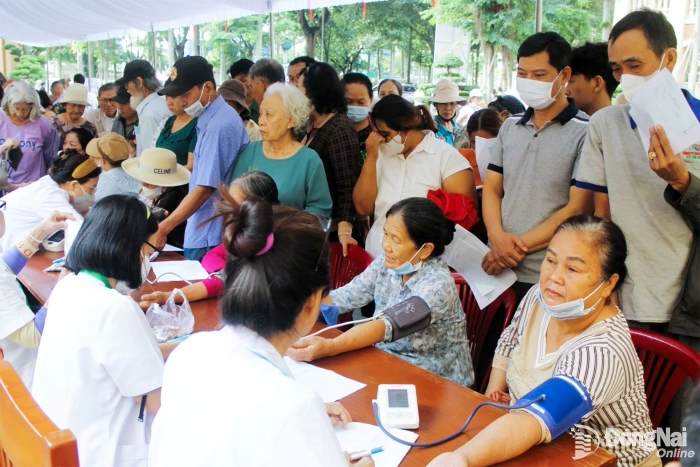
| Residents receive eye examinations and other specialist checkups during the citywide free health screening campaign. Photo: H. Dung |
The Standing Board of the Dong Nai City Party Committee has instructed Party committees and local authorities at all levels to continue fully implementing the targets, indicators, and schedules set out under the program. They are also required to conduct substantive reviews of results and classify implementation progress by locality, agency, unit, and target group so that timely support can be provided to areas where implementation is lagging.
Particular attention must be paid to groups that are more likely to be overlooked, including elderly people, people with disabilities, people with meritorious services to the revolution, poor and near-poor households, children, school and university students, factory workers, employees, temporary residents, informal workers, and other high-risk groups. Implementation must ensure that no eligible person is left out, no person is counted more than once, and no funding source is duplicated. Reported figures must also be consistent with actual lists and data.
The City Party Committee has also called for proactive efforts to address difficulties involving human resources, funding, facilities, medical equipment, information technology, and data connectivity and integration. Resources should be coordinated among localities and healthcare facilities to prevent prolonged obstacles from affecting overall progress. The program is regarded as an important, urgent, and ongoing political task. Accordingly, heads of Party committees, authorities, agencies, and units are directly responsible for the progress and quality of implementation within their assigned areas. They are also required to strengthen inspection and oversight to ensure that free health checkups and screenings are conducted openly and transparently, reach the right target groups, and are practical and effective, while avoiding perfunctory implementation and waste.
Party committees directly under the Dong Nai City Party Committee have been instructed to exercise strong and coordinated leadership and direction, overcoming complacency, dependence on others, and the practice of leaving the task entirely to the health sector. Heads of Party committees, authorities, agencies, and units are responsible for the progress, quality, and organization of implementation within their respective areas.
 |
| Elderly residents receive health checkups in Dong Xoai Ward. |
The Dong Nai City Party Committee has instructed its Information, Education and Mass Mobilization Commission to strengthen public communications on the purpose, significance, and benefits of periodic health checkups and free screening, emphasizing the principle that prevention is better than cure, as well as the importance of proactive healthcare and early disease detection to enable timely medical advice and treatment.
The Vietnam Fatherland Front Committee of Dong Nai City and socio-political organizations have also been asked to step up communications and encourage their members and the public to participate. Particular attention should be given to supporting elderly people, people with disabilities, vulnerable groups, poor and near-poor households, people with meritorious service to the country, factory workers, employees, and other high-risk groups.
Notably, the City Party Committee has called for stronger oversight of the management and use of funding to ensure that health checkups are provided to the right beneficiaries in an open, transparent, convenient, and effective manner. Any signs of formalistic implementation, inconvenience to residents, waste, or failure to reach eligible people must be promptly reported and addressed.
 |
| Doctors provide health checkups for children in Tri An Ward. |
Dong Nai Newspaper and Radio, Television is responsible for producing regular news reports, articles, features, talk shows, video clips, and multimedia products to promote the program. Coverage should highlight implementation progress and results in communes and wards, and showcase effective models and practices. Particular emphasis should be placed on mobile health checkups conducted in residential areas, workers’ rental housing complexes, industrial parks, schools, and other densely populated areas.
By Hanh Dung – Translated by Mai Nga, Minho

Thông tin bạn đọc
Đóng Lưu thông tin