
PART 2:
A SMART ECOSYSTEM CONNECTING INDUSTRIAL INFRASTRUCTURE AND SERVICES
Dong Nai is entering a new phase of growth, focusing on high-tech industries and modern services supported by its established industrial infrastructure. The upcoming operation of Long Thanh International Airport is expected to further strengthen the city's development potential.
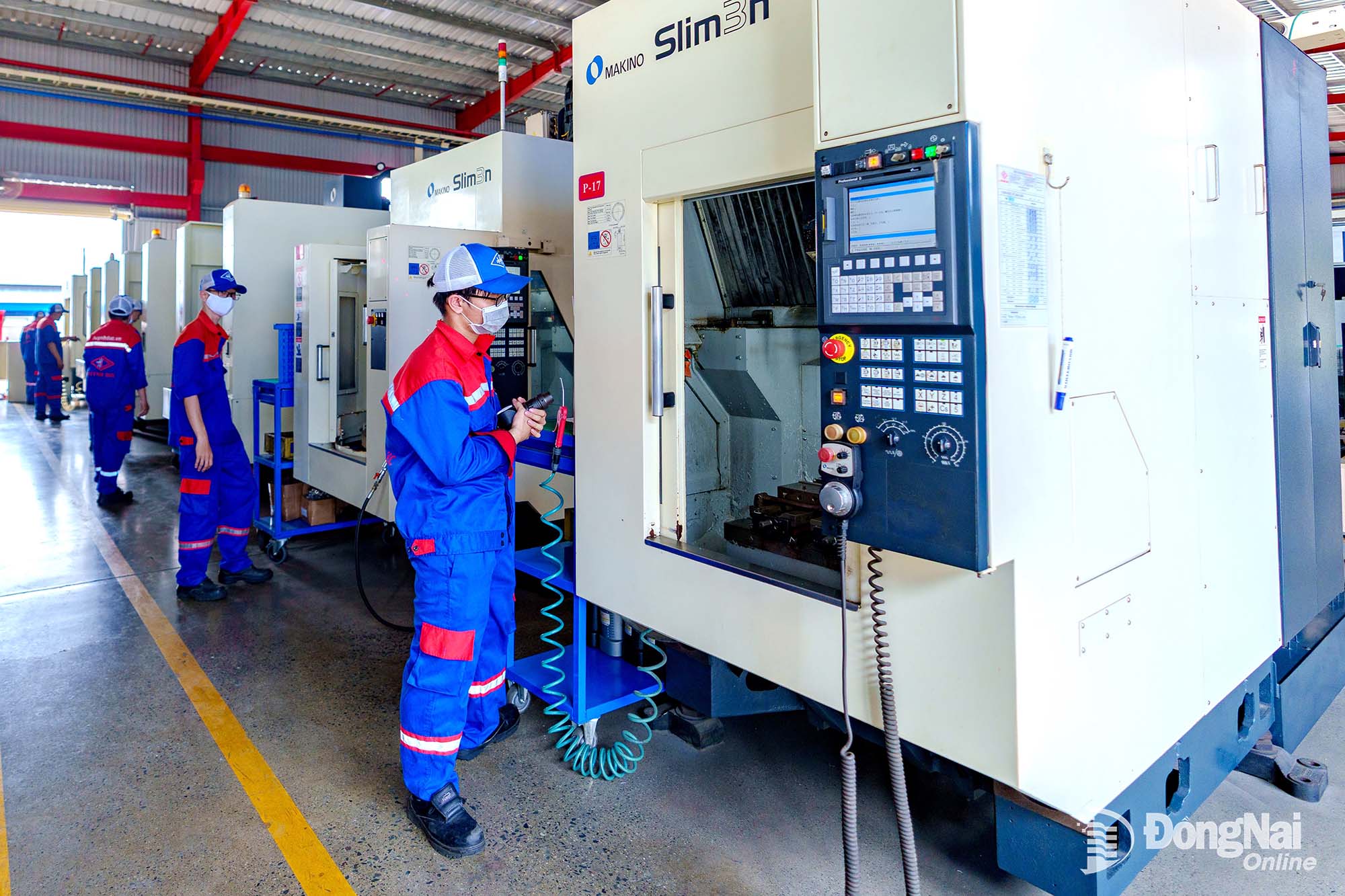 |
| Workers at a factory in Amata Industrial Park. |
Industrial development is about more than expanding factories and industrial parks (IPs). It requires coordinated infrastructure linking production, logistics and support services into an integrated system. Such connectivity can help businesses cut costs, improve operational efficiency and respond more effectively to evolving supply chain demands.
Transforming IPs into smart and eco-parks
Pham Viet Phuong, Deputy Head in charge of the Dong Nai Industrial and Economic Zones Authority, said the Southern key economic region was undergoing major economic restructuring. As the shift towards greener development gathers pace and environmental, social and governance (ESG) standards become more demanding, businesses must adapt to become more deeply integrated into global value chains. Those failing to meet the requirements risk losing their place in global supply chains.
IP development, therefore, must go beyond site preparation and production infrastructure. It should also take into account resource use, emissions reduction, operational management and service connectivity. This provides a basis for Dong Nai to transform existing IPs into green, smart and eco-parks.
Experts say that linking industrial infrastructure with support services requires not only digitalisation within individual businesses but also closer coordination across supply chains. Better information sharing on cargo, vehicles and delivery schedules would improve transport efficiency and make better use of existing infrastructure.
Dong Nai needs to accelerate the transition of existing IPs towards eco-industrial model, upgrade infrastructure and strengthen links between manufacturing, logistics, energy and support services. Integrating these elements more effectively would help businesses lower costs while enhancing the role of the city's industrial park network in regional and global supply chains.
Amata is among the IPs in Dong Nai transitioning towards an eco-industrial model. The park has adopted cleaner production practices, improved resource efficiency and introduced measures to reduce emissions. It currently meets 86% of the criteria set out in the international eco-IP framework. These improvements also deliver direct economic benefits to businesses, as more efficient use of electricity, water and raw materials helps lower production costs.
Drawing on the experience of Amata, Dong Nai is stepping up efforts to transform other IPs. In February 2026, the city issued Plan No. 76/KH-UBND, setting out a roadmap to convert existing IPs into green and eco-parks by 2030, with a vision towards 2050. The plan allows each IP to pursue the transition in line with its specific conditions and development potential.
Speaking at the Smart and Eco-IP Development Forum held in the city in late July 2026, Nguyen Kim Long, Standing Vice Chairman of the City People's Committee, said the shift towards greener development, sustainability and lower emissions was becoming increasingly urgent. He stressed that developing smart and eco-IPs was not merely a matter of meeting environmental standards, but also of modernising production, conserving resources, reducing costs, raising productivity and improving businesses' competitiveness in global supply chains.
Connecting manufacturing with logistics, energy and services
Dong Nai is well positioned to develop integrated industrial models that link production infrastructure with energy, logistics, technology and business support services.
Nguyen Tuan Anh, Deputy General Director of KN Holdings, said the group was developing two major IPs, including Bau Can – Tan Hiep and Xuan Que – Song Nhan. The projects are designed to integrate production infrastructure with energy systems, logistics, digital infrastructure, advanced management technologies and investor support services. Their planned facilities also include renewable energy systems, battery energy storage, resource management solutions, and water treatment and reuse systems.
For existing IPs, the transformation process is also underway. Nguyen Cong Dinh, General Director of Ho Nai IP Joint Stock Company (JSC), said the company was investing in infrastructure for the park's second development phase and exploring new locations with strong demand for industrial land and potential to attract investment. It is also upgrading essential infrastructure and facilities to meet businesses' needs, including transport networks, electricity and water supply, and waste treatment systems.
Within the industrial ecosystem, logistics provides the vital link between factories and markets. Long Thanh International Airport, Phuoc An Port and the network of interregional expressways are creating favourable conditions for Dong Nai to expand its transport, warehousing and freight forwarding services. However, the effectiveness of this infrastructure will depend on the actual connections between IPs, seaports, logistics centres and different modes of transport.
At Phuoc An Port, it is also accelerating digital transformation in its management and operations. Truong Hoang Hai, General Director of Phuoc An Port Petroleum Investment and Exploitation Joint Stock Company, said the company had invested in information technology infrastructure, a data centre and sector-specific management software. It is also gradually digitising operational procedures, records and data. These measures are expected to improve operational efficiency and transparency, reduce processing times and make port services more convenient for customers and partners, while enhancing Dong Nai's appeal to businesses and investors.
Ho Sy Hung, Chairman of the Vietnam Chamber of Commerce and Industry (VCCI): Strengthening regional linkages to expand supply chains and industrial services
Developing smart and eco-IPs is not only a way to reduce pollution and conserve resources, but also an important means of enhancing competitiveness and attracting new-generation foreign direct investment (FDI). However, progress in developing eco-IPs in Vietnam remains constrained by high initial investment costs, limited policy incentives and access to green financing, as well as insufficient cooperation and resource sharing among businesses.
Addressing these challenges requires coordinated action on institutional reform, policy development, infrastructure and technology. Stronger cooperation among IPs is also essential to building integrated value chains covering raw material sourcing, manufacturing, logistics and product distribution.
Dong Nai has a solid industrial base and an extensive network of IPs. Their transition towards eco-industrial and smart models should go hand in hand with infrastructure upgrades, more efficient use of energy, water and other resources, and closer cooperation among businesses. The city should also step up investment promotion while prioritising financially capable investors with strong management expertise and a long-term commitment to development. At the same time, regional cooperation should be leveraged to expand supply chains and industrial services.
Nguyen Duc Hien, Deputy Head of the Party Central Committee's Commission for Policies and Strategies: A strong shift towards a new-generation industrial development model
The development of IPs should move beyond the traditional model of concentrating factories towards integrated ecosystems that bring together manufacturing, services and urban development. Their performance should be assessed based on resource-use efficiency, supply chain integration, technological capabilities and value creation. This shift is central to Dong Nai's efforts to reshape its industrial development model.
The transition needs to be implemented through four groups of coordinated solutions. First, institutional reforms and improved spatial planning should lay the groundwork for restructuring IPs, strengthening regional connectivity and developing circular production models. Second, IP management should be modernised through data-driven governance, artificial intelligence and smart technologies. Third, investment policies should shift from prioritising the number of projects towards attracting high-quality investments that use appropriate technologies and offer greater potential for value creation.
Key requirements include integrating data systems, adopting clean technologies and resource-efficient solutions, and accelerating the digital transformation of IP infrastructure management. Businesses should also incorporate Vietnamese and international standards into their production processes. Together, these requirements will provide a basis for Dong Nai to pursue industrial development that is efficient, modern and sustainable.
By V. The, V.Gia – Translated by M.Nguyet, Thu Ha
Part 1: Developing smart cities through data-driven governance
Thông tin bạn đọc
Đóng Lưu thông tin