
Dong Nai has favorable conditions for developing commercial agriculture, with diverse raw material areas and a wide range of agricultural products. Stronger cooperation between farmers and businesses is essential to increasing product value and expanding markets.
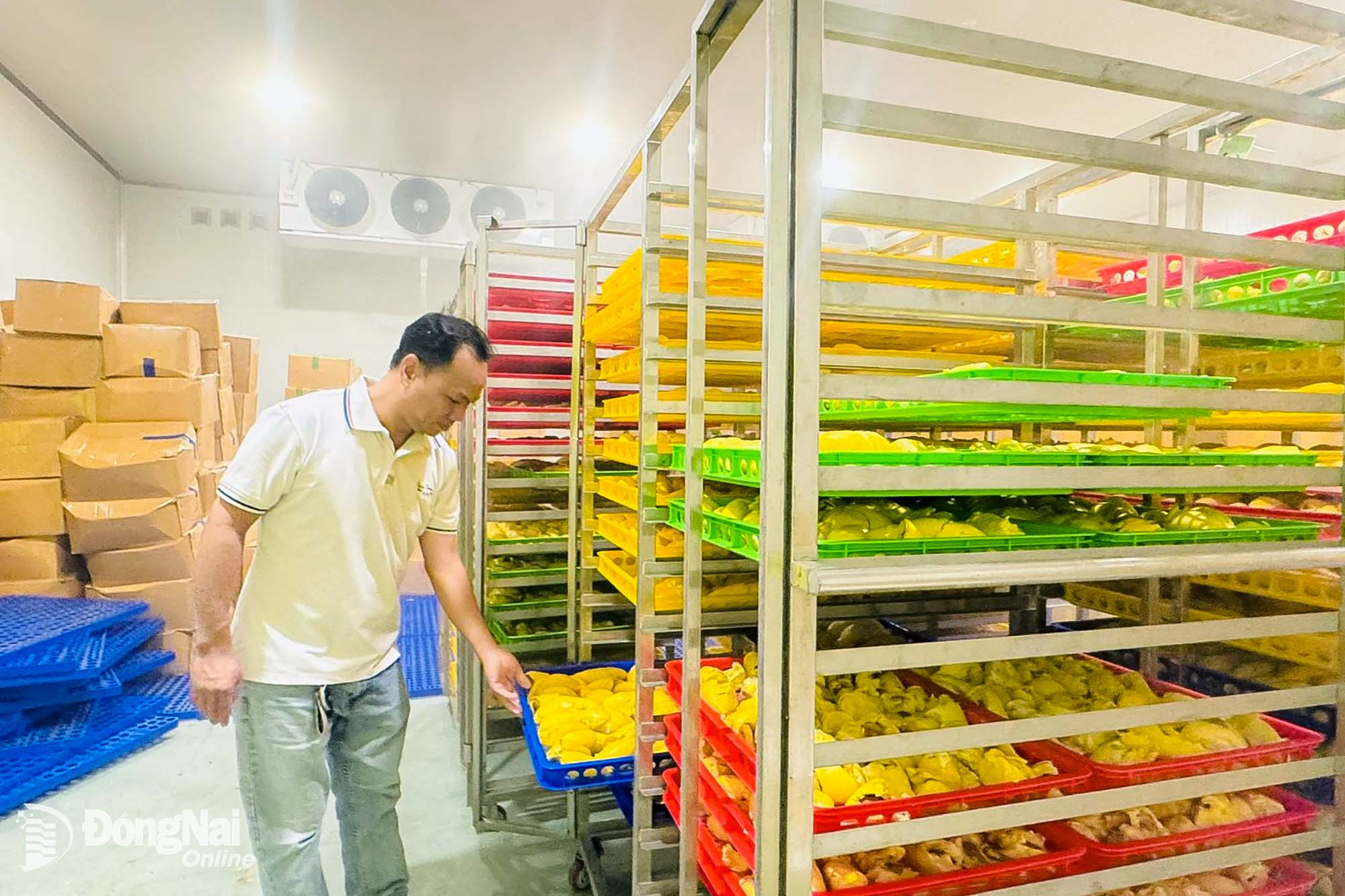 |
| Truong A Vung, Director of Toan Thang Fruit Co., Ltd. in Xuan Dong commune, inspects the freezing of fruit products for export. |
Closer cooperation between farmers and businesses will help make Dong Nai’s agricultural development more sustainable and increase the value of its products.
Favorable conditions for commercial agriculture
According to the Dong Nai City Farmers’ Association (DNFA), Dong Nai has favorable conditions for commercial agriculture, including diverse natural resources, a wide variety of crops and livestock, and an established production and processing base. Many production areas have begun applying scientific and technological advances, obtaining codes for growing areas and standardizing packing facilities to meet domestic and export market requirements. These efforts are helping lay the groundwork for developing aw material areas, forging partnerships with businesses, and expanding preliminary processing, preservation and deep processing.
Truong A Vung, Director of Toan Thang Fruit Co., Ltd. in Xuan Dong commune, said the company was developing a value chain connecting raw material areas with its fruit processing, freezing and export operations.
Major export markets, including China, the United States and Australia, have stringent requirements for hygiene and food safety, as well as strict limits on pesticide residues. To meet these requirements, the company has continued to upgrade its preliminary processing and freezing facilities in line with ISO standards. However, the supply chain can only operate effectively with close cooperation from farmers, particularly in controlling pesticide residues from the cultivation stage. Consistent production processes and quality standards are essential to ensuring that agricultural products meet export requirements and remain competitive in international markets.
Speaking at a ceremony in October 2026 marking the 96th anniversary of the Vietnam Farmers’ Union, Huynh Thi Hang, Deputy Secretary of the Dong Nai City Party Committee and Chairwoman of the city's Vietnam Fatherland Front Committee, urged farmers’ associations at all levels to promote cooperation among farmers, cooperatives, businesses, scientists, processing facilities and distribution networks. She also called for the development of suitable production areas, wider adoption of quality standards and traceability systems, stricter compliance with food safety requirements, and the establishment of stable supply chains.
Liu Thi Yen, Chief Executive Officer of Thuan Huong Production Trading Co., Ltd. in Thong Nhat commune, said the company had spent 16 years producing high-quality dried fruit and introducing Vietnamese fruit products to consumers.
To secure a steady supply of raw materials, the company works with farmers and orchard owners to source and process fruit. The arrangement gives growers a stable market for their produce while adding value through processing.
On the use of digital platforms, Yen said online sales and livestreaming were no longer as profitable as they once were, partly due to rising costs. However, businesses should continue investing in these channels to promote their brands and showcase their products. She added that her company could draw on its experience to help farmers promote their products online.
Bridging gap between farmers and businesses
Beyond connecting buyers and suppliers, organizations and businesses are proposing measures to help farmers access markets, adopt new technologies and participate in trade promotion activities. They are also looking to develop agricultural tourism models, opening up further opportunities for cooperation between businesses, production areas and cooperatives.
Dang Van Diem, Chairman of the Dong Nai City Business Federation, said the first step in connecting farmers with businesses was for the Farmers’ Association to provide information on producers, types of agricultural products, output volumes and production locations. Based on this information, the federation would share relevant details with its members and affiliated businesses to help them identify potential partners and establish business connections.
In addition to connecting businesses with raw material areas with businesses that purchase their products, the federation will work with relevant parties to select suitable production, processing and sales models, introduce these models and provide support to help the parties actively seek opportunities for cooperation. In agricultural tourism, promising models will be connected with tourism businesses to combine sightseeing and hands-on experiences with the promotion and sale of local products.
Echoing this view, Dang Quoc Nghi, Chairman of the Dong Nai Young Entrepreneurs Association, said many of the association’s members operated in the agricultural sector. Cooperation with the Farmers’ Association would give businesses opportunities to gain access to raw material areas, expand their markets and establish new partnerships.
According to Nghi, proposed cooperation activities should be discussed in detail and carried out under a clear implementation plan to ensure practical benefits for both sides. In addition to supporting business development, these partnerships should help farmers secure better prices for their products.
“We will also discuss ways for businesses to do more than simply connect farmers with buyers by supporting the application of technology in agricultural production,” he said.
Do Phuoc Dung, Vice Chairman of the DNFA, said the association would encourage members to move away from fragmented, small-scale production and adopt a more market-oriented approach to agriculture. This would involve organizing production to meet market demand, aligning planting schedules accordingly, and gradually adopting safe farming practices and quality standards.
One of the association’s key tasks will be to coordinate the review and assessment of major agricultural products, concentrated production areas, planting schedules, output volumes, quality standards, and the supply capacity of cooperatives, cooperative groups and farming households. This information will serve as a basis for connecting producers with businesses seeking to purchase, process and distribute agricultural products or invest in market development. The association will also encourage farmers and cooperatives to establish clear, transparent agreements with businesses while expanding links with retail networks, supermarkets and e-commerce platforms.
The association will also connect farmers and cooperatives with experts, entrepreneurs and businesses to help improve production management, apply science and technology, develop brands, accelerate digital transformation and expand markets.
Through closer coordination among business associations and the active role of farmers’ associations at all levels, stronger partnerships between farmers and businesses are expected to open up more market opportunities and add greater value to Dong Nai’s agricultural products.
By P.Hue – Translated by M.Nguyet, Minho



Thông tin bạn đọc
Đóng Lưu thông tin