
After nearly 10 years of implementing the 2017 Law on Support for Small and Medium-Sized Enterprises (SMEs), numerous policies have been introduced to help businesses access support and mobilize resources for development. However, the business community still faces many difficulties related to production premises, technology and markets.
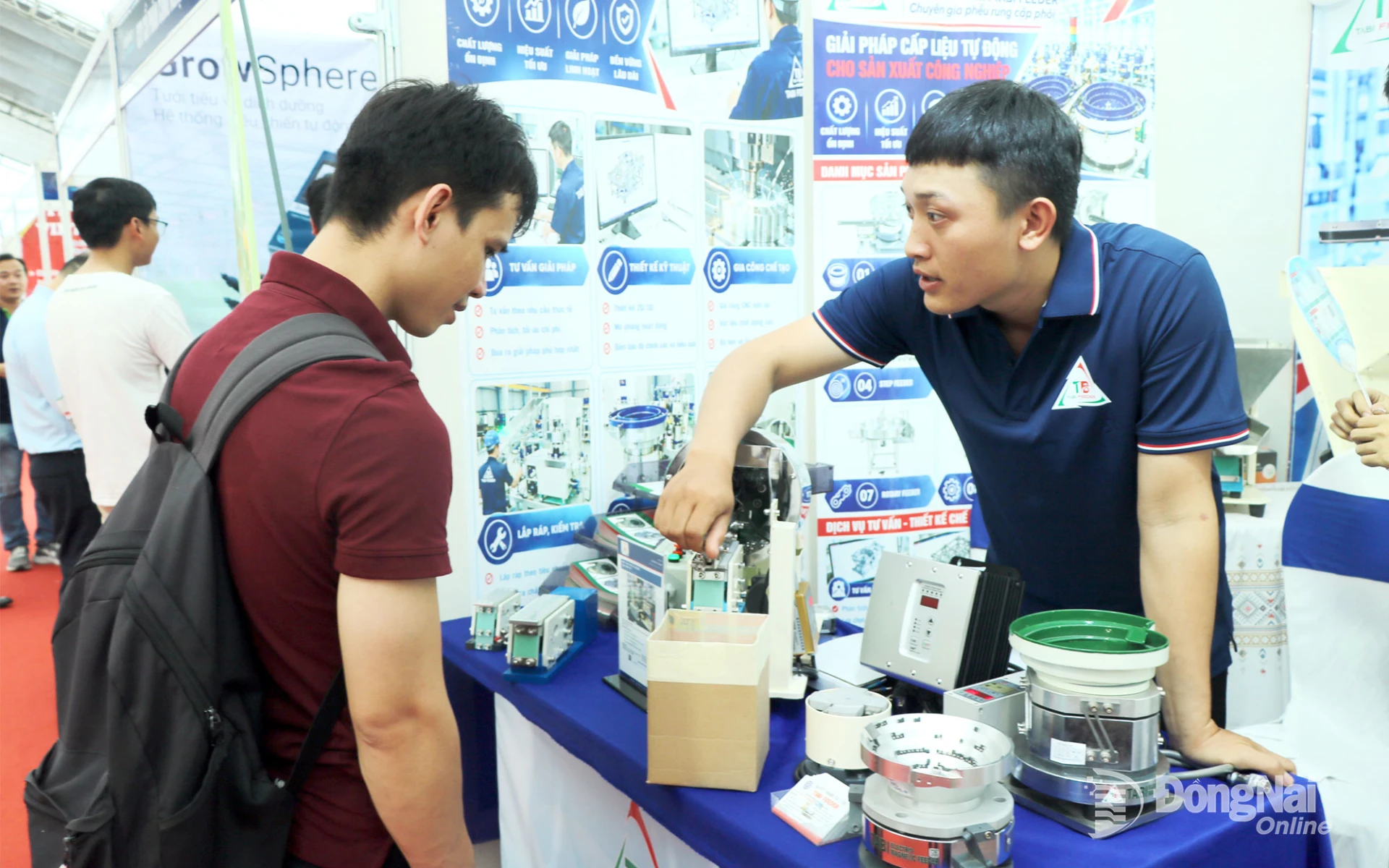 |
| An employee of Tabi Feeder Co., Ltd. (Tran Bien Ward) introduces the company's products at the DIGIFEST Dong Nai 2026 Exhibition. |
As Vietnam strives for high and sustainable economic growth, with the private sector positioned as the most important driving force, the National Assembly's discussion of the draft Law on the Development of Small and Medium-Sized Enterprises is raising high expectations among the business community.
Removing practical obstacles
More than 90% of businesses in Viet Nam are small and medium-sized enterprises, operating in almost every industry and sector. From manufacturing facilities in industrial parks and clusters to service providers, transport companies and trading businesses, this sector contributes to job creation and sustains the operations of many production chains. However, small scale also means limited capital, a constrained workforce and relatively low resilience to market fluctuations.
The 2017 Law on Support for Small and Medium-Sized Enterprises introduced various policies on credit, taxation, production premises, technology and consultancy.
However, during implementation, a persistent issue has been that most businesses still find it difficult to access government support policies. For many enterprises, the difficulties lie not only in a lack of capital or technology but also in administrative procedures, eligibility requirements and the agencies responsible for receiving applications.
Therefore, the draft Law on the Development of Small and Medium-Sized Enterprises currently under discussion by the National Assembly has attracted considerable attention. At the discussion session on the draft law on October 29, National Assembly deputy Trinh Xuan An, representing the Dong Nai City National Assembly Delegation, proposed establishing a mechanism under which businesses would only need to provide information once, submit their applications through a single point of contact and receive results within a clearly defined timeframe. State agencies should proactively share data and coordinate the handling of applications, rather than requiring businesses to carry documents from one agency to another. The deputy also proposed legal consultancy support policies to help businesses complete procedures when ceasing operations.
According to deputy Trinh Xuan An, stable policies are needed to give businesses confidence in making investments, while creating opportunities for them to access capital, partners and orders. This is particularly noteworthy because a business planning to expand its factory or invest in a new production line usually has to make calculations over several years. If policies lack consistency, businesses will be hesitant to commit their capital.
Another issue is access to support. National Assembly deputy Phan Thi Thuy Linh, representing the Thanh Hoa Provincial National Assembly Delegation, cited a survey of nearly 500 small businesses reported by the Ministry of Finance, showing that only around 9% of respondents said they had accessed support policies. The deputy noted that some capacity-building programs take one to two years to complete, while support resources are allocated on an annual budget basis. When these programs are interrupted, businesses find it difficult to pursue them to completion.
Enabling businesses to participate more deeply in the market
In Dong Nai, SMEs operate in various manufacturing sectors, including wood processing, mechanical engineering, electronics, textiles and garments, leather and footwear, logistics and services. Many serve as suppliers or subcontractors for large factories. However, to secure stable orders, businesses must meet increasingly stringent requirements for quality, delivery schedules, technology and environmental standards. This remains a gap that many domestic enterprises find difficult to overcome.
Nguyen Duy Khuong, Vice Chairman of the Dong Nai City Young Entrepreneurs Association and Director of 939 Investment Trading Joint Stock Company (Long Binh Ward), observed that SMEs do not necessarily lack ideas for innovation; rather, they lack the conditions to turn those ideas into solutions for production and business operations. Many businesses want to adopt technology but do not know which solutions are suitable, lack expert consultancy and do not have sufficient resources to conduct trials before making investments.
According to Khuong, the needs of each business group vary considerably. Manufacturing businesses need automation, quality control, savings in raw materials and energy; logistics businesses need warehouse management, transport optimization and document digitalization; while trading and service businesses are interested in customer management, e-commerce and artificial intelligence applications. Therefore, support should begin by identifying the specific difficulties businesses face and the problems they need to solve, rather than simply introducing available technologies.
In addition, Dong Nai has many large-scale factories and foreign-invested enterprises, but domestic businesses do not automatically become suppliers simply because they operate in the same locality. According to Ngo Thanh Binh, Director of Tabi Feeder Co., Ltd. (Tran Bien Ward), to participate in supply chains, businesses must understand what their partners need, what standards they must meet, how quality control processes work and whether they have sufficient capacity to meet those requirements. Alongside support for capital and technology, the new law needs to create favorable conditions for SMEs to access order information, participate in supplier development programs and receive guidance on meeting technical and environmental standards. With stable markets for their products, businesses will have a foundation for investing in machinery, production facilities and workforce training.
Businesses hope the State will introduce mechanisms for continuous support, particularly for programs involving technology investment, production improvements and workforce training. They need clear guidance on eligibility requirements, application documents and receiving agencies, avoiding situations in which support policies are available but businesses do not know where to begin.
By Vuong The - Translated by Diec Quyen, Thu Ha



Thông tin bạn đọc
Đóng Lưu thông tin