
Following the administrative merger, the implementation of the National Target Programs on new-style rural development, sustainable poverty reduction, and socio-economic development in ethnic minority and mountainous areas (collectively referred to as the national program) faces numerous difficulties and challenges. Meanwhile, the national criteria set for new-style rural areas for the 2026-2030 period include many new indicators compared with the previous period, while some existing indicators have been raised to higher standards.
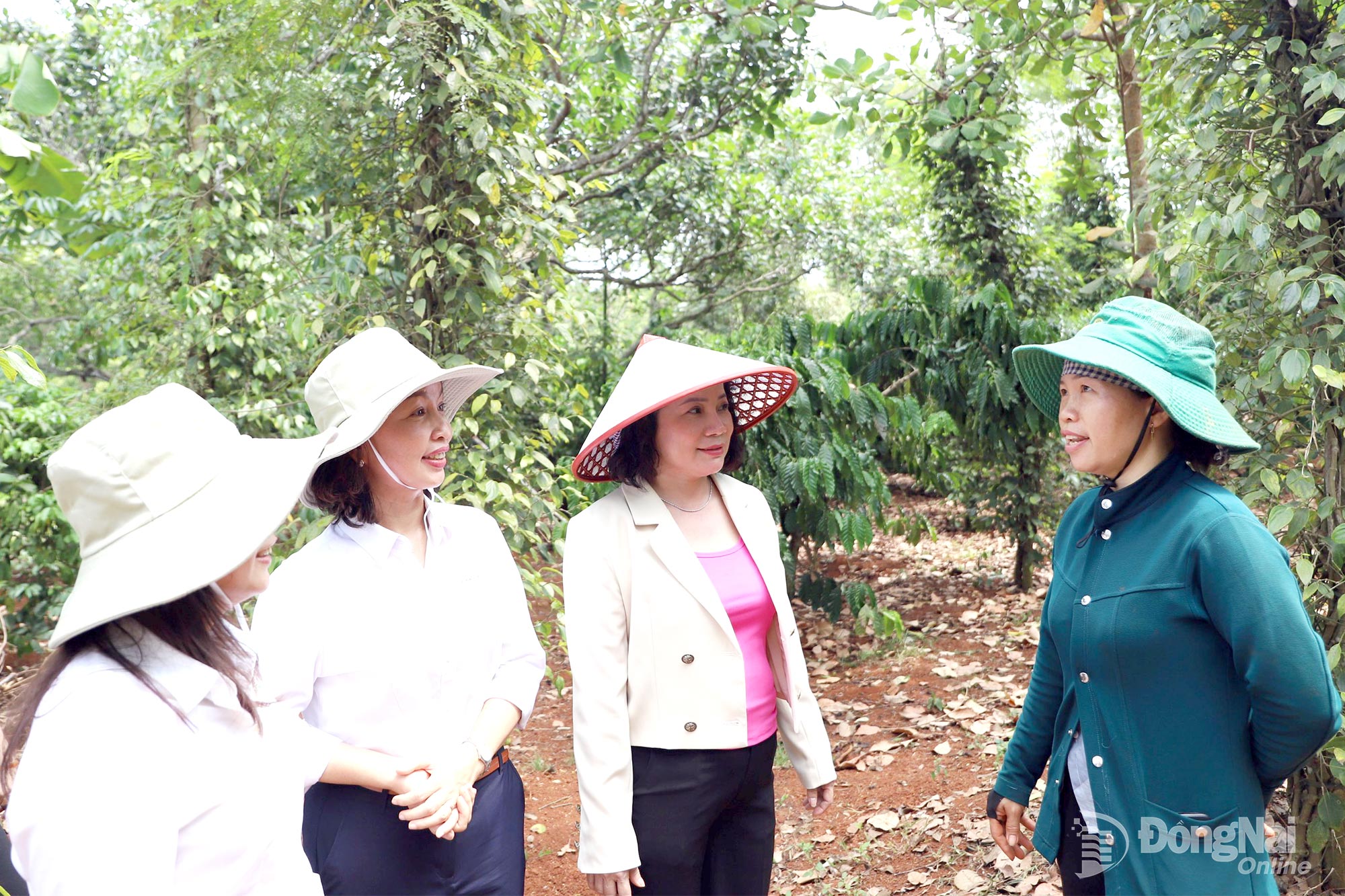 |
| Vi Thi Loi (right), an ethnic minority resident of Nghia Trung Commune, introduces an intercropping model of pepper and coffee in a cashew orchard that generates high economic returns. |
Nevertheless, Dong Nai remains strongly committed to implementing the program, with the goal of bringing about substantial improvements in both quantity and quality while pursuing the goal of developing modern, prosperous and culturally distinctive new-style rural areas, gradually narrowing the development gap between urban and rural areas, particularly in ethnic minority and mountainous regions.
Many challenges in the new period
In recent years, Party committees, Party organizations and authorities at all levels actoss Dong Nai have focused on directing and implementing the national program in a decisive manner. With the involvement of the entire political system and strong public support, the national target programs have achieved important results. A system of mechanisms and policies has been introduced in a coordinated, timely and comprehensive manner to implement the program. Essential technical infrastructure, including electricity, roads, schools and healthcare facilities, has received relatively comprehensive investment. Production has developed steadily toward sustainability, with concentrated production areas established in association with production linkages and product distribution. Rural residents' incomes, quality of life and access to services have continued to improve.
Deputy Director of the Department of Agriculture and Environment Le Thi Anh Tuyet said that the implementation of the national program has consistently received attention and direction from Party committees and authorities at all levels. The city has consequently implemented policies to promote socio-economic development, particularly measures to boost production, create jobs, increase incomes, reduce poverty, stabilize people's lives, and maintain political security and social order and safety.
However, following the merger, the implementation of the national program faces a number of difficulties and challenges. Dong Nai City has a large geographical area, with increasingly complex weather and natural disaster patterns, a dispersed population, and a high proportion of ethnic minority residents. Investment resources remain spread thinly rather than being concentrated, while technical infrastructure in agricultural production areas is still fragmented and inadequate. As a result, the achievements of the national program have not yet been truly sustainable.
Accordingly, some new-style rural development indicators have not been consistently maintained after certification. Some indicators on new-style rural communes remain below the requirements for the 2026-2030 period, including rural residents’ income growth rate, connectivity of the transport system, the proportion of rural residents using clean water, household waste collection and treatment, and the multidimensional poverty rate in ethnic minority and mountainous areas.
Strong determination
Resolution No. 11-NQ/TU, dated August 28, 2026, issued by the Dong Nai City Party Executive Committee on strengthening Party leadership in new-style rural development, sustainable poverty reduction, and socio-economic development in ethnic minority and mountainous areas for 2026-2030, with a vision to 2035, was the earliest resolution issued among the five national target programs. Compared with other localities nationwide, Dong Nai was among the first four to issue such a resolution. The city was also among the first to issue a decision on the criteria for new-style rural communes for the 2026-2030 period.
The implementation of the program must closely follow the viewpoints, objectives and tasks set out in Party policies and National Assembly Resolution No. 257/2025/QH15. It must also be aligned with the objectives of the Resolution of the First Dong Nai Party Congress for the 2025-2030 term and the Dong Nai City master plan for 2021-2030, with a vision to 2050. The Resolution identifies this as a key, regular and long-term task of the entire political system and society. Agricultural and rural development must be placed within the city's new overall development space and closely linked to urbanization, industrialization, the development of services, logistics, border-gate economy and the forest economy, as well as development corridors and growth poles, ensuring that rural areas participate in and benefit from the development process.
The approach will shift decisively from simply building new-style rural areas to pursuing comprehensive, modern, green and sustainable rural development.
Specifically, agricultural production must be reorganized toward large-scale commodity production, with the application of science and technology, innovation and digital transformation, as well as value-chain linkages, to increase value added and competitiveness. Poverty reduction must be linked to livelihood development, job creation, higher incomes and stronger capacity for people to improve their own living conditions. Residents will be placed at the center of the development process as its subjects and driving force. Improvements in incomes, material and spiritual well-being, quality of life and public satisfaction will serve as key measures of the program' effectiveness.
At the same time, the rural economy development must be pursued in a green, circular and ecological direction, with the application of high technology in conjunction with agricultural restructuring, digital transformation and innovation, while promoting the role of residents, communities and economic sectors as key actors. The city will gradually narrow development gaps among regions and population groups, particularly in ethnic minority and mountainous areas and border communes. It will also ensure harmony between socio-economic development and the protection of the environment, cultural identity and traditional values, laying the foundation for comprehensive development in rural areas and ethnic minority communities across the city.
Member of the Dong Nai Party Committee, Vice Chairwoman of the City People's Committee Nguyen Thi Cat Tien said that new-style rural development is a comprehensive, regular, continuous and sustainable process, while poverty reduction must be substantive and multidimensional, with efforts made to limit the risk of falling back into poverty. The focus is on developing production, creating livelihoods and sustainable jobs, increasing incomes, and improving people's access to basic social services. The city's goal is to build modern, prosperous, distinctive and sustainable new-style rural areas linked to urbanization and climate change adaptation; pursue multidimensional, inclusive and sustainable poverty reduction; ensure social welfare and gender equality; and improve incomes, quality of life and access to basic services, thereby contributing to an increase in the people’s happiness index.
By 2030, the National Target Program on new-style rural development, sustainable poverty reduction, and development in ethnic minority and mountainous areas aim for 100% of communes to meet the new-style rural standards under the 2026-2030 criteria set. More than 10% of communes are expected to meet the standards for modern new-style rural areas. Average per capita income is targeted at VND120 million per year.
By Binh Nguyen - Translated by Mai Nga, Thu Ha
Thông tin bạn đọc
Đóng Lưu thông tin