
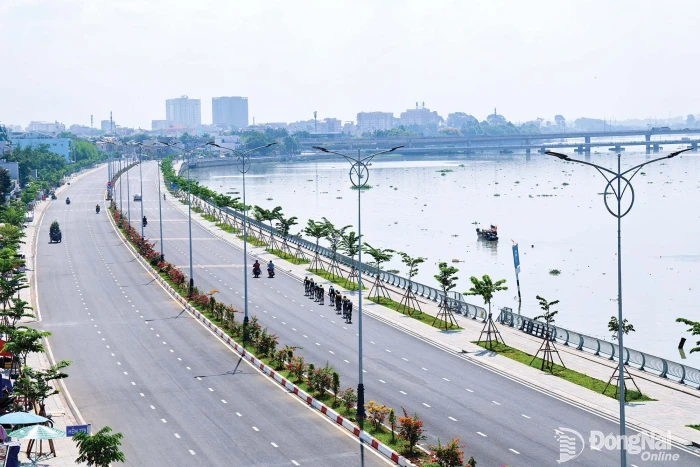
Dong Nai is implementing and preparing to launch a series of transport, urban development and resettlement projects aimed at creating new momentum for economic growth. To bring these projects to fruition, compensation, resettlement and site clearance efforts play a vital role in unlocking development resources, paving the way for accelerating investment, public investment disbursement and driving socio-economic development.
 |
| Transport infrastructure projects are being implemented in Nhon Trach ward. Photo: Hoang Loc |
In response to this requirement, leaders of the Party Committee and People's Committee of Dong Nai City have issued a range of directives, while agencies and local authorities have stepped up efforts to accelerate implementation.
Land clearance as a catalyst for growth
Experience has shown that major national and local projects can only proceed on schedule when land clearance is carried out in a timely and coordinated manner. Conversely, delays in site clearance often result in cost overruns, slower public investment disbursement, prolonged construction periods and reduced project efficiency.
In Dong Nai City, its Land Fund Development Center (LFDC) serves as the key agency responsible for compensation and site clearance for major transport projects, large-scale urban and resettlement developments, as well as the preparation of cleared land for auction.
Nguyen Cao Tai, Director of the Dong Nai City LFDC, said the agency fully recognizes that every successful land auction, every compensation case resolved ahead of schedule and every project accelerated contributes directly to unlocking development resources. To this end, the center has developed detailed land clearance plans for each project on a monthly and quarterly basis, clearly assigned responsibilities to individual officials, closely monitored progress and promptly addressed emerging difficulties.
"Our consistent spirit is to carry out compensation and land clearance work proactively and effectively while maintaining close coordination with local authorities and relevant agencies to ensure assigned tasks are completed on schedule," Tai said.
Dai Phuoc commune is among the localities expected to benefit significantly from major transport infrastructure and urban development projects. As such, land clearance has been identified as one of its key priorities.
According to Chairman of the Dai Phuoc commune People's Committee Ho Quoc Tan, the locality has been committed to concentrating resources on accelerating compensation and site clearance for several strategic projects, including the Cat Lai Bridge, Phu My 2 Bridge and two large-scale urban development projects recently approved by the City People's Council.
Tan noted that around 3,000 hectares of land are expected to be acquired to serve upcoming projects. These projects will not only create new urban spaces along the Dong Nai River and stimulate trade and services, but also generate employment opportunities for local residents.
The locality is therefore working proactively to complete legal procedures, strengthen public communication efforts and accelerate land clearance to ensure projects can be implemented on schedule.
Ensuring land clearance does not become a bottleneck
Land clearance is often the first and most critical step in project implementation, serving as the key to unlocking development resources. Once sites are handed over, projects can proceed according to plan, public investment capital can be disbursed more effectively and local infrastructure can be upgraded more rapidly. This, in turn, enhances the locality's attractiveness to investors and creates favorable conditions for socio-economic development.
Through a number of working sessions, Nguyen Van Ut, Deputy Secretary of the City Party Committee (CPC) and Chairman of the Dong Nai People's Committee, has has repeatedly called on agencies and local authorities to eliminate bureaucratic inertia, avoid passing responsibility and improve accountability in public service delivery, particularly in site clearance work.
Dong Nai is currently implementing an action program aimed at achieving double-digit economic growth and becoming one of the country's major growth poles. To achieve this goal, the city has identified infrastructure bottlenecks as a priority area requiring urgent action. Efforts are therefore focused on accelerating key projects, streamlining administrative procedures, improving planning quality, advancing digital transformation and creating a more transparent and business-friendly investment environment.
The message from city leaders is clear: every project completed ahead of schedule creates additional room for growth; every administrative procedure shortened strengthens public and business confidence; and every decisive action taken today opens up new development opportunities for the future.
During a recent working session with the CPC’s Standing Board on June 13, Prime Minister Le Minh Hung also urged Dong Nai authorities to swiftly remove site-clearance bottlenecks affecting key projects, particularly strategic transport links connected to Long Thanh International Airport, in order to ensure their synchronized operation by the end of 2026.
He also called for faster implementation of key projects, including the Bien Hoa–Vung Tau Expressway, Ring Road 3 of Ho Chi Minh City and the Bien Hoa–Vung Tau railway project. At the same time, local authorities were instructed to accelerate land clearance for projects preparing for construction or implementation, including Ring Road 4 of Ho Chi Minh City, the Gia Nghia–Chon Thanh section of the Western North–South Expressway and the Ho Chi Minh City–Thu Dau Mot–Chon Thanh Expressway.
As Dong Nai enters a new phase of development as a city-level administrative unit, land clearance is no longer the responsibility of a single agency or locality. Instead, it has become a key task for the entire political system to unlock land resources, leverage the city's position as a central hub within one of Vietnam's major economic growth poles and create new space for development. When site clearance progresses smoothly, new transport routes, modern urban areas and large-scale infrastructure projects can be completed on schedule, or even ahead of schedule, helping Dong Nai achieve faster and more sustainable growth.
The LFDC, which has been assigned by the City People's Committee to carry out compensation, resettlement and site clearance work for major projects, is currently directly implementing 11 projects, overseeing 16 others through its branches and preparing compensation and land clearance procedures for an additional 28 projects.
By H. Loc – Translated by M.Nguyet, Thu Ha


Thông tin bạn đọc
Đóng Lưu thông tin