
Just over a month after officially becoming a city, Dong Nai organized an environmental conference to gather insights from experts, policymakers and the business community on priorities for its new phase of development.
 |
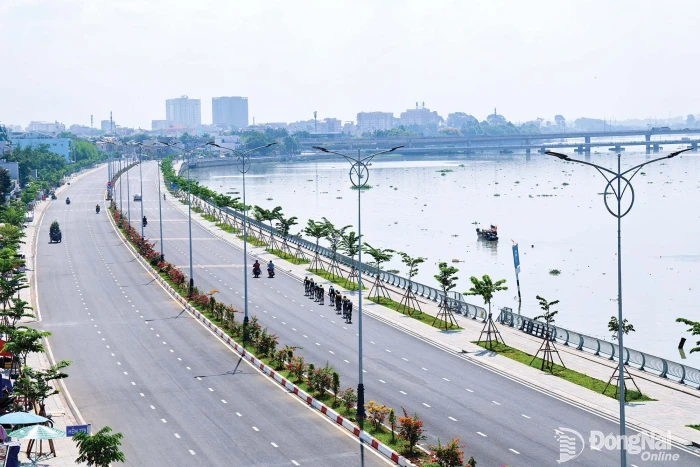
| Developing green, modern, and climate-resilient urban areas is one of the development models Dong Nai is pursuing. |
The event formed part of the city’s strategic preparations to lay the foundation for a green growth model, with the goal of building a modern urban center that balances economic expansion with environmental protection.
No growth at the expense of the environment
This has remained a consistent principle guiding Dong Nai’s development over the years. Accordingly, all major policies adopted by the City Party Committee (CPC), the People’s Council and the People’s Committee are built around the objective of sustainable development, with environmental protection regarded as a non-negotiable priority.
Associate Professor Dr. Nguyen Tri Quang Hung, Head of the Faculty of Environment and Natural Resources at Nong Lam University Ho Chi Minh City, said Dong Nai is entering a new phase of development with a stature and strategic role far greater than before. Naturally, the greater the city’s position, the greater its responsibility for sustainable development. Only by upholding the principle that economic growth must not come at the expense of the environment can Dong Nai maintain its role as an industrial powerhouse while laying a solid foundation for long-term sustainable development.
 |
| An eco-urban area on Tan Van Islet in Bien Hoa ward. Photo by Hoang Loc. |
Based on that perspective, Associate Professor Dr. Hung proposed that the Southern urban-industrial area associated with the growth pole of Long Thanh International Airport should be planned according to a green urban structure in order to avoid becoming a collection of massive concrete developments lacking ecological space. Meanwhile, the Northeastern area should be oriented toward high-tech agriculture and green tourism in order to preserve its role as a “green lung” for the wider region.
In parallel with spatial planning, environmental infrastructure should also be developed in line with the pace of urbanization. The city should prioritize investment in drainage and centralized wastewater-treatment projects in major urban centers such as Tran Bien, Bien Hoa, Long Thanh, Nhon Trach and Long Khanh. At the same time, stricter environmental requirements should be applied to industrial parks, industrial clusters and large-scale livestock farms in both the construction and operation of environmental protection infrastructure.
From the business perspective, Nguyen Thi Ngoc Thao, environmental manager at C.P. Vietnam Corporation, said the company has been implementing a wide range of initiatives to support the city’s roadmap toward achieving net-zero emissions by 2050.
These efforts focus on building sustainable raw-material supply chains, deploying smart-factory solutions, increasing the use of renewable energy sources such as solar power, biomass and biogas, and converting livestock waste into energy. Among the company’s notable achievements, renewable sources now account for approximately 34% of its total energy consumption. The company also planted more than 1.5 million trees during the 2021–2025 period and launched several community-based environmental initiatives, including the conservation of long-tailed macaques in the Long Thanh Protection Forest, plastic-bottle recycling and clean-water programs for schoolchildren, and solar-power installations in border areas of Dong Nai City.
Under Dong Nai’s Carbon Emissions Reduction Plan, the city targets a 20% reduction in emissions during 2025–2030 and a 45% reduction in 2030–2035, followed by a carbon-neutral phase in 2035–2045 and the achievement of net-zero emissions by 2050.
Building Dong Nai into a green city will be a long-term journey. Achieving that goal ahead of schedule will require more than government policies and investment resources alone. It will also depend on the active participation of the entire political system, the business community and local residents. When environmental considerations are placed at the center of development, economic growth and nature conservation can advance together, becoming twin pillars of sustainable urban development.
Building a green growth ecosystem
In recent years, Dong Nai has launched numerous programs, projects and action plans aimed at promoting the circular economy, green growth and carbon-emission reduction. The city has also approved its Carbon Emissions Reduction Plan to 2030, with a vision toward 2050, targeting net-zero emissions in line with Vietnam’s commitment made at the 26th United Nations Climate Change Conference (COP26).
According to Tran Trong Toan, Deputy Director of the Department of Agriculture and Environment, in the coming years, the city will focus on improving policies and regulatory mechanisms, strengthening state management and accelerating digital transformation in the environmental sector. At the same time, the city will strengthen pollution control and environmental quality monitoring, accelerate wastewater-treatment and drainage projects, and improve the quality of water resources. Other priorities include expanding waste sorting at source, applying advanced treatment technologies, promoting the green economy and circular economy, reducing greenhouse gas emissions and advancing toward the net-zero target by 2050.
 |
| Dong Nai is striving to move beyond the traditional model of an industrial center. In the photo: Green-oriented industrial production at Long Duc Industrial Park in Binh An commune. |
Nguyen Tuan Anh, Member of the CPC’s Standing Board and Vice Chairman of the City People’s Committee, affirmed that environmental protection has been identified as a central and long-term priority in Dong Nai’s socio-economic development strategy.
Accordingly, Dong Nai will implement synchronized measures covering household solid-waste management, source-based waste classification, environmental infrastructure development and stricter control of emissions from production and business activities. The city also plans to allocate greater resources and introduce policies to attract investment in projects that support sustainable development, including clean-water supply systems, urban wastewater treatment, green and smart urban development, green transportation, environmental monitoring and accident prevention, sustainable management of land and mineral resources, forest protection, biodiversity conservation and the expansion of parks and green spaces to improve environmental quality and residents’ quality of life.
Regarding Dong Nai’s long-term development orientation, Notice No. 69-TB/VPTW dated May 30, 2026, conveying conclusions by Party General Secretary and State President To Lam during a working session with the CPC’s Standing Board, emphasized the need to create a new growth model that enables Dong Nai to move beyond the limits of a traditional industrial center.
The conclusion calls for integrating Dong Nai’s existing industrial system, logistics network, strategic gateway location and the emerging urban space of Long Thanh into a modern development ecosystem driven by high-tech industries, aviation-related services, high-value-added services, supporting industries, the digital economy, the green economy and high-tech agriculture.
By H.Loc – Translated by M.Nguyet, Thu Ha


Thông tin bạn đọc
Đóng Lưu thông tin