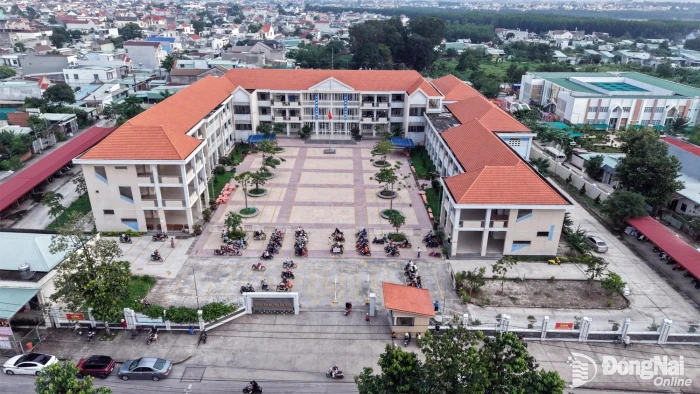
After the National Unity Day of April 30th, 1975, the party committee and people of Dong Nai accompanied the whole of the country in carrying out economic, social renovation and development tasks. After the successful anti-American resistance war the independent and unitive nation enjoyed favorable conditions for concentrating all resources on the tasks of making good war damages, building and developing the economy and society.
After the National Unity Day of April 30th, 1975, the party committee and people of Dong Nai accompanied the whole of the country in carrying out economic, social renovation and development tasks. After the successful anti-American resistance war the independent and unitive nation enjoyed favorable conditions for concentrating all resources on the tasks of making good war damages, building and developing the economy and society. However, at that time, there were many obstacles and difficulties due to war damages such as agriculture with its low capacity caused by manual working and backward technology, industry was at a standstill because of damaged machinery, a shortage of raw materials and skillful technicians, seriously downgraded infrastructure, difficult transportation of goods etc. The social facilities including medical, educational and cultural systems were poor quality. Besides, there were high rates of unemployment, poor literacy and poor security. Furthermore, men and factories had to provide for the wars occuring in the both of the Southwest and the Northern Vietnamese borders.
In order to overcome all above challenges, the party committee and people of Dong Nai tried their best to make good the war damages, take the advantages of national unity, renovate and develop the economy step by step, building up a primary socialist material facilities as well as looking after the people’s living and spiritual conditions.
With over than 26 years of building and developing the economy and society, the party committee and people of Dong Nai were determined to try their best for self-improvement. They promoted traditional corrageousness and adamance according to the comment "the Easterner has overcome hard situations heroically". They took full advantage of favorable conditions in nature and society. As a result, Dong Nai obtained great and honorable results on political, economy, education, society, security etc.
During the last few years, the economic and social building and development tasks have been executed to pass through the two stages of economic management listed below:
The first stage (from 1976 to 1985)
The aim of this stage was to consolidate and develop the economy and society for 5 years following a system based on administrative subsidies.
During this time, the Dong Nai people accompanied by other provinces in the South gained remarkable results of making good war damages, rebuilding and the setting up socialist production. This included reclaiming and expanding lands for the use in cultivation to provide enough food for the people; rebuilding industry, handicraft, commerce and services; settling social problems on education, medical, security and looking after invalids. Social evils i.e drugs were quickly eliminated. Furthermore, a rapid growth of the economy was ensured: Up to 1985, the GDP had increased double since 1976 (annual average raised 8%). Also, the average capita GDP had also raised 1.4 times in the same period.
Hasty renovation, created a new economic relationship, a socialist economic relationship. This was set up based on administrative subsidies with a single ownership (state-run and collective form). So, the economy grew slowly and eventually started a downward trend. At that time, the GDP has decreased nearly 4% during the period of 1981-1985 against 1976 –1980. Consequently, the country suffered a shortage of manpower and a poor economy. Manpower and facilites were wasted. Furthermore, no international support was received. These difficulties were caused by the economy and the system based on administrative subsidies. Hence, the economy has been isolated from the global developed commodity economy and international currencies as well.
The second stage (from 1986 to 2000)
During this stage, the innovation policy was applied and replaced the system based on administrative subsidies, with a state managed market economy and following socialist trends as proposed by the Vietnamese Communist Party in the 6th congress.
After 15 years of this policy, the party committee and people of Dong Nai, whose patriotism, creativeness and revolutionary nature, obtained great success on the economy and society in the province. By 2000, the GDP with its price in comparison with 1994 increased 3.86 times against 1985 and 7.7 times against 1976. The economic and social infrastructure and the production capacity is also increased. The provincial economic status was able to stand steady on its legs and develop rapidly.
The rapid growth of the economy in the period from 1991 to 1995 with its annual GDP, rising approximately 14%, was remarkable. The economy improved increasing industrial capacity of 18.2% in 1985 to 38.7% in 1995 concentrating all efforts on upgrading economic and social infrastructure i.e. transportation, power network, communication etc. All these changes have taken effect to attract foreign investors, renew urban and rural areas. At the same time, urgent matters of living conditions have also been settled such as: employment, poverty-alleviation, welfare affairs for invalids and singles and so forth.
In the period from 1996 to 2000, with an annual GDP of 12%, the economy has been developed towards quality. Some good results have been obtained: new seedlings for cultivation of over than 90% of the total areas; advanced technology as applied by many industrial businesses in order to improve the better quality of products; various kinds of products being available for satisfying, meeting and expanding customers’ tastes. Also, the social urgent problems were basically solved.
During the innovative 15 years of 1986 to 2000, many remarkable results were gained, many challenges had to be faced such as unconsolidated growth of the economy; lower competitive and effective; oversupplying, deflation etc. Despite of these difficulties and obstacles, the following great results have been obtained: by 2000, the value of GDP (in comparison with price in 1994) was VND 10,458.8 billion, raised up 3.86 times against 1985. At this time, the average growth was 9.5%, which was higher against 8% of the first stage of 10 years from 1976 to 1985. This figure of the average growth was raised double that of the general growth all over the country. This also showed the provincial growth was increasing more than that of other provinces in the Southeast of Vietnam. During 10 years from 1991 to 2000, the provincial average growth has increased 13% higher than 11.3% of Ho Chi Minh City. By 2000, the capita GDP (in comparison with the price in 1994) was VND 5,125 which is up 2.52 times against 1985. During the period from 1986 to 2000, the provincial average growth was 6.4% which was higher against 3.2% of the first stage of the period 1976 –1985. This figure the average growth was raised double in comparison with the first stage. At the same time, the provincial industry and agriculture developed rapidly, by 2000 the industrial and agricultural values raised up 16.6 times and 1.8 times against 1985.
The period from 1986 to 2000 was a remarkable time for carrying out an innovatory economic policy under the leadership of the Vietnamese Communist Party. At the same time, the economy followed a more reasonable way. As a result, a system of all sectors and the regional industry has grown.
The economy has been changed gradually towards industrialization and modernization. The competition between the provincial sectors, regions and localities was a force for the rapid growth of the economy. In 1985, the GDP of capacity of agriculture-forest, industry- construction and services was 57.5%, 18.2% and 24.3% against 22.8%, 52.2% and 25% by 2000. In 1985, breeding capacity of the agriculture was only 11% this raised to 23% by 2000. Areas for cultivating industrial plants and fruit trees have set up in order to supply raw materials for the processing industry and exporting. In the industrial sector, major businesses have been set up in industrial zones. These include agricultural and foodstuff processing, leather shoe factories, textile industry, building materials manufacture. All these rapidly developed and controlled the domestic market. By 2000, the commerce made up 42% of all the services, communication made up 7.5%, and finance and banking 8.2%, state run education and medical care 10%, others of 32.3%.
Economic development for the districts in Dong Nai province have followed the economic-social growing plan in the developing center of the South of Vietnam. The hard regions have been provided with investment supports and have continued developing gradually.
All the sectors have been encouraged to replace 2 forms of state-run and collective ownership with multisector economy. By 2000, the state-owned economy, which made up 31% of the GDP, has changed and grown little by little. At the same time, the co-operative economy was also reorganized according to a new rule and made up 0.5% of the GDP. Other sectors, in which are invested by foreigners made up 29% of the GDP, which has grown rapidly.
During the innovatory period from 1991 up to now, prompting the growth of the economy, and developing all sectors have been most important while the economic investment was accumulating and expenditure are increasing at the same time. Up to 1995, accumulation of the economy had raised up fast and reached the total of VND1438.47 billions (according the existing market price) that increased 3.2 times against 1991. By 2000, the total of economic accumulation was VND 2,641.61 billions which raised 1.84 times against 1995. The total of the accumulative budget and expenditure was higher than before. This total made up 9.22% in 1985, 10.8% in 1990 and 26.2% by 2000. The motive power for prompting the growth of the economy in the province was the higher increased accumulative investment of all sectors. Although expenditure has been decreased slightly, its absolute value is still increasing higher year after year. All the above mentioned results mark an obvious advance on developing the provincial economic potential and making a perfect system for the economy and society in general.
STRATEGY
During the period of 2001 – 2010, general strategy included taking full advantage of the provincial potentials and competition between the provinces for developing the economy and the society. The province will hold the initiative in integrating into AFTA and will make good use of international support. At the same time, challenges of social problems and environmental pollution has been caused by integration into the international trade this will will be limited as a minimum. Furthermore, the provincial economy will be accompanied with other major regions in the South of Vietnam to become a national developed economic center. All these efforts will contribute to change the country into an industrial country by 2020 of this century.
Economic strategy is as bellow: prompting the annual growth of the economy up 10% in the period of 2000 – 2005 and 10 –11% in the period of 2006 – 2010; changing basically and entirely the provincial economy according to industrialization and modernization tendency. By 2010, the capacities of industry – construction, agriculture-forest-pisciculture and services will make up 57-58%, 12-13%, 31-33% (up to 39-40% if applicable).
The average capita GDP will be VND 7 – 8 millions or equivalently USD 650 – 700 by 2005 (in comparison with price in 1994) and VND 11-12 millions or USD 1,000 – 1,100 by 2010 that raise up 2.2 times against 2000.
-
Industry: The annual average growth of industrial production in the province will make up 13-15% in which is invested by foreigners increases 16-17%. By 2010, the regional capacity will make up 72-80% of the industrial sector. The growth of the domestic industry will be 7%. The capacity of the domestic industry will make up one-fourth of all sectors’ value. The GDP of the domestic industry will make up 55 –57% of all sectors’ value.
-
Agriculture: During the period of 2001-2010, the annual average growth of agricultural production in the province will make up 3.4%, in particular, 3.5% in the period 2001-2005 and 3.3% in the period 2006-2010. By 2010, breeding will make up 35% of the agriculture.
-
Import and export: Export and import turnover was only USD 3 billions by 2000 and will raise up USD 10 billions by 2010. Export turnover was USD 1,63 billions by 2000 up to USD 6-6.5 billions by 2010. Exported goods will be various and raise up their competitiveness in the traditional markets, North American and European Union.
Social strategy is to consist of:
-
Prompt continuously family planning movement, decrease natural booming, lower mechanical emigration as well as constrain population boom at 1.4% by 2010.
-
Make compulsory to everyone general education at the high school graduation. By 2010, teachers of primary and secondary schools (including private and public schools) will be approximately 19,000 people in order to attract 100% children coming to primary school and 100% students coming to secondary school; Further professional, informatics and foreign language training; Improve better skill for manpower; Create favorable conditions for employees to be capable of competing against one another anywhere in the integrated situation; Invest more money in vocational schools in order to meet the demand of industrial development; Upgrade some professional training schools to junior colleges or universities.
-
By 2010, the following infectious diseases will be lower 25% than 2000: tuberculosis, whooping cough, measles, diphtheria, tetanus, polio, cholera, B hepatitis and so on; Promptly test and cure occupational diseases (higher rate in industrial provinces); Lower than 7% malnutrition for the newborn. By 2010, the rate of population using water with its hygienic conditions will be over than 85%.
-
Cultural – social services: Setting up cultural places and system along with tourist areas where will attract the domestic and oversea tourists. At the same time, building cultural centers where will be held popular sport activities for getting good records.