
Since its establishment, the Communist Party of Vietnam has consistently affirmed, "The country takes the people as the root… Only when the root is strong will the tree be stable." Mass mobilization work serves as a bridge connecting the Party, the State, and the people, playing a vital role in determining the strength and resilience of the great national unity bloc.
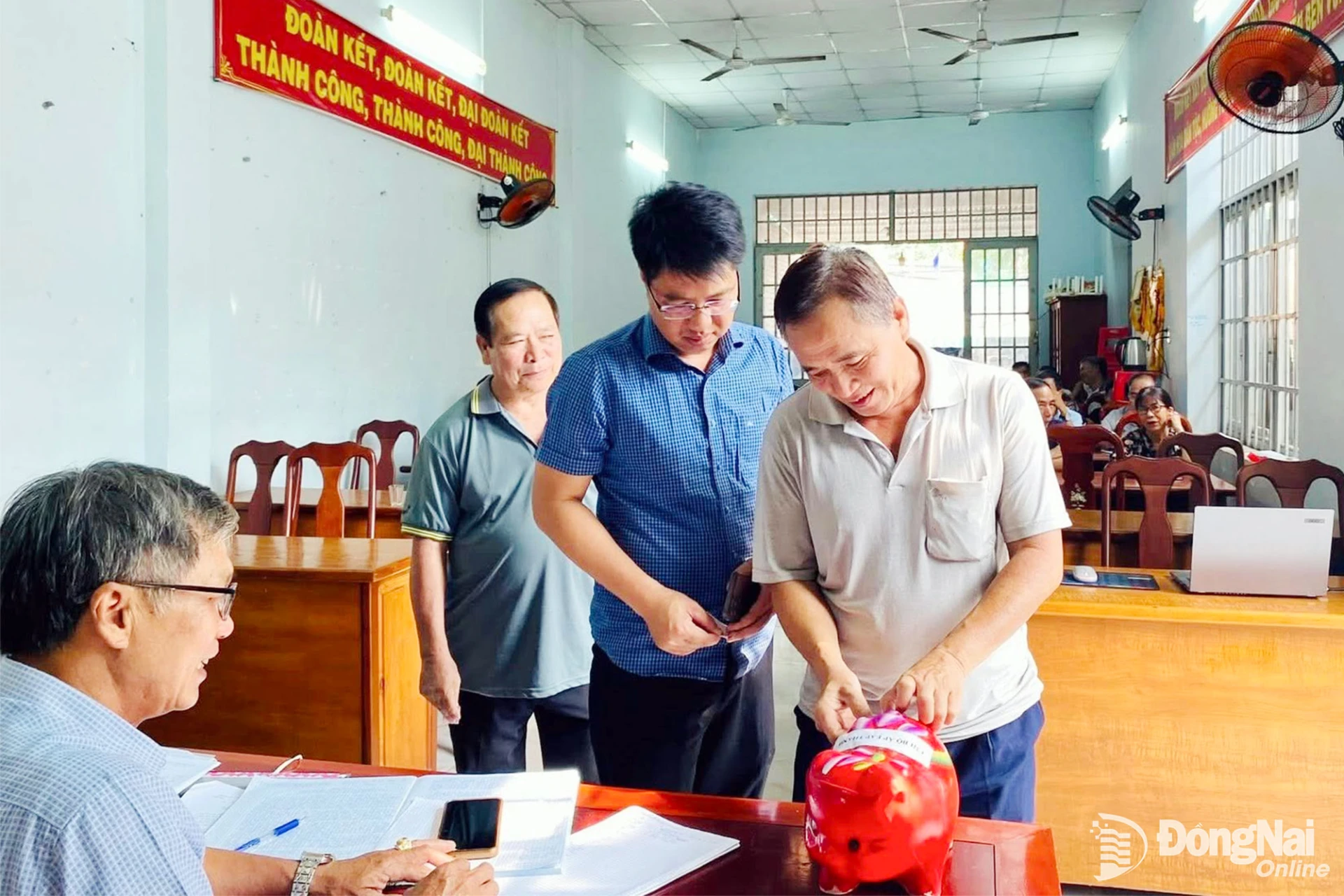 |
| Party members in Dau Giay Ward contribute to a piggy bank fund to support disadvantaged students. |
Over the past 96 years, under the Party's leadership, mass mobilization work has helped strengthen public trust in the Party and mobilize the immense strength of the people during the resistance wars, the founding of the nation, as well as national building and defense.
Today, amid international integration and development, mass mobilization work benefits from many favorable conditions but also faces numerous difficulties and challenges. People’s lives have changed significantly, while their awareness, needs, and aspirations are becoming increasingly diverse. This requires the Party's mass mobilization work to continue to undergo vigorous, creative, and effective renewal, further affirming its important role in strengthening the relationship between the Party and the people.
Practical actions for people
In response to the special 500-day-and-night emulation campaign themed “Unity – Discipline – Efficiency – Breakthrough, building a civilized and modern Dong Nai," launched under Resolution No. 05-NQ/TU issued by the Dong Nai City Party Committee’s Executive Board on May 1, 2026, Bu Dang Commune initiated a 90-day campaign to collect data for public services and a 180-day campaign to implement a plan supporting residents in applying for their first land use rights certificates, commonly known as "red books."
According to Nguyen Thanh Tung, Deputy Secretary of the Bu Dang Commune Party Committee and Chairman of the Commune People's Committee, land is both an essential means of production and a valuable asset for residents. Data collection showed that more than 2,000 land parcels in the commune had yet to receive their first land use rights certificates for various reasons, including unauthorized transfers and discrepancies in land surveys. Notably, the most outstanding applications involved poor, near-poor, and disadvantaged ethnic minority households. Meanwhile, the procedures for obtaining land use rights certificates are complicated, making it difficult for residents to complete them independently.
To address these obstacles, the Bu Dang Commune People's Committee established working groups to visit residents directly, going into every alley and knocking on every door to assist them with procedures for obtaining land use rights certificates.
To date, Bu Dang Commune has collected 139 data fields covering population, civil status, insurance, education, labor, employment, land, housing, the environment and agricultural production. Through this initiative, data is being systematically standardized and updated to support administrative management and better serve local residents.
Once they obtain land use rights certificates, residents have greater opportunities for economic development, including using their land as collateral for bank loans to invest in production and business activities, financing their children's education, dividing land plots among their children when they marry, or changing land use purposes.
Bu Dang Commune's approach demonstrates a shift in the leadership and management methods of Party committees and local authorities, from passive administrative management, in which officials wait for residents to come and complete administrative procedures, to goal- and results-oriented governance that takes people's quality of life as a measure of the political system's performance. This approach has helped consolidate public trust and strengthen the close relationship between the Party and the people.
When completing administrative procedures, residents want to avoid repeated visits and lengthy waiting times. Under the "Appointment-Free Friday" model, residents of Binh Minh Commune have an additional day on which their administrative procedures are prioritized for prompt processing.
Pham Thuy Linh, a resident of Binh Minh Commune, said that after learning about the model, she visited the commune office on a Friday to register her child's birth and had the procedure completed by officials in a short time.
Promoting skillful mass mobilization across all fields
Pham Thi Le Thuy, Vice Chairwoman of the Binh Minh Commune People's Committee and Director of the Commune Public Administrative Service Center, said that every Friday, residents applying for services such as certification of marital status, marriage registration, issuance of civil status record extracts, copies of birth certificates and death registration are assisted by specialized civil servants. These officials receive and process applications, submit documents to commune leaders for signature, and return results on the same day, provided that the applications are complete, valid, and do not require additional verification.
After one year of implementing the "Appointment-Free Friday" model, the Binh Minh Commune People's Committee had processed more than 2,000 applications. The number of applications handled on Fridays was 30%–40% higher than on other weekdays. On Fridays, the Commune People's Committee assigns additional personnel from relevant departments to accelerate processing and minimize waiting times. Commune leaders also remain on duty to promptly sign administrative documents.
Building on the 96-year tradition of the Party's mass mobilization work, every cadre, Party member, Youth Union member, association member, and citizen continues to uphold a strong sense of responsibility, solidarity, and consensus, actively participating in patriotic emulation movements, public campaigns, and practical community initiatives. Particular attention is given to developing and replicating "Skillful Mass Mobilization" models associated with socioeconomic development, environmental protection, the promotion of civilized lifestyles, the maintenance of public order and security, and improvements in people's living standards.
Le Thi Thai, Member of the City Party Committee and Standing Deputy Secretary of the Party Committee of the Vietnam Fatherland Front and mass organizations of the city, said mass mobilization work in Dong Nai has been implemented comprehensively and extensively across all sectors. Emulation movements, campaigns, and initiatives such as "Skillful Mass Mobilization," "Friendly Governance," and "Mornings with the People" have been maintained in close association with the political tasks of individual localities, agencies, and units. Efforts to understand people's thoughts, public opinion, concerns and aspirations have also been intensified, particularly during the reorganization of villages, hamlets and quarters; the operation of the two-tier local government model; and the implementation of major construction works and projects. To strengthen direct channels for receiving people's opinions, recommendations, concerns and aspirations, 35 of the city's 95 communes and wards have implemented the "Listening to the People Month" model.
Activities to ensure social welfare and protect the legitimate rights and interests of union members, association members, and residents have also been widely implemented. In the third quarter of 2026 alone, agencies and units involved in the city's mass mobilization work allocated more than VND7 billion to build and repair 117 Great Solidarity houses for poor households. They also completed 28 military-civil gratitude houses, six comradeship houses, and 17 houses for resistance war veterans exposed to toxic chemicals.
To meet the requirements of integration and development, agencies, units, and localities are accelerating digital transformation and the application of information technology in mass mobilization work. Organizations have increasingly used digital platforms for leadership, administration, communications, monitoring public opinion, and managing work processes, while gradually digitizing records and documents and applying artificial intelligence (AI) to specialized tasks. Notably, the Vietnam Fatherland Front launched the "24/7 Digital Front" portal to receive public feedback, the City Youth Union implemented an AI project to restore 38 photographs of martyrs, and heroic Vietnamese mothers; and the veterans’ association digitized historical materials.
Dong Nai is currently implementing numerous key national and municipal projects to promote socioeconomic development. Therefore, leaders of Party committees and authorities at all levels are prioritizing dialogue with residents, particularly in areas where major projects are being implemented, to promptly address difficulties, remove obstacles, and respond to legitimate public requests, thereby building a broad social consensus.
By Phuong Hang – Translated by Minh Hong, Thu Ha


Thông tin bạn đọc
Đóng Lưu thông tin