
Export markets are imposing increasingly stringent requirements on Vietnamese enterprises. Raw material sourcing, origin traceability, environmental standards, consistent quality and the ability to maintain long-term supplies are increasingly seen as prerequisites for joining supply chains.
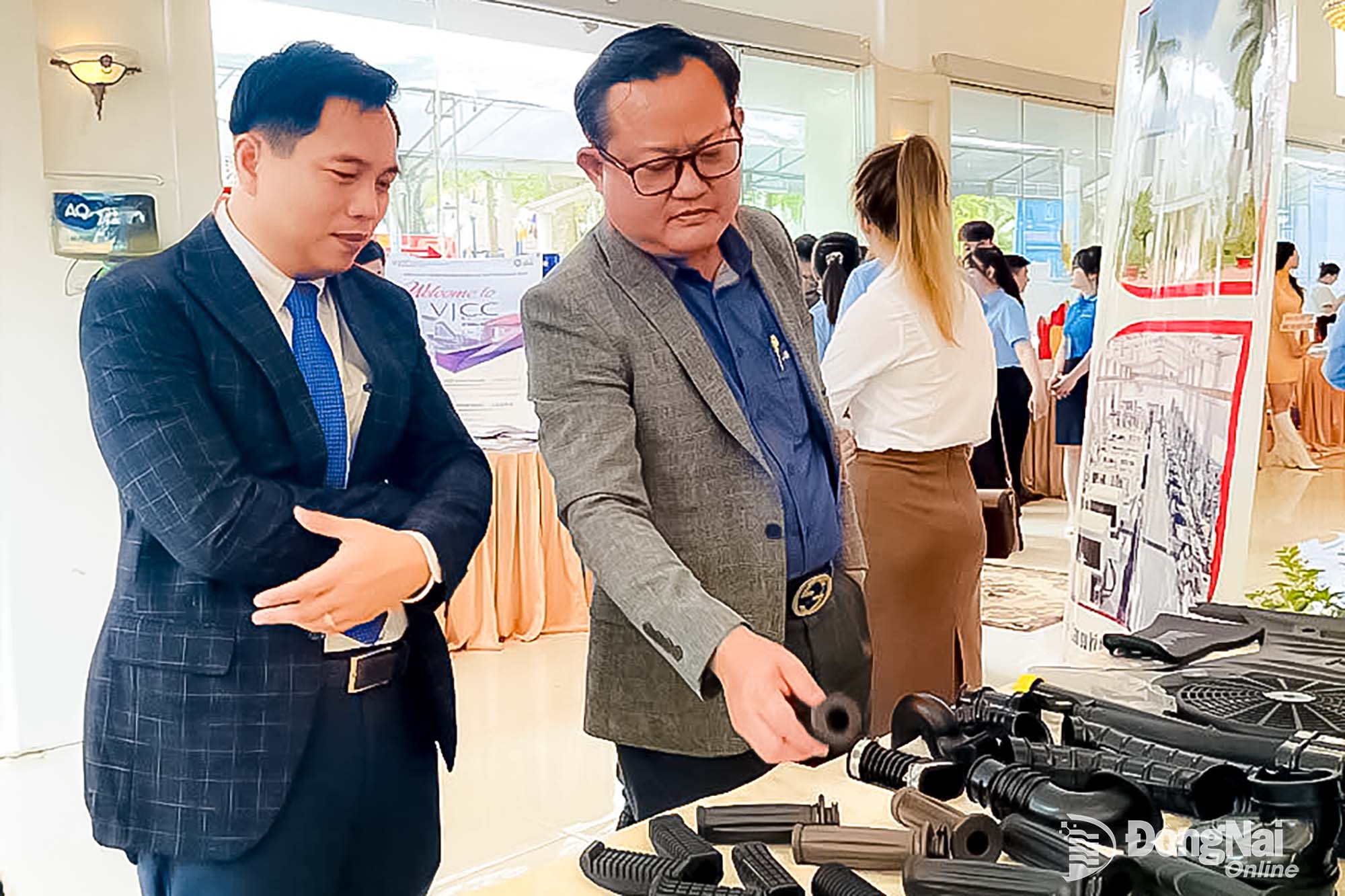 |
| Products are manufactured by Tuong Lai Co., Ltd. in Long Thanh Ward. |
These requirements present challenges but also provide an impetus for Vietnamese enterprises to strengthen their production capacity and improve their positions in the value chain.
Market requirements drive enterprises to change
Vietnam has an increasingly diversified manufacturing base and participates in numerous free trade agreements (FTAs). Over the past 30 years, the country has signed and implemented 17 bilateral and multilateral FTAs, establishing trade relations with many of the world's leading partner countries.
Currently, approximately 5,000 Vietnamese enterprises participate in global supply chains, with some serving as suppliers to international corporations in sectors such as electronics, precision engineering, textiles and garments, leather and footwear, furniture, food, and logistics. Securing orders from major corporations represents a step forward, but to advance further, enterprises must meet stringent requirements for quality, delivery schedules, management, and the ability to maintain a stable supply. The gap between being merely a supplier and becoming a high-value link in the supply chain therefore remains considerable.
International buyers are increasingly concerned not only with finished products but also with the entire production process. Beyond the products themselves, requirements concerning raw material sourcing, labor conditions, energy consumption, greenhouse gas emissions, packaging, waste, and traceability are prompting Vietnamese enterprises to gradually raise their standards.
According to Tran Ngoc Liem, Director of the Ho Chi Minh City Branch of the Vietnam Chamber of Commerce and Industry (VCCI), developed countries with large markets are major consumers of Vietnamese goods. Advanced markets, including the United States and Europe, impose stringent standards on imported goods. Therefore, enterprises seeking to maintain their market shares must pay greater attention to environmental, social, and governance (ESG) standards, corporate social responsibility, raw material origins, and carbon footprints.
Trade defense measures present another challenge. When faced with anti-dumping, anti-subsidy, or anti-circumvention investigations, enterprises must have sufficiently clear documentation, accounting records and data to clearly demonstrate product origins, production processes, and costs.
Transport costs, exchange rates and risks associated with foreign trade contracts also directly affect export efficiency. Enterprises therefore need to adopt a longer-term approach to business planning rather than relying solely on short-term processing orders.
Strengthening capacity through greater connectivity
According to Vo Son Dien, Chairman of the Ho Chi Minh City Association for Supporting Industries (HASI), Vietnam's supporting industries remain fragmented, lack connectivity, and depend heavily on imported components and equipment. The southeastern region, in particular, is a major hub for manufacturing, exports, and supporting industries. Greater connectivity among enterprises in the region is therefore necessary to establish supply chains.
Enterprises in the region should adopt a model in which large enterprises place orders and small and medium-sized enterprises participate in different stages of production. This approach would help establish supply networks instead of leaving individual enterprises to seek their own markets. In their export activities, Vietnamese enterprises need to move beyond short-term transactions toward developing long-term markets. They should proactively establish links with distributors, industry associations, and partners in destination markets to stay informed about market developments.
For individual enterprises, strengthening connections to enhance competitiveness and build trust with partners is particularly important. Tuong Lai Co., Ltd. (Long Thanh Ward) specializes in manufacturing technical rubber and engineering plastics and providing machining services. The company has organized its production operations under a closed-loop model encompassing product development, mold manufacturing, cost optimization, quality control, component processing, and mass production in accordance with customer requirements.
Truong Quoc Cuong, Director of Tuong Lai Co., Ltd., said the company is expanding cooperation with domestic and foreign technology partners, particularly in the Republic of Korea, to gain access to advanced production standards, strengthen localization capacity, and develop smart factories.
Similarly, Nguyen Nhat Huy, General Director of Numatec Vietnam Joint Stock Company (An Phuoc Industrial Park), said that through its own efforts, the company has gradually expanded its connections and cooperation with foreign direct investment (FDI) partners in the city and the region in recent years. The company hopes to receive additional support from relevant authorities to facilitate business connections, enabling it to confidently upgrade its production capacity and better meet the requirements of FDI partners, particularly Japanese investors.
Many supporting industry enterprises in Dong Nai are also facing the need to upgrade their technology and management practices to meet the requirements of major customers. Economic experts believe that, to retain customers over the long term, enterprises must maintain consistent product quality, effectively manage raw material supplies, invest in technology, and standardize production processes. These measures are also necessary for enterprises to gradually take on higher-value orders.
By Vuong The – Translated by Minh Hong, Minho




Thông tin bạn đọc
Đóng Lưu thông tin