
Dong Nai currently has more than 1 million students at all levels, ranking only behind the capital city of Hanoi and Ho Chi Minh City. Improving the quality of education is recognized as a driving force for developing a high-quality workforce, with the city taking decisive action through a range of specific measures.
At a conference on implementing tasks for the 2026-2027 school year, Le Truong Son, Member of the Dong Nai City Party Committee’s Standing Board and Vice Chairman of the City People's Committee, said, “The quality of education and training is always the foundation for the quality of human resources. Therefore, in the coming period, the City People's Committee will continue to invest in education as a strategic policy decision. Beyond making investment in general education, vocational education and higher education must also assert their positions in the Southern region and the entire country.”
Focusing on solutions to improve teaching and learning quality
Dong Nai City has demonstrated its determination to innovate and improve the quality of education and training by successfully reorganizing 453 public educational institutions, from preschool and general education to vocational education and continuing education. The reorganization and streamlining reduced the number of public educational institutions in Dong Nai by 42% compared with the period before July 1, 2025. The process was completed 10 days ahead of the deadline set by the Ministry of Education and Training for localities nationwide. Following the reorganization, the Department of Education and Training continues to direct educational institutions to improve the quality of teaching and learning from the first semester of the new school year. Results must be verified through honest assessment figures, with a resolute rejection of the culture of achievement-based performance.
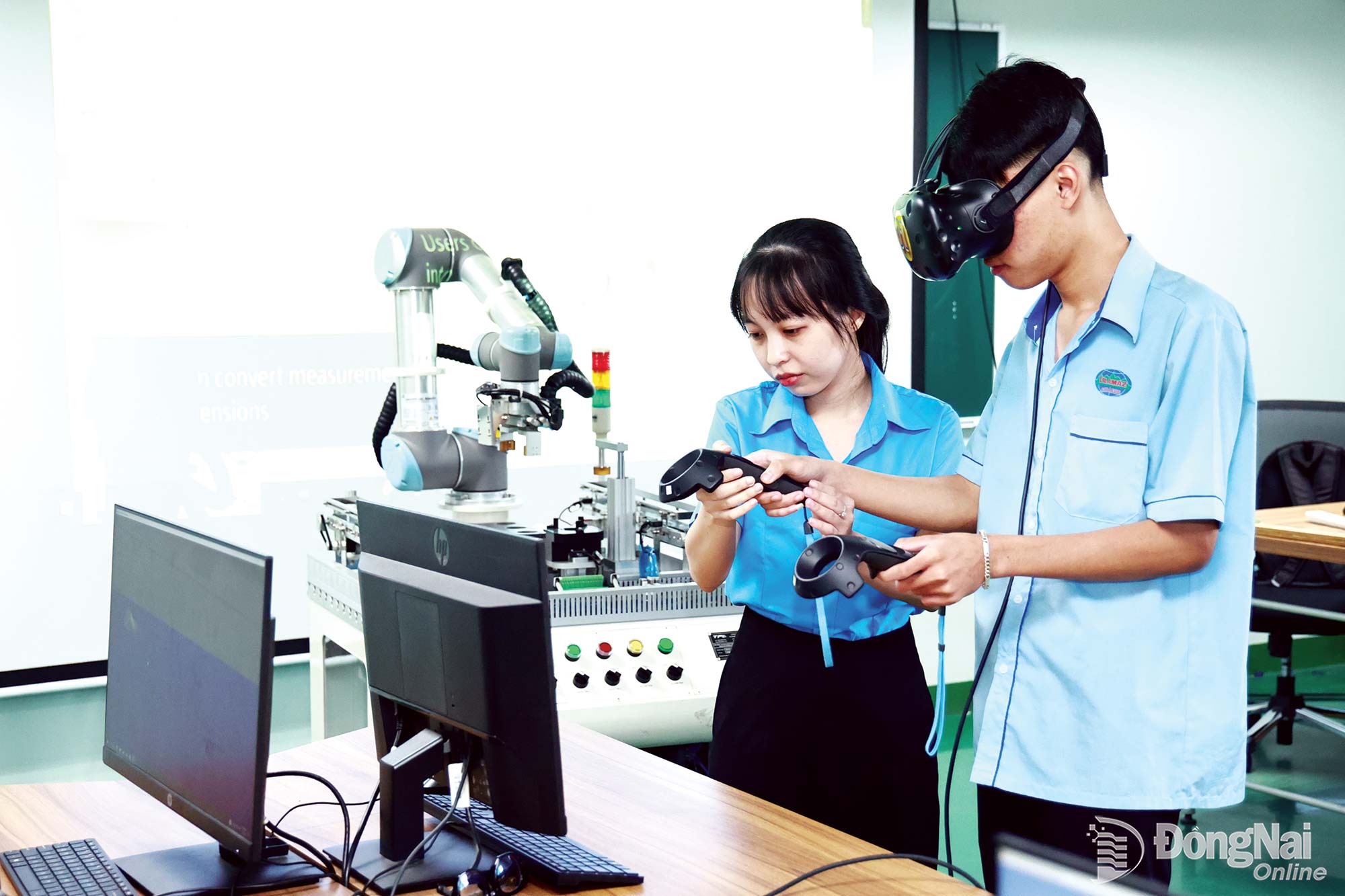 |
| Students at Lilama 2 International Technology College in Long Phuoc Commune practice operating modern robots. Photo: Cong Nghia |
Hoang Thi Ngoc, Principal of Nguyen An Ninh Primary School in Tam Hiep Ward, said that following the reorganization, the school developed a highly specific roadmap to achieve breakthroughs in facilities, teaching staff, and curricula. Specifically, the school will focus on building a swimming pool, sports training grounds, and science, technology, engineering and mathematics (STEM) classrooms at Branch Campus 2, formerly Tan Tien Primary School, where ample land is currently available and class sizes are moderate. At the same time, the school requires teachers to improve their professional qualifications, particularly their ability to use English to teach other subjects.
Drawing on experience in continuously improving the quality of teaching and learning, particularly in identifying and fostering gifted students over many consecutive years, Pham Thi Thanh Ha, Principal of Tran Bien High School in Tam Hiep Ward, said that achieving high educational quality requires teacher development to always be prioritized. Each teacher must be strict with themselves and resolutely abandon the rut of “trick-based teaching and rote learning.” Teachers need to shift toward fostering a fundamental understanding of knowledge, clearly grasping the nature of problems, and developing students' critical thinking, self-study methods, and research skills so that they can both improve and renew themselves during lessons.
The consistent view of the city's leadership is to prevent disparities in educational development. Education in remote, isolated, and border communes must receive greater investment to narrow the gap with more advantaged areas. To concretize this view, the city has invested nearly 1.2 trillion VND to build schools in eight border communes, including Bu Gia Map, Dak O, Hung Phuoc, Thien Hung, Tan Tien, Loc Tan, Loc Thanh, and Loc Thanh. In implementing the Project on Building Schools in Border Communes for the 2025-2026 period, the total allocated capital has reached more than 621 billion VND, equivalent to 52% of the plan. Regarding infrastructure progress, among the 10 projects allocated capital in 2025, seven projects have been completed and put into use at the beginning of the 2026-2027 school year. Of the 25 projects included in the 2026 plan, 11 projects have begun construction, while 14 are completing investment preparations.
Dong Nai is leveraging modern infrastructure to attract leading Vietnamese universities and foreign universities to establish training facilities in Dong Nai under favorable policies. At the same time, the city is expanding socialization to attract private investment in education segments ranging from preschool and general education to other advanced educational programs.
Hoang Manh Thuong, Secretary of the Party Committee and Chairman of the People's Council of Loc Tan Commune, said that recently, the Commune Party Committee has made efforts to concretize the directives of the Central Government and Dong Nai City to improve the quality of local education and training. Before the start of the new school year, the commune invested in school facilities, provided textbooks, and offered free health insurance. Since September 5, the commune has organized free lunches for students so that parents can feel assured when sending their children to school.
Repositioning human resource training hub
Dong Nai is facing major opportunities for breakthrough development based on its achievements in high-quality infrastructure. A prime example is Long Thanh International Airport, which is preparing to begin Phase 1 operations with one terminal and two runways. In the near future, three additional terminals and two more runways will be deployed, creating a “mega-airport” for the Southeast Asian region.
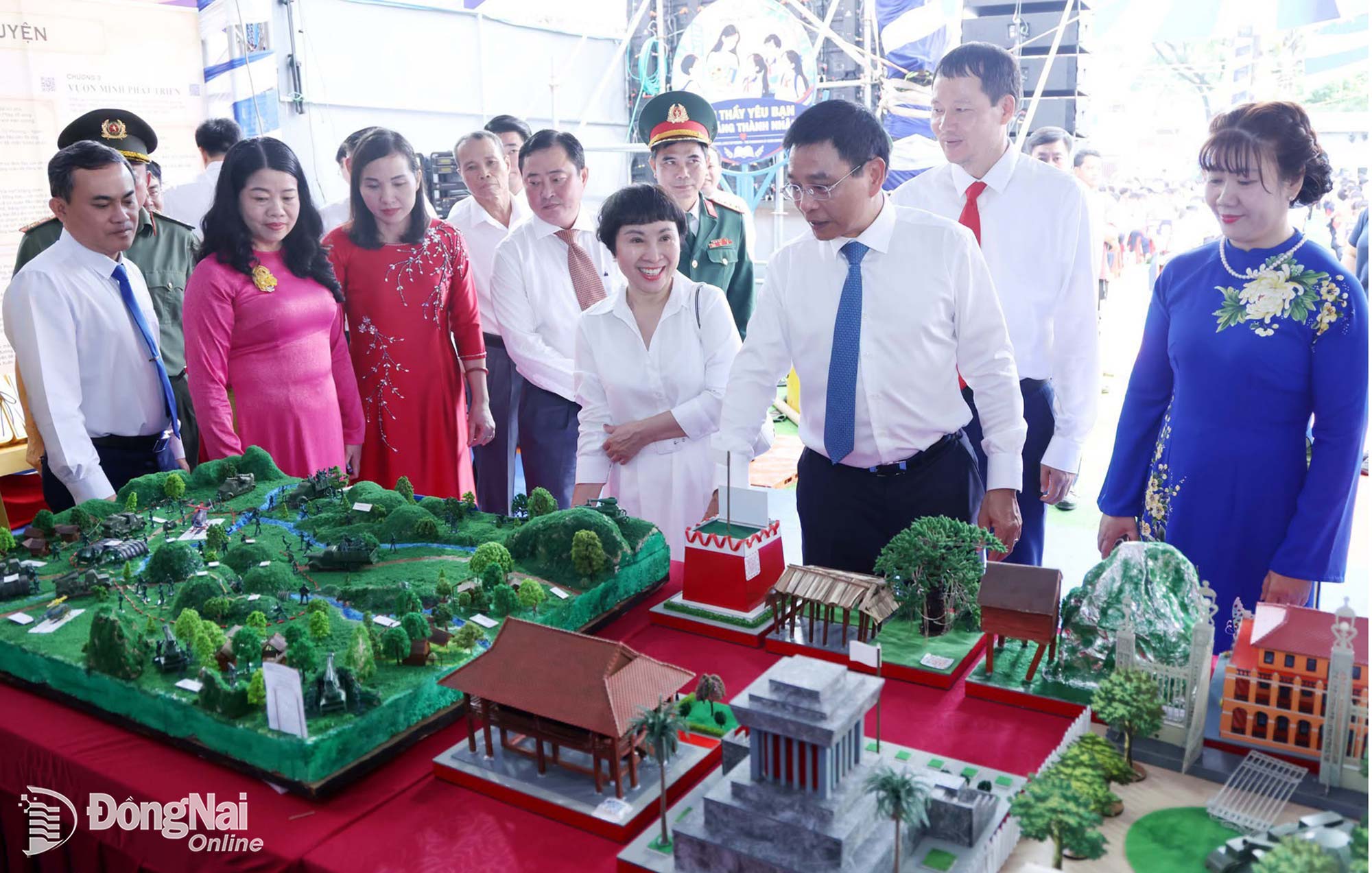 |
| Member of the Party Central Committee and Deputy Prime Minister Nguyen Van Thang (third from right) and Member of the Party Central Committee, Secretary of the City Party Committee, and Head of the Dong Nai City National Assembly Delegation Vu Hong Van (second from right) visit the innovation space at Hung Vuong Secondary School (Trang Bom Ward). |
Upon completion, the demand for human resources will be immense. The effects of the airport, seaports, expressways, large urban areas, next-generation industrial parks, logistics centers, and financial centers will generate massive demand for highly skilled labor. This poses a major challenge for Dong Nai City because if the issue of the quantity and quality of human resources is not resolved, the realization of the city's development goals will be affected.
According to a report from the Department of Education and Training, regarding the scale and network of educational institutions, the city currently has five universities and four university branch campuses; 10 colleges and one college branch campus; seven vocational schools and one vocational school branch campus; 13 vocational education centers; 10 enterprises participating in vocational education activities; and three regional vocational education-continuing education centers. Overall, the network of training institutions basically meets the learning and vocational training needs of people and businesses.
Member of the Party Central Committee, Permanent Deputy Secretary of the City Party Committee,
and Chairwoman of the City People's Council Ton Ngoc Hanh:
“The quality of human resources and science and technology are among the core factors”
Dong Nai is facing historic development opportunities, especially now that the Politburo and the National Assembly have issued several crucial mechanisms and policies, creating momentum for Dong Nai to achieve breakthrough development and become a driving urban center of the nation. To seize these opportunities effectively, the quality of human resources and science and technology are among the core factors. Schools must continue to closely follow the city's development orientation and improve training quality, particularly for key human resources to supply the city.
Some institutions have received investment to achieve high quality, enabling them to provide training in key industries and trades that directly serve industrial parks, logistics centers, and Long Thanh International Airport. However, the distribution of training scale and capacity among institutions remains uneven. Some training fields still overlap, remain small in scale, and have yet to develop into specialized training centers linked to the city's spearhead economic sectors. Nevertheless, the structure of training industries has shifted positively toward increasing the proportion of technical, technological, and modern service groups.
At a recent working session between Member of the Party Central Committee, Permanent Deputy Secretary of the City Party Committee, and Chairwoman of the City People's Council Ton Ngoc Hanh and principals of universities and colleges in Dong Nai City, representatives of the schools all expressed their desire for more favorable mechanisms and policies to enable them to participate in the chain of training, human resource supply, and scientific and technological transfer.
By Cong Nghia – Translated by Minh Hong, Thu Ha


Thông tin bạn đọc
Đóng Lưu thông tin