
One of the notable provisions of the Urban Development Law is the expansion of space and mobilization of social resources for large-scale projects capable of generating new impetus for urban development. This is considered a significant shift from a fragmented investment mindset toward selecting strategic projects with spillover effects and the potential to drive socio-economic development.
Against this backdrop, the role of the City People's Council is clearly enhanced, not only in deciding on resource allocation but also in establishing new development mechanisms and policies, particularly through additional authority to decide on investment-related matters.
The municipal People's Councils are given more tools to facilitate development
 |
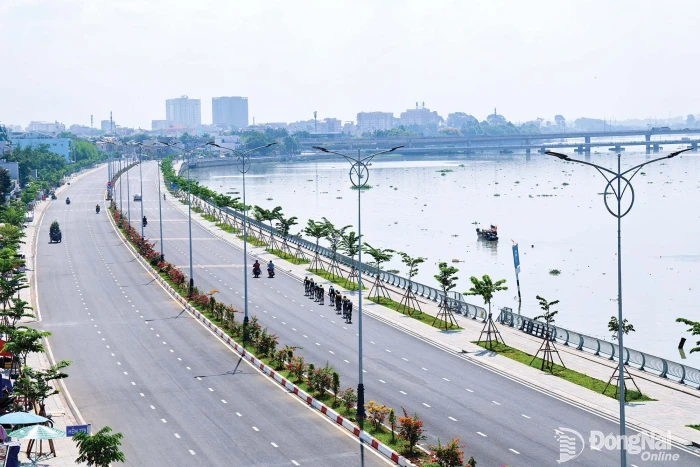
| A corner of Tran Bien Ward, the central urban area of Dong Nai City. |
In the spirit of the Urban Development Law, the People's Councils no longer perform only decision-making and supervisory functions within the traditional administrative management framework. They are better positioned to proactively specify mechanisms and policies tailored to the distinctive characteristics and development requirements of each urban area. This creates further room for the municipal People's Councils to issue resolutions and policies aligned with development needs in planning, investment, land, infrastructure, science and technology, innovation, digital transformation, and the attraction of social resources.
Specifically, the municipal People's Councils have the authority to decide on investment policies for public investment projects and public-private partnership (PPP) projects of national significance that use the municipal budget or other lawful sources of funding, excluding nuclear power plant projects.
The municipal People's Councils may decide on investment policies for public investment projects and PPP projects within the city that use central budget funds, official development assistance (ODA), or foreign concessional loans and fall under the decision-making authority of the National Assembly or the Prime Minister, in cases where such authority is delegated by the National Assembly or the Prime Minister. The municipal People's Councils may also decide on adjustments to investment policies for public investment projects and PPP projects already approved by the National Assembly or the Prime Minister and for which the municipal People's Committees have been assigned as the managing agencies, provided that such adjustments do not increase investment capital from the central budget, ODA, or foreign concessional loans.
 |
| Construction of a social housing project in Phuoc Tan Ward, Dong Nai City. |
The municipal People's Committees will regulate the assessment of projects' compliance with planning based on the principles of planning law when approving or sanctioning investment policies, deciding on investment policies, designating project owners, making investment decisions, selecting investors, and issuing investment registration certificates.
The Chairpersons of the municipal People's Committees have the authority to decide on investment policies for projects under the jurisdiction of the municipal People's Committees in accordance with laws on public investment and investment under the public-private partnership method.
The Chairpersons of the municipal People's Committees approve investment policies for investment projects falling under the Prime Minister's authority in accordance with investment laws, excluding investment projects involving betting or casino businesses; nuclear power plant projects; foreign-invested projects in the fields of telecommunications infrastructure, publishing, and the press; and projects in the defense and security sector with top-secret classification within the city.
For large and important projects requiring the application of special mechanisms and policies that differ from those stipulated by laws, resolutions of the National Assembly, ordinances, resolutions of the National Assembly Standing Committee, the municipal People's Councils may decide on such special mechanisms and policies upon receiving approval from competent authorities and after consulting relevant central authorities.
Compared with the past, the Urban Development Law stipulates that the municipal People's Councils are authorized to decide on criteria, conditions, sequences, procedures, and forms for selecting investors and contractors, as well as contract types and payment mechanisms for PPP projects. This provision also applies to the authority, sequence, and procedures for implementing urgent or emergency projects and works in their respective cities.
In addition, the law provides for direct appointment of contractors and investors, as well as the selection of investors or contractors in special cases for urgent or emergency projects or works, or for projects, works, or work items that need to be implemented immediately to ensure project progress. It also covers mechanisms and policies for investment, infrastructure management, and other support measures for the development of legal services and international dispute resolution within the cities.
Removing difficulties and obstacles facing delayed projects
 |
| The intersection of the Phan Thiet–Dau Giay Expressway and National Highway 56 in Hang Gon Ward, Dong Nai City. Photo: Pham Tung |
The Urban Development Law will create additional mechanisms to address projects that have been stalled for many years or are progressing slowly due to obstacles related to procedures, planning, land, investment, and responsibilities among management agencies. In reality, many large-scale projects that have mobilized significant resources remain "frozen" because of prolonged legal bottlenecks, resulting in wasted land, capital, and development opportunities.
For projects decided on or approved by the municipal competent authorities in accordance with laws on public investment, investment, public-private partnerships, housing, and bidding that were delayed before the effective date of the Urban Development Law, the municipal People's Councils may issue or decide on special policies and measures that deviate from legal provisions to resolve difficulties and obstacles, provided that they comply with the principles and requirements of the Urban Development Law.
Specifically, there must be inspection or examination conclusions or legally effective court judgments identifying that the violations or irregularities were caused by the fault of state management agencies or the joint fault of state management agencies, investors, and project owners. The resolution of difficulties and obstacles must be carried out concurrently with the process of addressing responsibilities in accordance with inspection or examination conclusions or court judgments, ensuring that no new irregularities are created and that there is a plan to remedy damages.
For projects subject to ongoing criminal, administrative, or civil proceedings, the provisions of this clause shall be applied only after legally effective court judgments have been issued or decisions to terminate the proceedings have been made. In cases where legally effective court judgments contain provisions for handling that differ from those issued by the municipal People's Councils under this clause, the court judgments shall prevail.
Organizations and individuals committing violations must be strictly handled in accordance with Party regulations and State laws, ensuring the remediation of economic consequences and the recovery of material benefits gained through violations. Irregularities must not be legalized, and no new irregularities may be allowed to arise. Organizations and individuals who take advantage of the implementation of this clause to engage in corruption, negativity, or shield violations must be inspected, supervised, and strictly handled.
The handling process must ensure consistency with objective reality and specific historical circumstances; ensure a balance between the interests of the State, the legitimate rights and interests of related entities, and the legitimate interests of third parties within the overall national interest as prescribed by law; ensure security, order, and social safety; and minimize disputes and complaints, especially those involving foreign elements.
 |
| Phuoc Khanh Bridge on the Ben Luc - Long Thanh Expressway. Photo: Pham Tung |
Projects must be classified based on criteria regarding the causes of delay. Decisions on resolution measures must be appropriate to the legal status, financial obligations, level of violation, and feasibility of continuing each project.
Information on the projects, difficulties, obstacles, and all sequences, procedures, and decisions for handling the projects must be fully disclosed. The status of project handling must be reported to the Government annually before December 31 if policies or measures differing from those of the Government, the Prime Minister, or ministers or heads of ministerial-level agencies are applied. A report must be submitted to the National Assembly Standing Committee if such policies or measures differ from the regulations of the National Assembly or the National Assembly Standing Committee.
The handling of delayed projects as stipulated must be completed no later than December 31, 2031. The handling of delayed projects as provided for in this clause does not alter or terminate civil liability or other legal responsibilities in accordance with inspection or examination conclusions or legally effective court judgments, if any.
Investors may be granted an extension of a project's operating period before the expiry of that period, except in cases where the Investment Law does not permit extensions.
By Hai Thanh – Translated by Minh Hong, Thu Ha


Thông tin bạn đọc
Đóng Lưu thông tin