
Dong Nai strives to become a city developed along an airport-oriented, riverside, multi-center, multi-objective, green, and smart urban model, while serving as a hub for high-tech industry, aviation, aerospace, and an aviation economy meeting international standards.
 |
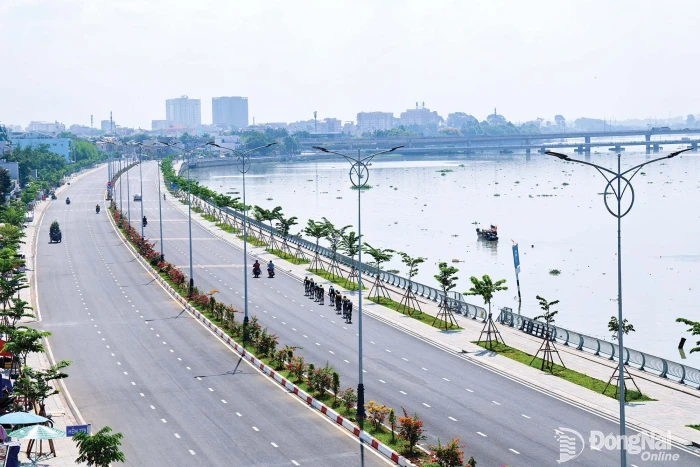
| A view of Phuoc An Port in Phuoc An Commune, Dong Nai City. |
Recently, the city has focused on a range of measures to encourage and support businesses in developing modern production and supply models, adopting advanced technologies, and gradually meeting requirements and standards for green production and consumption, with a view to developing a circular economy.
Expanding and connecting development space
Located at the strategic intersection of the Southeast, Central Highlands, and Mekong Delta, Dong Nai has all five modes of transportation: road, railway, inland waterway, maritime, and aviation.
Together with Long Thanh International Airport, Phuoc An Port, Hoa Lu International Border Gate, and a network of expressways totaling nearly 400 km, Dong Nai is forming a modern inter-regional and international connectivity system, becoming a transit, logistics, and industrial hub in southern Vietnam. Flows of goods, logistics, investment, and technology not only circulate within the locality but also connect Vietnam with the ASEAN region and the global supply chain.
According to many experts, with these advantages, Dong Nai is asserting its role as a strategic link in regional and global supply chains. The locality is strategically positioned to connect the East-West Economic Corridor, the Cai Mep – Thi Vai deep-water port cluster, Long Thanh International Airport, and the system of key industrial parks, creating a seamless network linking research, production, supporting industries, logistics, and exports. This provides a foundation for enhancing competitiveness, strengthening supply chain adaptability, and attracting high-quality investment inflows.
At the forum "Developing Smart – Eco Industrial Parks – a Driving Force for Investment Attraction and Green Economic Development in the Southeast Region," held in Dong Nai at the end of July 2026, Chairman of the Vietnam Chamber of Commerce and Industry (VCCI) Ho Sy Hung stated that developing eco-industrial parks is not only the "key" to addressing industrial environmental issues but also an effective strategy for building highly competitive industrial clusters. Therefore, transitioning industrial parks toward sustainability across all three aspects – environmental, economic, and social – is an objective and inevitable trend.
According to many experts, to promote the development of smart and eco-industrial parks, Dong Nai needs to continue taking a proactive and innovative approach to investment promotion, particularly in attracting foreign investors with strong financial capacity and sound management capabilities who are committed to long-term investment in Vietnam and willing to participate in eco-industrial park development projects. The locality also needs to strictly comply with incentive and investment encouragement mechanisms for eco-industrial park development as stipulated by the Government. At the same time, Dong Nai needs to make effective use of regional linkage mechanisms in industrial development to both capitalize on its strengths and advantages and foster linkages and cooperation among eco-industrial parks in other localities, as well as among regions, in forming an interconnected chain spanning the supply of raw materials and fuels, logistics, and consumer markets.
Ho Sy Hung emphasized, "We believe that with close cooperation between state agencies, the business community, and investors, Dong Nai in particular and the whole country in general will soon form a system of eco-industrial parks to welcome even more new-generation investment inflows."
Deputy Head in charge of the Dong Nai Industrial Parks and Economic Zones Authority Pham Viet Phuong said that Dong Nai is oriented toward developing a modern industrial ecosystem integrating supporting industries, smart logistics, digital transformation, green energy, and eco-industrial parks. This is the foundation for the locality to attract high-tech projects and enhance the quality of investment inflows.
Promoting green consumption and smart logistics
Along with developing green production and building smart and eco-industrial parks, Dong Nai is also placing increasing emphasis on a green transition toward sustainable consumption. The trade and service sectors in the area are paying greater attention to "greening" solutions by eliminating single-use plastics, adopting clean energy, and digitizing operational processes. This shift on the supply side has significantly raised consumer awareness, turning it into practical daily actions.
In the current context of integration and scientific and technological development, to enhance competitiveness through technological transformation, local businesses need to accelerate digital transformation activities, promote the circular economy, and boost green production and consumption solutions, thereby contributing to the locality's efforts to realize the roadmap for carbon reduction and move toward the net-zero goal.
Trang Phuc, a representative of the marketing department at Co.opmart Bien Hoa in Tam Hiep Ward, said, "In recent times, consumers have become increasingly interested in fresh food and agricultural products that are clean and have clear origins, especially prioritizing products that meet VietGAP and GlobalGAP standards."
Bich Phuong, a resident of Tran Bien Ward, shared, "Consumers like me are increasingly interested in green and sustainable consumption. Currently, I am also getting used to supermarkets and shopping malls charging fees when customers request plastic bags at checkout. Besides that, choosing to buy products with environmentally friendly packaging and energy-saving features is also becoming more common. To promote green consumption more effectively, in my opinion, businesses and local supply chains need to have more practical activities and models to propagate and spread a positive, civilized, and sustainable consumption trend and culture."
In addition, to keep pace with broader trends and enhance the competitiveness of services, developing green and modern logistics is a goal that local businesses are working to achieve. Localities, including Dong Nai, need solutions to promote science and technology, strengthen chain linkages in port services and transport support, and develop human resources, while accelerating the green transition and sustainable development amid increasingly deep integration.
According to many experts, investment in green port infrastructure, the modernization of equipment powered by clean energy, and the development of green supply chains, transport corridors, and logistics will be important drivers of greater competitiveness and a stronger position for the local port and logistics services sector.
Permanent Vice Chairman of the Dong Nai Logistics Association Nguyen Duy Hung shared that developing a logistics ecosystem optimized for supply chains will help promote the development of the port and logistics system, enabling the locality to seize new opportunities. Dong Nai needs to strengthen linkages in port system development and accelerate administrative procedure reform in the fields of logistics and import and export, thereby facilitating cost optimization across goods supply chains, with a view to building a professional, modern, and sustainable logistics community in the area. The implementation of a smart and integrated logistics service system is a key factor in "retaining" investors and boosting exports.
By Hai Quan – Translated by Minh Hong, Minho


Thông tin bạn đọc
Đóng Lưu thông tin