
The Dong Nai river not only plays a vital role in supplying water resources and regulating the ecological environment, but also possesses exceptional value in terms of landscape, commerce and urban development. However, for many years, the economic potential along the riverbanks has not been fully tapped in proportion to the advantages that Dong Nai possesses.
 |
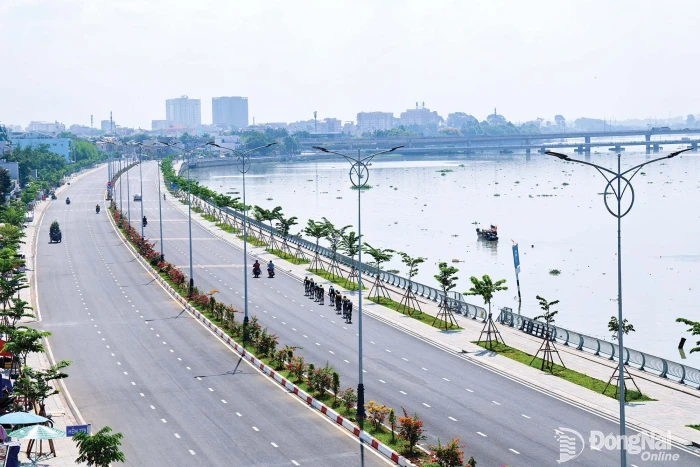
| A view of the riverside urban area along the Dong Nai river section passing through Tran Bien ward. |
As Dong Nai has assumed its new status as a city, the need to develop a riverside economy has become more evident than ever before.
Great potential still untapped
Some experts believe that Dong Nai has numerous advantages for developing a riverside economy and urban areas, yet these advantages have not been fully utilized. Dr., Architect Ngo Viet Nam Son, Chairman of NgoViet Architects & Planners (Ho Chi Minh city), stated that Dong Nai possesses a unique advantage that few urban centers enjoy: it boasts both a strongly developed industrial and logistics system and a major river flowing through the urban core.
According to Son, now that Dong Nai has become a city, the mindset for riverside development must also change. The riverbanks can no longer be viewed merely as locations for small-scale housing developments or fragmented projects. Instead, they should be developed into strategic spaces for services, tourism, landscape development and a modern urban image of the city.
In reality, many areas along the Dong Nai river remain underutilized. A number of locations still suffer from uncoordinated development, limited transport connectivity, and a lack of public parks, river ports and modern service spaces.
Dang Van Diem, Chairman of the Dong Nai Business Federation, remarked that few localities possess river advantages comparable to Dong Nai. Several of Vietnam’s most prominent riverfront cities feature iconic bridges spanning their rivers, while Dong Nai has yet to achieve this. According to Diem, this issue should be carefully considered in urban planning, architecture and landscape design.
In addition, Diem suggested that the city should prioritize investment in riverside roads connecting the administrative center with the Nhon Trach area, along with landscape parks and tourism infrastructure. Such investment would enhance the value of the entire river basin and serve as an important factor in attracting strategic investors to participate in developing large-scale projects, thereby making better use of the locality’s potential and advantages.
Reshaping the riverside landscape
In recent years, Dong Nai has implemented numerous major infrastructure projects in riverside areas, particularly in central locations and areas with strategic advantages.
The city has invested in key regional connectivity projects such as the Dong Nai riverside road Project (section from Hoa An Bridge to Tan Trieu ward), the Central Axis road project (from Vo Thi Sau street to Dang Van Tron street), Cai River riverside road, and Huong Lo 2. These projects have created modern riverside transportation and landscape corridors while enhancing urban connectivity with Ho Chi Minh city.
In local long-term development vision, the river system and natural ecosystem have been identified as strategic landscape corridors that will shape the distinctive identity of Dong Nai’s urban environment. The Dong Nai river serves as the core element for developing a green, ecological and smart riverside urban model capable of adapting effectively to climate change.
Alongside public infrastructure investment, a number of major projects developed by large corporations near the Dong Nai river are playing a leading role. These include the nearly 300-hectare Hiep Hoa urban area, the Aeon Mall trade center, Aqua City, and more recently, a smart riverside urban area in Dai Phuoc commune. In particular, the transformation of the former Bien Hoa 1 Industrial Park into a modern urban-commercial-service complex has become one of the city’s priorities. These projects are opening up vast new development opportunities, stimulating consumption, creating jobs and improving residents’ quality of life.
To better capitalize on the inherent advantages of the riverside corridor, Dong Nai should take advantage of its new city status not only through infrastructure investment but also by developing riverside parks, pedestrian streets, shopping centers, marinas and modern service complexes, rather than allowing riverside land bank to be fragmented and exploited for short-term purposes. Investing in and attracting businesses to help build the Dong Nai riverside economy is no longer merely a long-term orientation but has become an urgent task to create new growth drivers for the city.
At a recent meeting of the City Steering Committee for Business Support and Economic Development on May 28, Member of the Standing Board of the City Party Committee and Standing Vice Chairman of the City People's Committee Nguyen Kim Long stated that the city had recently adopted a policy to study raising the clearance heights of existing bridges spanning the Dong Nai river in order to better exploit inland waterway transportation and attract more businesses to the locality.
“We have invested in several beautiful riverside roads. However, the issue is how to fully utilize the functions and benefits these projects can deliver. These landscape corridors should not simply serve street vendors or a handful of restaurants. They must feature modern landmark projects. This is an important task in planning, construction and reshaping the image of the Dong Nai river that relevant agencies of the city need to carefully calculate and urgently implement, particularly to meet the requirements and responsibilities of a dynamic riverside city”, Standing Vice Chairman of the City People's Committee Nguyen Kim Long emphasized.
By Vuong The - Translated by Diec Quyen, Thu Ha


Thông tin bạn đọc
Đóng Lưu thông tin