
Databases serve as a critical foundation for digital transformation. Data systems play a pivotal role, affecting all activities in the digital environment, and are regarded as a valuable new resource for exploitation and effective use.
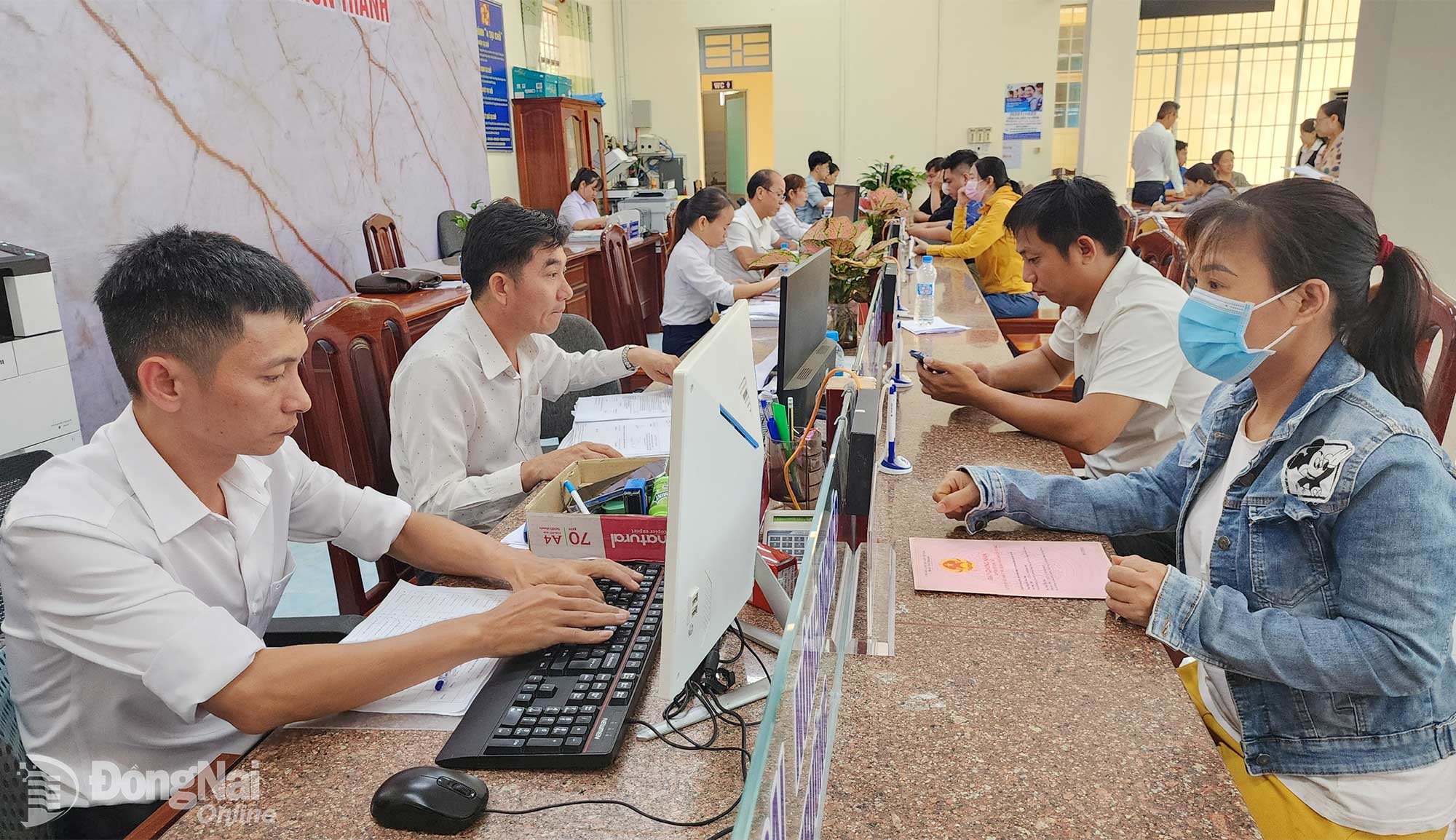 |
| Citizens complete administrative procedures at the Chon Thanh ward Public Administrative Service Center. |
Recognizing the importance of data systems, agencies, departments and sectors across Dong Nai City have actively developed and improved their databases, ensuring that data is accurate, complete, clean, up-to-date and unified. These efforts have laid a solid foundation for the development of a citywide shared database.
Enriching the database system
With identity cards or chip-based citizen identification cards, people can conveniently register for medical examinations and treatment anywhere, as health insurance (HI) card information has been integrated with the national population database. In Dong Nai City, 100% of medical examination and treatment facilities have implemented HI-covered services using identity cards or chip-based citizen identification cards, meeting requirements for retrieving HI card information through personal identification numbers. By late April 2026, the city had successfully processed more than 14.5 million HI card information lookups using identity cards or chip-based citizen identification cards, supporting HI-covered medical services and data connectivity with other sectors.
The Dong Nai health sector is accelerating the interconnection of birth certificates with the HI Assessment Portal while implementing digital signatures, standardizing data structures, and enhancing service delivery for two groups of interconnected administrative procedures: birth registration, permanent residence registration, the issuance of HI cards for children under six years old; and death registration, deregistration of permanent residence, and the settlement of funeral and survivor benefits. The integration of digitally signed birth certificate data is a key component of the implementation of the Government’s Project 06 on developing population data and electronic identification and authentication applications to support national digital transformation.
Data connectivity between the social insurance (SI) sector and agencies in public security, justice, health, education and training, labor, and taxation is being strengthened through the national insurance database. When citizens complete administrative procedures at communes or wards, information is synchronized with the national database system, enabling relevant sectors to share and use the data efficiently.
Nguyen Thi Thu Tam, a civil servant at the Bu Dang commune Public Administrative Service Center, said that interconnected data is an important digital asset that will be reused in the handling of subsequent administrative procedures, helping citizens avoid repeatedly declaring information that already exists in the system. Standardized and enriched data also helps shorten processing times, reduce errors, and ease the workload for both citizens and frontline administrative officers.
These improvements are the result of the SI sector’s sustained efforts to develop and enhance its database system over recent years. The sector has proactively updated and standardized data on participants and beneficiaries of SI, HI, and unemployment insurance programs. At the same time, it has strengthened coordination with relevant departments and sectors to promote data sharing and interconnection.
To Thanh Dong, Director of the Binh Phuoc SI Branch under Dong Nai City SI, said that most data on participants and beneficiaries of SI and HI policies have been synchronized and verified through personal identification numbers and citizen identification cards. The SI sector has provided 70 fully online public services integrated with the National Public Service Portal. As of the end of April 2026, Dong Nai City SI had verified 99.62% of citizen information in its managed database against the National Population Database.
The Dong Nai City Intelligent Operations Center has been developed based on a shared data warehouse model, connecting and integrating information from departments, agencies, sectors, and localities across the city. Data sources are continuously collected, standardized, and updated to ensure they are accurate, complete, clean, up-to-date, unified, and shared. This provides real-time information to support leaders at all levels in monitoring developments and enhancing the effectiveness of governance and administration.
Nguyen Minh Quang, Deputy Director of the Dong Nai Department of Science and Technology
Continuously updating and cleaning data
Databases with an established foundation, along with centrally developed databases, have been and continue to be digitized and synchronized to ensure consistency and effective use. The Department of Agriculture and Environment, for example, is managing and operating approximately 2.7 million land plots through the DNAI.LIS software. Of these, nearly 1.8 million certified land plots have been reviewed, updated, and synchronized with the national land database managed by the Ministry of Agriculture and Environment, facilitating data sharing and use.
Since the completion of the campaign to enrich and cleanse the national land database in late 2025, communes and wards have continued efforts to ensure that all land plot records are accurate, complete, clean, and up-to-date. At the same time, local authorities have continued to enhance and cleanse the national land database by assigning identification codes to land plots and synchronizing the information with the system. Each identified land plot serves not only as a legal record but also as a commitment to a service-oriented, transparent, and professional administration.
Trinh Quang Hung, Deputy Director of the Chon Thanh Branch of the Land Registration Office, said that the branch has reviewed, classified, and updated data for more than 61,000 land plots. The determined efforts to complete the land database not only strengthen local resource management but also provide an important foundation for advancing administrative reform and enhancing the locality’s investment attractiveness.
In addition, the tax sector has standardized 97.78% of personal tax identification numbers. The education and training sector has updated and cleansed data for 86% of students across the city, while 85% of personnel records in the education sector have been verified. Other sectors and fields are also finalizing the review, collection, updating, and cleansing of citizen information to support data connectivity, sharing, and effective use.
Ensuring the free flow of data is not the responsibility of any single agency or sector alone. At its core, success depends on the innovative mindset of public institutions and the dedication of cadres and civil servants. Accurate, complete, clean, and up-to-date data provides a solid foundation for Dong Nai to advance toward a modern urban government model, paving the way for a prosperous and sustainable digital future.
By Ngan Ha – Translated by Minh Hong, Thu Ha



Thông tin bạn đọc
Đóng Lưu thông tin