
Dong Nai boasts a history spanning nearly 330 years of formation and development, starting from the journey of southward expansion to the threshold of becoming a centrally governed city. Throughout its developmental journey, the locality has always carried with it a rich and distinctive cultural legacy. Preserving and promoting these core cultural values is how the province moves forward, while also retaining its historical memory and cultural depth.
In this new phase of development, Dong Nai has the potential to emerge as a model of a modern city that is dynamic yet far from monotonous, the one that continues to grow while retaining its cultural richness. Its accumulated layers of history, intertwined cultural flows, and its people - simple, dynamic, and compassionate - form a solid foundation for the province to continue moving forward on its journey.
From an open land shaped by history…
When mentioning Dong Nai’s journey toward becoming a centrally governed city, attention often turns to economic growth, expanding infrastructure, green and modern industrial zones. Yet, beneath these visible transformations lies a deeper and more enduring strength: its diverse cultural heritage, quietly shaped over centuries.
 |
| A dance performance at the Rain-Praying Festival of the S’tieng community in Tan Khai commune. |
From its earliest days, Dong Nai was an open land. During the southward expansion of the Vietnamese people, the land became a stopover and a meeting point for successive waves of settlers. Alongside this, long-established indigenous communities with their rich cultural heritage coexisted with the newcomers and shaped a space of cultural convergence, where each cultural trait retained its distinct identity, while still blending into a shared whole. Each wave of settlers left its mark, like layers of sediment quietly accumulating over time, creating a rare and profound cultural depth.
The southward expansion, as recorded in historical accounts, shows that Dong Nai was not merely a land of “white rice and clear water,” but also a place shaped by generations of early settlers who overcame hardships to reclaim and cultivate this favorable land. They endured harsh conditions, “crocodiles in rivers and tigers in the forests”, before laying the foundations for economic development, social stability, and public order, ultimately shaping the present-day Dong Nai.
According to Nguyen Khac Vinh, Deputy Director of the Provincial Department of Culture, Sports and Tourism, Dong Nai’s cultural identity is also deeply rooted in its geographical position as a transitional zone linking the Central Highlands, the Southeast, and the Southwest, each with its own distinct characteristics. Over time, as an open land, Dong Nai has attracted multiple communities across different historical periods. While diverse, these cultures have coexisted in unity, interacting and blending across regions and cultural streams, thus contributing to the dynamism, warmth, and harmony that define both the culture and the people of Dong Nai.
Endowed with favorable geographical conditions and a mild climate, and long regarded as a “good land for birds to perch,” Dong Nai continues, in this era of integration and development, to welcome workers from across the country. As they arrive and choose to stay, they bring with them their customs, culinary traditions, and crafts, gradually shaping a rich and multi-layered cultural landscape.
Developing culture on par with a modern city
Amidst approaching changes, as Dong Nai stands on the threshold of becoming a centrally governed city, a key question emerges: how can it move forward more rapidly without losing its identity? As urban space continues to expand, core cultural values must be preserved and promoted. Alongside economic growth, culture must develop proportionately. That is when Dong Nai assumes the look of a modern city - yet remains instantly recognizable, not merely through new infrastructure, but through a familiar and enduring cultural identity.
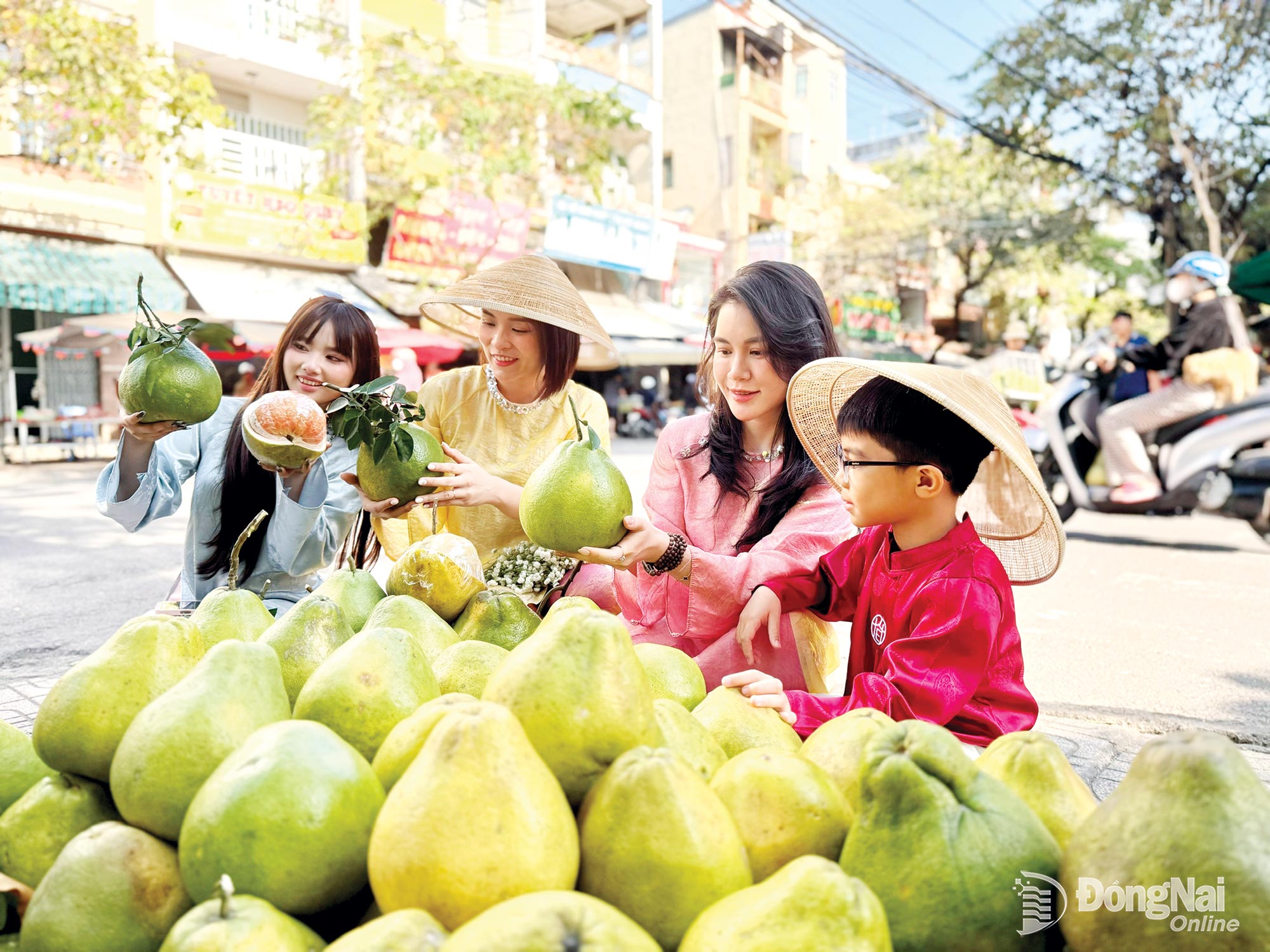 |
| A visitor purchases Tan Trieu pomelos, a Dong Nai specialty, at Bien Hoa Market. Photo: Nhat Ha |
According to Dr. Nguyen Van Quyet, a cultural expert, cultural values lie not in grand things but are embedded in everyday life - in the way people eat, dress, greet one another, and maintain their customs and way of living. As urbanization accelerates, such seemingly small details are often the most vulnerable to being overlooked. For this reason, preserving culture must begin with daily life. Younger generations should be encouraged to understand and carry forward traditional practices, ensuring that culture is not confined to museums but continues to live in people’s minds and hearts.
Cultural identity, by its nature, is not something that exists only in nostalgia. Even amid material change, it still endures in how Dong Nai’s people preserve traditional dishes, heritage sites, and festivals, as well as in the stories they pass on to future generations. Ultimately, a great city is defined not only by economic growth or large-scale infrastructure but also by its cultural depth and collective memory. This will transform Dong Nai into a contemporary, sustainable location where past and future coexist.
While southern Dong Nai reflects rapid urbanization and industrial growth, marked by continuous renewal and strong cultural interaction, the northern areas of the province remain closely associated with the lifestyles of ethnic minority communities such as the S’tieng, Choro, and M’nông, where cultural values have been preserved across generations.
The more the economy develops, the more important it is to nurture and preserve the cultural foundation. According to Nguyen Khac Vinh, Deputy Director of the Department of Culture, Sports and Tourism, Dong Nai’s transition to a centrally governed city also presents an opportunity to conserve, restore, and promote local cultural values. In this context, it is essential to maintain a consistent perspective that places culture at the core, guiding future planning and development. Efforts should also be made to cultivate and promote the values of the people of Dong Nai in the years ahead.
Sharing her expectations, Thuc Ngan, a resident of Tran Bien ward, expressed that beyond expanding cultural spaces and activities, greater attention should be given to nurturing cultural values in everyday life. This, she noted, is key to ensuring that culture develops in a way that matches the standards of a modern, livable city in the future.
By Nhat Ha – Translated by Minh Hong, Thu Ha


Thông tin bạn đọc
Đóng Lưu thông tin