
Dong Nai City is entering a period of accelerated development with its airport, seaports and numerous industrial parks, driving a substantial demand for human resources, particularly highly skilled workers.
To meet this demand in the coming years, the city People’s Committee has directed the Department of Home Affairs and the Department of Education and Training to reorganize the network of public vocational training institutions while preparing resources to restructure the system toward greater efficiency, modernization and higher quality.
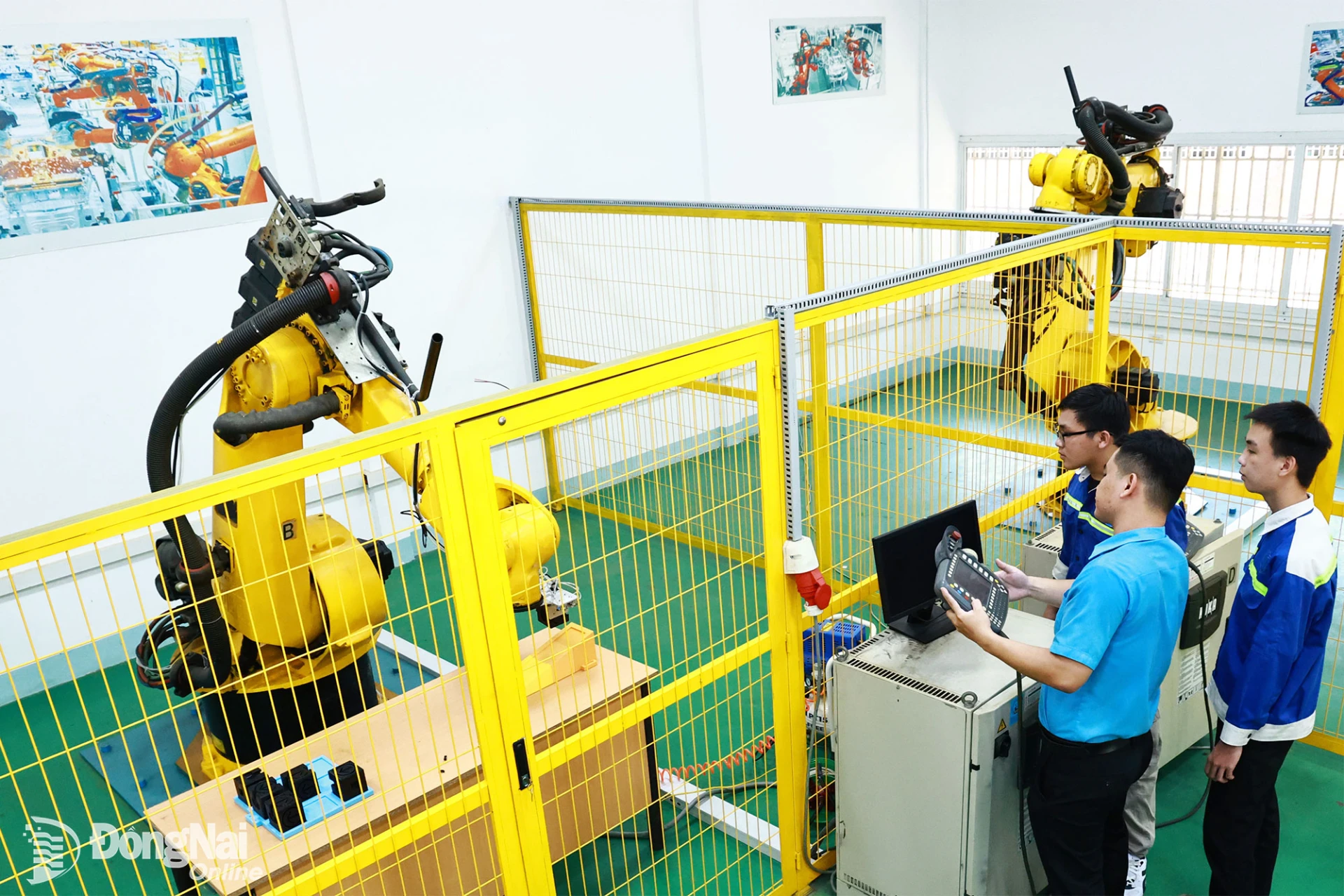 |
| The automated robotic arm training workshop at Lilama 2 International Technology College. |
A diverse but fragmented and overlapping network
According to a report by the municipal Department of Home Affairs, Dong Nai directly manages four public colleges and intermediate-level vocational institutions with relatively large training capacities: Dong Nai College of Engineering and Technology, Binh Phuoc College, Dong Nai Medical College and Dong Nai Intermediate School of Culture and Arts. These institutions offer a relatively broad range of training programs to meet diverse learning needs. However, their training quality remains limited and does not yet fully meet businesses’ labor requirements. Most schools are also unable to cover their operating costs entirely through training activities and continue to rely on annual state budget allocations.
The city is also home to four public colleges managed by central government agencies, including the College of Machinery and Irrigation, Dong Nai College of Decorative Arts, College of Statistics II, which has been converted into a campus of the University of Finance – Marketing, and Lilama 2 International Technology College, as well as an intermediate-level school under the Vietnam General Confederation of Labour. Notably, the Prime Minister has approved in principle the transfer of Lilama 2 International Technology College, currently under the Ministry of Industry and Trade, to Dong Nai for direct management, with preparations underway for the handover.
Over the years, the city has made efforts to streamline its vocational education network, dissolving or merging several institutions. However, significant shortcomings remain. Although the number of administrative units has been reduced, individual institutions still operate campuses at multiple locations. A case in point is Dong Nai College of Engineering and Technology, formed in 2025 through the merger of Dong Nai High-Tech College and Dong Nai Technical College. Despite the merger and renaming, the institution continues to operate three separate campuses in Nhon Trach, Long Thanh and Tran Bien wards. Each campus has substantial land and facilities, but these resources have yet to be fully utilized for training.
Similarly, Binh Phuoc College manages four separate properties. Operating 28 distinct training programs across multiple campuses has fragmented its investment resources, making it difficult to develop practical training workshops that meet modern industrial standards. This fragmentation of facilities is a major bottleneck that constrains workforce training and wastes the city’s resources. Meanwhile, the Northern part of the city still lacks sufficient highly skilled workers, even as the city plans to attract heavy industry to the area to create more jobs.
A key weakness holding back the entire network of colleges and intermediate-level vocational schools is the overlap in training disciplines. Few institutions have established a distinctive reputation for training quality. Most have been reluctant to develop new curricula, focusing instead on teaching “what they already offer” rather than “what businesses need.”
When vocational education institutions are unable to achieve financial autonomy, they lack the resources to reinvest in modern training equipment and technologies. Without a sufficiently comprehensive and decisive restructuring, the system risks falling further behind and failing to supply the highly skilled workers that the labour market urgently needs.
According to Hoang Minh Son, Member of the Party Central Committee, Minister of Education and Training, Dong Nai has ample land and facilities to become a major workforce training center for southern Vietnam and the country as a whole, particularly given its rapidly developing infrastructure. High-quality transport connectivity will be especially attractive to companies using advanced technologies. Once the “triple-helix” ecosystem linking the State, educational institutions and businesses operates effectively, supported by a diverse range of training disciplines, Dong Nai will not only address its labor shortage but also have the potential to become a leading hub for knowledge-based industry.
Building an integrated training ecosystem
To comprehensively address these shortcomings, the city People’s Committee is directing the development of a plan to reorganize public vocational training institutions. Specifically, Binh Phuoc College is expected to undergo major changes, with different groups of training disciplines potentially transferred to institutions with corresponding strengths. Its four existing properties could be restructured into shared practical training centers. Under this open model, the centers would serve students from multiple vocational institutions and could also function as assessment and skills-enhancement facilities for workers at industrial parks.
According to the municipal Department of Education and Training, it is finalizing a strategy for high-quality vocational training in the new development phase. A training ecosystem for spearhead industries needs to be established as soon as possible, focusing on aviation, logistics, precision engineering, automation, semiconductor chips, artificial intelligence (AI), tourism services and modern management. This ecosystem would be closely linked to Long Thanh International Airport, Phuoc An Port, new-generation industrial parks and high-end tourist destinations preparing to begin operations. Reorganizing vocational training institutions and restructuring their training programs are therefore essential, particularly to introduce new disciplines such as aviation, semiconductor technology and AI. Although these fields require substantial resources and pose significant training challenges, a strong commitment to developing them is necessary to achieve a breakthrough.
Nguyen Khanh Cuong, Rector of Lilama 2 International Technology College, said the institution was in the process of being transferred from the Ministry of Industry and Trade to the direct management of the Dong Nai City People’s Committee. The college is being positioned as a leading center for aviation support workforce training and engineering and technology education in southern Vietnam. It has proactively signed strategic cooperation agreements with major partners, including Vietjet Air, Airports Corporation of Vietnam and international vocational training organizations. The college also hopes to be upgraded to a vocational university so it can train highly qualified practical engineers to international standards.
Vocational training experts said that once the institutional network had been streamlined, the city would need to fundamentally change its approach to budget management, moving away from per-capita funding toward competitive bidding and commissioned contracts for specialized training. Public funding should be allocated according to clear priorities for each group of disciplines, closely aligned with local workforce demand. With adequate investment, vocational institutions could improve training quality, build stronger reputations among students and employers, and increase their financial autonomy. This would reduce their dependence on state funding while helping establish a sustainable and professional ecosystem for supplying skilled workers.
The most far-reaching social benefit of a high-quality vocational education system would be its ability to reshape educational pathways for students after graduating from secondary and high school. Modern training centers that offer reliable employment prospects and competitive incomes could help eliminate social prejudices against vocational education. They would also serve as a strategic lever for narrowing socioeconomic development gaps, particularly by providing greater opportunities for disadvantaged students in remote areas and ethnic minority communities who may not have the means to attend university.
By Cong Nghia - Translated by Mai Nga, Thu Ha


Thông tin bạn đọc
Đóng Lưu thông tin