
A host of infrastructure, industrial and energy projects are generating strong demand for equipment, components, structures and mechanical products. However, this demand has yet to translate into orders for domestic businesses. Most mechanical engineering and manufacturing businesses remain involved mainly in simple processing, while higher-value stages such as design, system integration and equipment manufacturing remain limited.
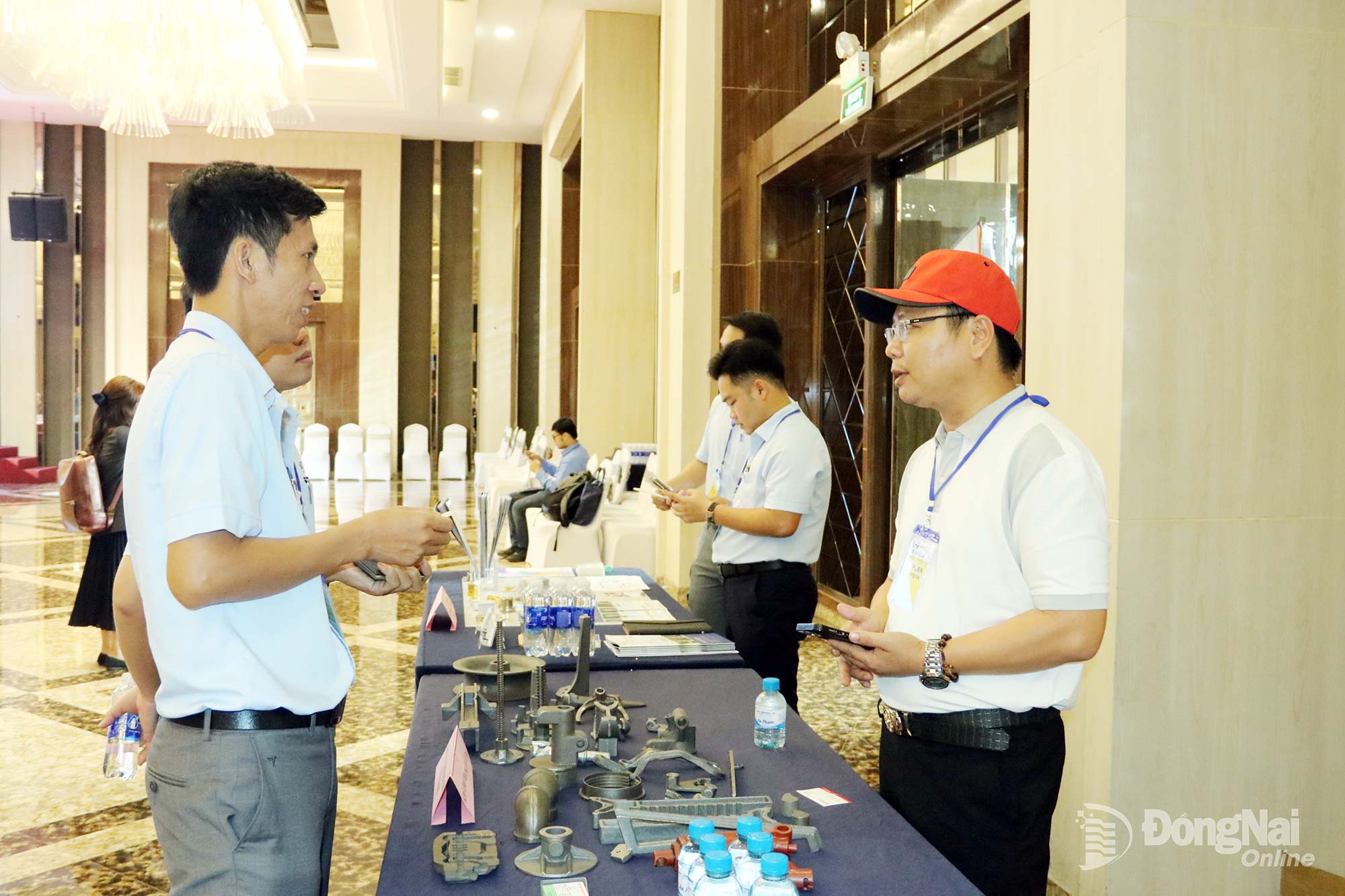 |
| Products of Kim Vinh Thang One Member Co., Ltd. (Ho Nai Industrial Park). |
The challenge facing the mechanical engineering industry, therefore, is not simply a matter of machinery, technology or investment capital. It also lies in how policies connect market demand with domestic production capacity.
From market demand
Nguyen Huu That, Director of Diep Nam Phuong Production and Trading Co., Ltd. (Long Thanh Ward), said the company is continuing to invest in machinery and technology to expand its range of mechanical engineering and manufacturing products. According to That, the development of infrastructure projects and industrial parks is creating additional opportunities for businesses. What the company expects is to have greater opportunities to participate more deeply in the supply chain for products and services.
For a mechanical engineering business, investing in additional CNC machines, inspection and measurement equipment, or automation for a production stage requires substantial capital. Businesses must consider not only the cost of equipment, but also whether there will be orders after the investment, the expected production volume and how long it will take to recover the capital.
This is one of the factors making businesses cautious about upgrading their capacity. When technical requirements, production volumes and opportunities to participate in supply chains are not identified early, businesses are less willing to invest in advance to anticipate market demand.
According to Dang Quoc Nghi, Chairman of the city's Young Entrepreneurs Association, a major difficulty for an innovative business is sometimes not a lack of ideas or capital, but the absence of a sufficiently reputable first customer to validate the value of its products.
From this reality, Nghi proposed that every year, authorities, foreign-invested enterprises and large businesses should announce their actual needs that require solutions, such as saving electricity in factories, agricultural traceability, by-product processing, environmental monitoring, services for workers, operations in airport areas or the digitization of public processes. When needs are presented as specific problems to be solved, businesses have a basis for proposing solutions tailored to partners' requirements. Authorities need to create a level playing field and equal opportunities so that suitable solutions can be demonstrated in practice.
For the mechanical engineering industry, this approach could begin with the early announcement of demand for equipment, spare parts, components, structures, production lines and the technical requirements of major projects. Domestic businesses would then know what the market needs, what they are capable of producing and where they need to invest to strengthen their capabilities.
To move deeper into the value chain, businesses must shift from processing to equipment design and manufacturing, system integration and gradually mastering technologies. However, to invest in this transition, businesses need a clear enough market signal.
Unlocking policy bottlenecks based on production needs
The key change needed in policies supporting the mechanical engineering industry is not merely to help businesses purchase machinery, upgrade equipment or train workers, but to link support with actual market demand.
A business with an order but lacking inspection and measurement equipment needs a different support mechanism from a business that has yet to master design technology. A business that already has products but does not yet meet the standards of a tier-1 supplier needs support in terms of standards, certification and the completion of its production processes. For a business with new products but no first customers, mechanisms for testing, placing orders or pilot implementation could provide an important stepping stone.
This approach could draw on the spirit of Resolution No. 57-NQ/TW, dated December 22, 2024, of the Politburo on developing science, technology, innovation and national digital transformation. The resolution calls for removing institutional barriers, creating favorable mechanisms for innovation and promoting domestically developed technological products. For the mechanical engineering industry, this spirit needs to be translated into specific production challenges: new products must have places to be tested, businesses seeking to enter supply chains must have opportunities to prove their capabilities, and new technologies must have real-world projects in which they can be refined.
Decision No. 929/QD-TTg, dated May 25, 2026, approving the Supporting Industry Development Program for 2026-2035, also identifies mechanical engineering and automation as priority fields. For Dong Nai, the next step is to concretize these orientations based on the capabilities of local businesses. The city needs to identify which mechanical products can be produced immediately, which require additional technological investment, which businesses have the potential to become suppliers, and what conditions they still lack to participate in supply chains.
Accordingly, new policies can determine who should receive support, at which stage and in what form. Support should also be linked to measurable outcomes, with specific timelines and criteria, and focus on products with large market demand, potential to replace imports or opportunities to participate in key projects.
According to Dr. Phan Dang Phong, Director of the National Research Institute of Mechanical Engineering under the Ministry of Industry and Trade, Vietnam's mechanical engineering and manufacturing industry still has substantial room for development. To effectively tap into this market potential, it is necessary to focus on key solution groups such as developing strategic products, mastering technologies, building core mechanical engineering businesses and developing a high-quality workforce. These factors will determine the competitiveness of Vietnamese businesses and their level of participation in domestic and international value chains.
Resolution No. 29-NQ/TW, dated November 17, 2022, of the 13th Party Central Committee on the continued enhancement of national industrialisation and modernisation by 2030, with a vision to 2045, calls for prioritizing resources and establishing sufficiently strong mechanisms and policies to develop priority areas of foundational industries. Accordingly, priority should be given to developing mechanical engineering for the production of agricultural machinery, automobiles, ships, construction equipment, energy equipment, electrical equipment, medical equipment and other fields, while strengthening the self-reliance of domestic businesses.
By Vuong The - Translated by Diec Quyen, Thu Ha




Thông tin bạn đọc
Đóng Lưu thông tin