
The Long Thanh International Airport project is a major national strategic infrastructure project, serving as a key driver of economic development for Dong Nai City's key economic region, the Southern Key Economic Region, and the country as a whole.
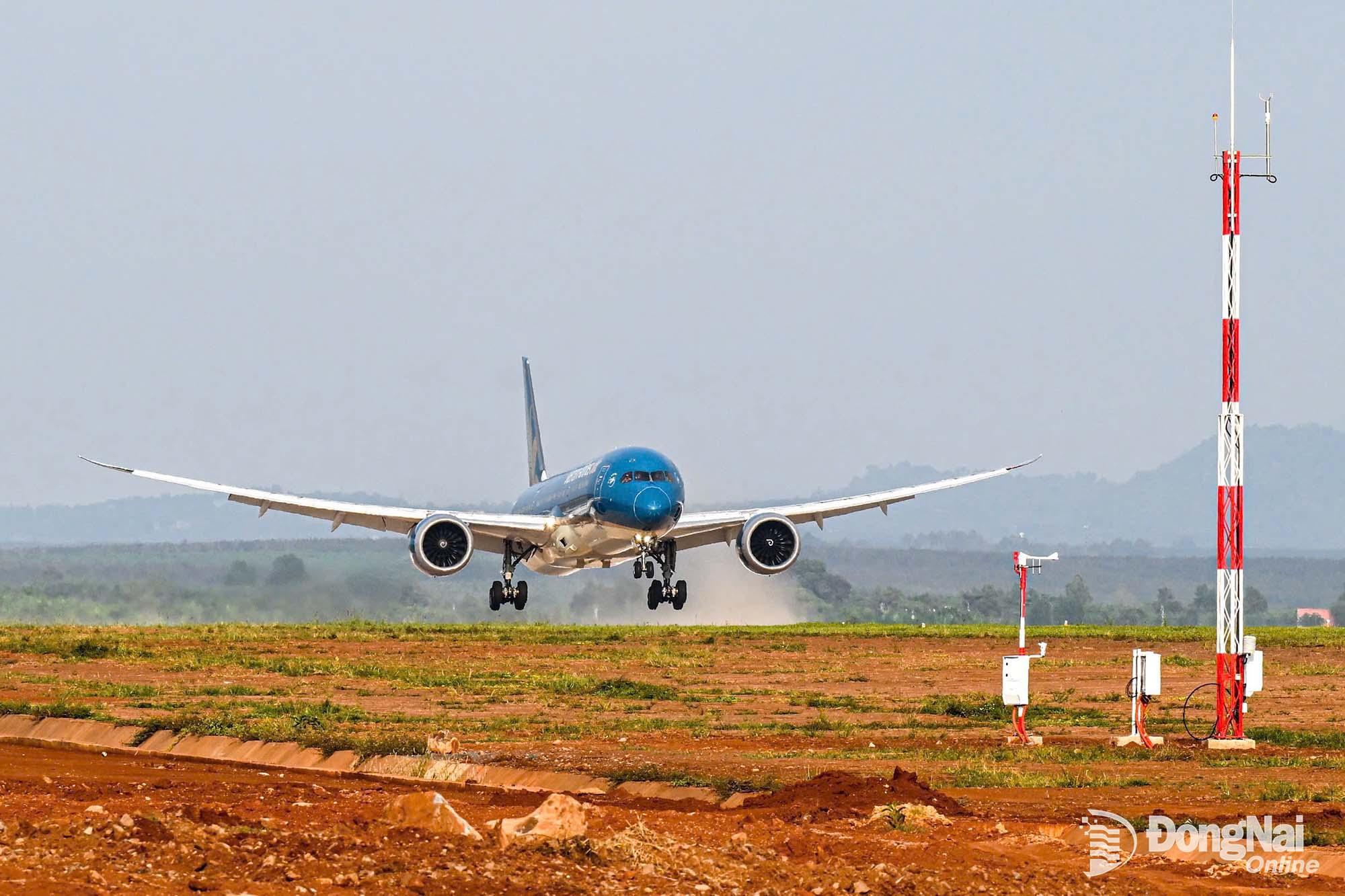 |
| Long Thanh International Airport is expected to welcome more test flights in December and will require a large workforce to support operations. |
Ensuring the smooth operation of Long Thanh International Airport and maximizing its potential will depend heavily on human resources. The Airports Corporation of Vietnam (ACV) and airlines are accelerating recruitment and training to meet the airport's staffing needs. This represents a “golden opportunity” for training institutions and students to acquire new skills and gain access to professional employment opportunities.
Strong demand for skilled workers
Long Thanh International Airport is the largest airport project ever undertaken in Vietnam and one of the largest in Southeast Asia. Phase 1 is designed to handle 25 million passengers and 1.2 million tonnes of cargo annually. By Phase 4, the airport is expected to serve up to 100 million passengers and handle 5 million tonnes of cargo each year. It will form a vast economic ecosystem, generating substantial demand for workers across a wide range of related sectors.
While completing the airport's infrastructure may take only several years, preparing the workforce required to operate it takes considerably longer. In practice, each position requires rigorous training and specialized aviation certification. Consequently, preparations for the Long Thanh workforce are being carefully planned, with every recruitment process required to meet the standards of an international-scale airport.
Assoc. Prof. Dr. Lam Thanh Hien, Rector of Lac Hong University:
A foundation for aviation workforce training
Aviation human resources and technology are diverse and complex, and training in this field has its own specific requirements. However, universities in Dong Nai already have a foundation for developing specialized aviation workforce training based on existing disciplines such as mechatronics, information technology, logistics, economics, languages, and tourism. The key issue now is how universities can gain access to shared technologies and operating procedures and receive clear, long-term workforce training orders.
Regarding staffing during the initial operating phase, Truong Trung Thanh, Deputy Director of Long Thanh International Airport, said the airport is expected to require 1,032 employees, excluding positions at other coordinating agencies and units. Since early 2026, the airport has conducted successive recruitment and training drives, with progress currently reaching nearly 40% of the target. Under the upcoming plan, another three to four large-scale recruitment rounds will be held, with the initial goal of hiring about 200 highly qualified employees. These steps are aimed at ensuring sufficient staffing before commercial operations begin.
Newly recruited employees will quickly be sent for hands-on internal training at Noi Bai International Airport and Tan Son Nhat International Airport. At the same time, the project management board is implementing a retraining program for the existing workforce to fully meet the operational requirements of the new airport. These training courses will not only provide professional knowledge but also develop practical skills through hands-on experience in high-intensity working environments. This will help employees gradually become familiar with the work and be ready to take over complex operating systems.
According to the Dong Nai Department of Education and Training, during the construction of Long Thanh International Airport, ACV has repeatedly coordinated with the city to prioritize recruiting local workers, particularly those from areas where land was acquired for the airport project. In recent years, universities and colleges in the city have oriented their training programs toward meeting the airport's operational workforce needs, building on their existing areas of expertise, particularly mechanical engineering, electronics, refrigeration and air conditioning, logistics, and related fields.
Notably, LILAMA 2 International Technology College has partnered with ACV and several airlines to train aviation workers in areas such as aircraft maintenance and ground services. However, universities and colleges need to accelerate their cooperation with ACV and airlines to develop more specialized, professionally oriented aviation training programs if they are to fully capitalize on the opportunities created by Long Thanh International Airport. The Department of Education and Training has also developed a roadmap to upgrade a vocational education and continuing education center into a vocational secondary school in the Long Thanh area. The school will not only provide training in aviation-related occupations but also supply workers to industrial parks.
Opportunities for skilled workers
Unlike previous airports, Long Thanh Airport is being developed as a leading “clean, green and smart” airport in the region. It will optimize the passenger experience through seamless technology, biometric applications, and automated systems that allow passengers to serve themselves. Although the existing workforce is considered ready for basic operations, Truong Trung Thanh, Deputy Director of Long Thanh International Airport, said the transition to more advanced integrated technologies would require additional time. The airport must prepare carefully to avoid being overwhelmed by the rapid pace of technological change in the global aviation industry.
According to representatives at Long Thanh airport, there are currently four major workforce skill gaps that need to be addressed promptly. The first is the ability to handle unexpected situations and incidents. International passengers have many transit hub options, and their choice of service depends on connection times and the quality of their experience. In an integrated automated system, even a minor weakness in an employee's professional handling of a small technical or operational problem can immediately affect the entire passenger experience. Staff therefore need repeated on-site training using simulated scenarios.
The second and third gaps involve skills in maintaining high-tech equipment and working with big data. Modern systems, such as screening equipment and automated baggage conveyor systems, require highly skilled technicians who can perform procedures professionally and with absolute precision. At the same time, managers cannot operate on intuition alone but must develop a predictive mindset grounded in actual passenger-flow data. The shift in working mindset and the rapid adoption of new science and technology will require a certain period of time for these capabilities to be developed and refined.
The fourth area involves communication skills, foreign-language proficiency, and the ability to assist passengers, while ensuring absolute protection of personal data. As passengers increasingly complete procedures themselves, employees' roles will shift toward providing guidance, supervision, and quick resolution of unexpected problems. In particular, with biometric technology being deployed, cybersecurity and protection of passengers' personal data will become critical responsibilities. Security personnel and operational staff will therefore need specialized training through dedicated centers meeting international standards.
From a broader perspective, Assoc. Prof. Dr. Vu Anh Tuan, Director of the Vietnamese-German Transport Research Center at Vietnamese-German University in Ho Chi Minh City, said Long Thanh International Airport constitutes an extremely complex system of engineering, technology, and logistics. At the highly skilled level, the project will require engineers capable of integrating multiple systems and managers with expertise in both technology and operations.
By Cong Nghia – Translated by Mai Nga, Minho



Thông tin bạn đọc
Đóng Lưu thông tin