
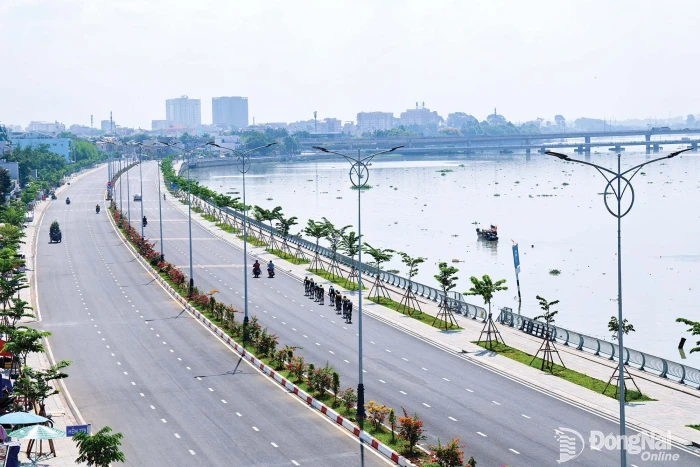
Under the scorching midday summer sun, Luu Thi Dung’s family and a team of workers, are dismantling the family home they have lived in for nearly three decades in Vinh Thanh Quarter, Tran Bien ward, to make way for the riverside route along the Cai River.
 |
| Officials from the Dong Nai City Party Committee (CPC)'s Commission for Information, Education and Mass Mobilization, and Tran Bien ward, meet with residents affected by the Cai River Riverside Road project. |
Wiping sweat from her face, Dung admitted that leaving the family home was not easy. "We've lived here for nearly 30 years. This place has been closely tied to our family's livelihood, so naturally it's difficult to leave. But for the city's development, our family, like hundreds of others, agreed to hand over the land on schedule," she said.
Putting public interests first
Dung said that her family’s entire property, covering more than 500 square meters, will be fully cleared for the project. With no resettlement home available yet, they have temporarily moved in with their daughter while salvaging as many reusable building materials as possible to reduce the cost of rebuilding later.
Recognizing the concerns of residents relocating and rebuilding their lives, the Party Committee and People's Committee of Tran Bien ward established working groups to visit every affected household and explain the significance of the project.
According to ward authorities, several national- and municipal-level infrastructure projects are being implemented in the locality, including the Riverside Road along the Cai River, the Bien Hoa–Vung Tau Expressway, Huong Lo 2, the Central Axis Road, the Riverside Road along Dong Nai River, and the Dong Nai River embankment project. While site clearance is essential for project construction, it remains one of the most challenging stages because it directly affects the legitimate rights and interests of affected residents.
Nhon Trach ward accelerates land handover for multiple projects
The Party Committee and People's Committee of Nhon Trach ward reported significant progress in compensation, resettlement and land clearance during the first half of 2026, thanks to close leadership from the CPC and Dong Nai People's Committee, strong support from municipal departments and the coordinated efforts of the entire political system. The ward handed over the entire site required for the expansion of the Ho Chi Minh City–Long Thanh Expressway and completed 95.4 percent of site clearance for Road 25B. The locality has also intensified public outreach to encourage residents to hand over land early for a number of major projects, including the 220kV Nhon Trach Industrial Park Substation, the 220kV Nhon Trach 3 Power Plant–500kV Long Thanh Substation transmission line, a new section of the 110kV four-circuit transmission line, and the Ba Ky Canal reinforcement project.
According to Ho Van Nam, Party Secretary and Chairman of the People's Council of Tran Bien ward, effective site clearance requires Party committee leaders to remain closely involved at project sites, engage directly with residents and promptly resolve emerging issues rather than relying solely on subordinates. To that end, the ward has mobilized the entire political system by establishing public outreach teams, assigning members of the ward Party Committee's Standing Board to oversee individual projects, and assigning Party members and officials to work directly with affected households.
"The approach should be flexible yet resolute. Policies must be explained in a transparent, fair and reasonable manner, while legitimate opinions from residents should be fully heard and taken into account," he said.
Similar efforts have also delivered positive results in Dong Xoai ward, where public outreach has played a key role in advancing site clearance for major development projects.
According to Vu Van Muoi, Party Secretary and Chairman of the People's Council of Dong Xoai ward, site clearance is currently underway for two key infrastructure projects in the ward. For the Western section of the North–South Expressway linking Gia Nghia and Chon Thanh, nearly 85 percent of the project site has been handed over to the contractor. Meanwhile, for the Hai Thuong Lan Ong Road project, extending from Ton Duc Thang Street to the Binh Phuoc ward boundary, 77 percent of the site has been cleared, handed over and leveled for construction.
Effective public outreach during site clearance requires the combined efforts of the entire political system. Dong Xoai ward has consistently ensured that the process is carried out in an open, transparent and democratic manner. The ward has also fully leveraged the role of the Vietnam Fatherland Front and mass organizations by visiting households directly, explaining the practical benefits and long-term value of the projects, and encouraging residents to support their implementation.
"When people fully understand the benefits these projects will bring and stand united in support of the common good, they are willing to put the community's interests first by voluntarily handing over their land and complying with the law," he said.
Public outreach remains a strategic priority
Dong Nai City is one of Vietnam's most strategically important localities. A series of nationally significant infrastructure projects, including Long Thanh International Airport, the Bien Hoa–Vung Tau Expressway, Ring Roads 3 and 4, the Dau Giay–Tan Phu Expressway, the Gia Nghia–Chon Thanh Expressway, and the Chon Thanh–Thu Dau Mot Expressway—are being accelerated and are expected to open up new development opportunities for the city.
Recognizing communication and public outreach as a key task that must pave the way for project implementation, city authorities have stepped up efforts to raise public awareness, build consensus and encourage compliance with the law. These efforts have helped minimize complaints and accelerate the implementation of key tasks and strategic infrastructure projects.
Close leadership from the CPC, together with strong coordination across the political system, will help bring these key projects into operation sooner, supporting Dong Nai's goal of achieving double-digit economic growth and building a green, prosperous, modern and civilized city.
Member of the CPC’s Standing Board and Head of the CPC’s Commission for Information, Education and Mass Mobilization Duong Minh Dung
According to Duong Minh Dung, Member of the CPC’s Standing Board and Head of the CPC’s Commission for Information, Education and Mass Mobilization, the city's communication strategy follows the principle of "Communication must lead the way, implementation must be synchronized, and guidance must remain consistent." The commission has advised the CPC’s standing members and its Standing Board to strengthen communication and public engagement, helping Party committees, government agencies, mass organizations and residents better understand the significance of the city's strategic projects.
During project implementation, whenever residents raise petitions or concerns, the CPC's Commission for Information, Education and Mass Mobilization has instructed the city's communication and mass mobilization system, the Vietnam Fatherland Front and socio-political organizations to coordinate with relevant state agencies in implementing laws and policies, promoting socio-economic development and addressing issues attracting public attention. The commission has also advised competent authorities to organize public dialogues, listen to residents' concerns and aspirations, and make timely policy adjustments to protect the interests of the State, businesses and residents while strengthening social consensus.
Dung said communication and mass mobilization efforts for the city's key tasks and strategic infrastructure projects will continue to focus on providing official information, particularly on policies related to land acquisition compensation, land price frameworks and vocational transition support for residents directly affected by project implementation. These efforts will help address public concerns and prevent social tensions from developing into public security hotspots at the grassroots level.
He also stressed the importance of strengthening dialogue between grassroots authorities and residents, especially households directly affected by the projects, while giving full consideration to well-founded public feedback in order to further refine policies towards ensuring a balance between the interests of the State, the public and businesses.
By Duong An – Translated by M.Nguyet, Thu Ha


Thông tin bạn đọc
Đóng Lưu thông tin