
Following the provincial merger, the new Dong Nai province, comprising the former Binh Phuoc and Dong Nai provinces, has a student population of over 1.2 million and more than 1,300 educational institutions. Dong Nai ranks among the five localities with the largest number of students nationwide, following Hanoi, Ho Chi Minh City, Nghe An, and Thanh Hoa.
Truong Thi Kim Hue, Member of the Provincial Party Committee and Director of the Dong Nai Department of Education and Training (DOET), stated: “In each stage of development of the former Dong Nai and Binh Phuoc provinces, provincial leaders placed strong emphasis on education. This undertaking served as an important foundation for the new Dong Nai province to establish a well-developed school system and fairly comprehensive educational quality following the merger. As of now, 69.78 percent of schools in Dong Nai meet national standards.”
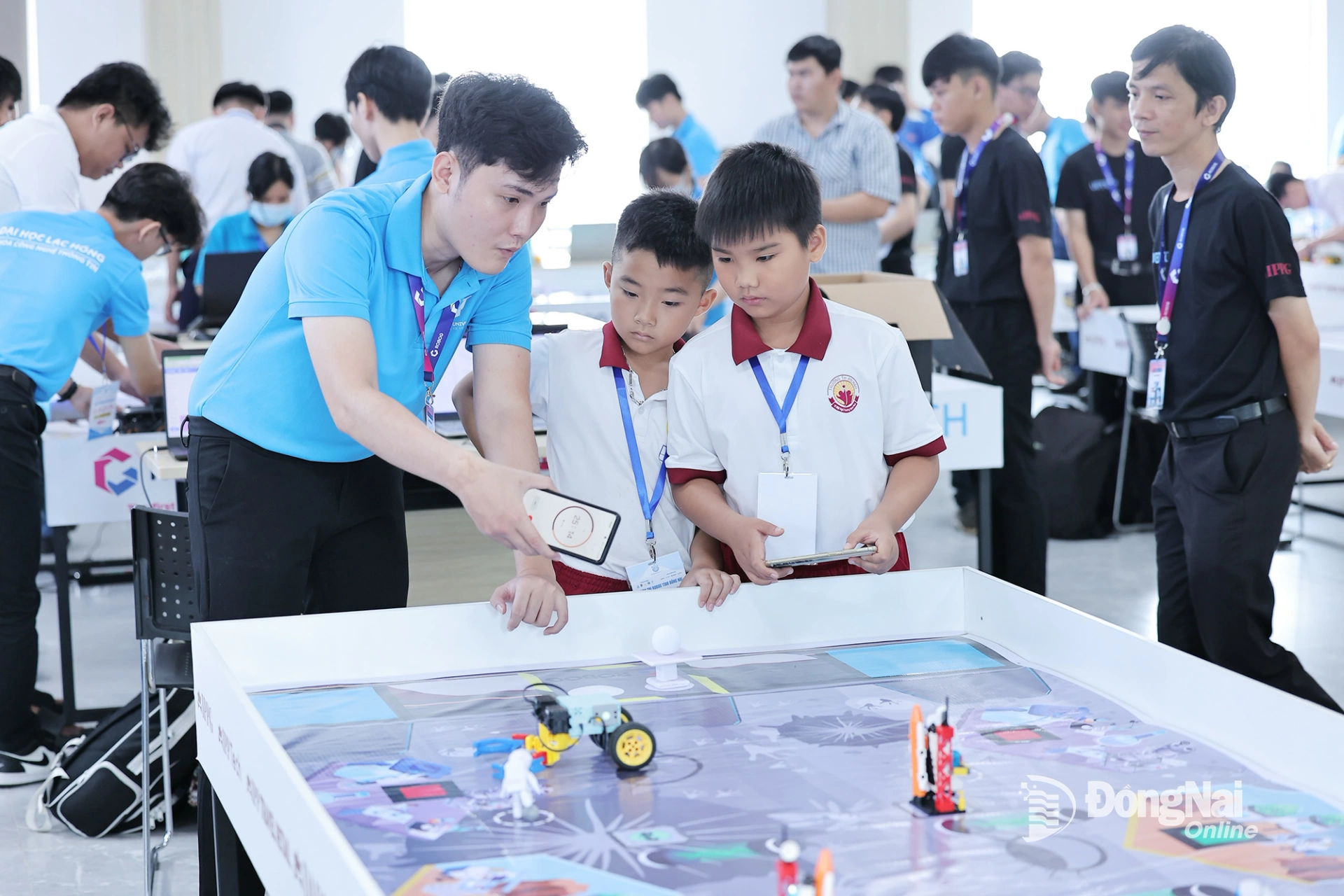 |
| The STEM Education model has been introduced in schools in Dong Nai. Photo: Cong Nghia |
Rising from hardship
After the liberation of the South and national reunification on April 30, 1975, Loc Thanh, a border commune, had a vast area but a sparse population and faced many hardships. As a result, developing the school system in Loc Thanh was especially challenging. The lack of educational infrastructure made it difficult for students to access schooling, while the illiteracy rate, particularly among ethnic minorities, remained very high. This bottleneck posed a significant challenge for local Party committees and authorities, and was a major concern for provincial leaders.
Nguyen Thi Tuyet, Principal of Loc Thien Primary and Secondary School (Loc Thanh commune), shared: Compared to many years ago, the school now has significantly improved conditions to serve, care for, and educate students. Thanks to investment from the province and support from the commune, the school was recently recognized as meeting national standards at level 1 and achieving level 2 accreditation in educational quality. The school is optimistic that, with new education policies, it will soon enjoy even better teaching and learning conditions, particularly through the implementation of digital transformation in education and the two-session-per-day teaching model.
Dieu Khim, Permanent Deputy Secretary of the Party Committee of Loc Tan commune, shared: "Previously, I was also an ethnic minority student with many difficulties. Thanks to the attention of the Party and the State, I was fully supported to study, and then I went to university. Later, I was assigned to work as a commune official, contributing to building my homeland. If there had not been the support for education from the Party and the State, I would certainly not have the life and working conditions I have today."
As for the remote and disadvantaged communes of the former Dong Nai province, such as Ma Da, Phu Ly, Dak Lua, Thanh Son, and Xuan Hung, in the early years following the liberation of the South and national reunification, these areas were considered "education black spots," facing numerous challenges related to school facilities and teaching staff. Today, in most of these communes, the school system has been significantly upgraded, with modern and well-equipped infrastructure, and 100 percent of public schools have been recognized as meeting national standards.
Speaking about the new picture of the Dong Nai education sector after the merger of the two former Binh Phuoc and Dong Nai provinces, Deputy Director of the DOET Do Dang Bao Linh said: The provincial education system has been completed, with over 1.2 million students and over 1,300 preschool and general education institutions across the province. The percentage of preschool and general education schools in the province recognized as meeting national standards reached 69.78%. Regarding the system of college and university training institutions, Dong Nai province currently has 4 universities, 2 university branches, and 12 colleges (excluding universities and colleges of the Ministry of National Defense and the Ministry of Public Security located in the province).
In addition to a relatively high proportion of schools meeting national standards, Dong Nai province has developed a network of specialized high schools, currently comprising three institutions: Luong The Vinh High School for the Gifted, Quang Trung High School for the Gifted, and Binh Long High School for the Gifted. These schools play a key role in identifying and nurturing academically outstanding students, contributing to the province’s efforts to build a high-quality human resource base. In recent years, students from these specialized high schools have made remarkable efforts and, with the dedicated support of their teachers, have earned numerous top prizes in national competitions for excellent students and in Olympic contests, becoming a source of pride for the province.
Pioneering the socialization of education
Compared to the national average, Dong Nai province has performed well in promoting the socialization of education, with 20.6 percent of students enrolled in non-public schools, well above the national average of 6.68 percent. As of the 2025–2026 school year, the province’s network of non-public schools comprises 190 institutions, ranging from preschool to high school. This system includes 150 preschools, 6 primary schools, 5 lower secondary schools, and 29 upper secondary schools. These non-public schools have enrolled 145,000 students across all levels, accounting for approximately 20.6 percent of the province’s total student population.
Dong Nai province is entering a new era with many emerging development opportunities. As such, the role of the education and training sector is increasingly critical, directly shaping the quality of human resources. The province will continue to prioritize and allocate resources commensurate with the importance of education, viewing it as a comprehensive breakthrough sector. In addition to improving the quality of preschool and general education, vocational schools, colleges, and universities must continuously innovate, emphasizing the launch of new academic and training programs that are still lacking in the province, especially in emerging fields such as aviation, logistics, and semiconductor microchips.
Deputy Secretary of the Provincial Party Committee, Chairman of the People's Committee of Dong Nai province, Vo Tan Duc
The socialization of education in the province has led to the establishment of non-public educational institutions offering training based on international school models and granting international baccalaureate diplomas. There are also high-quality schools that emphasize foreign languages, information technology, soft skills, and implement a two-session-per-day schedule across all grade levels.
In addition, the construction and operation of preschools to serve the children of enterprise workers have initially been effectively implemented with many new preschools being established such as: Dong Phuong Preschool in Song May Industrial Park (Binh Minh commune); Dona Standard Preschool in Xuan Loc Industrial Park (Xuan Loc commune); Thai Quang Preschool (Long Binh ward); Nhung Bong Hoa Nho Preschool (Bien Hoa ward)...
In addition to local investors, Dong Nai province has also attracted significant interest from out-of-province and foreign investors in educational projects. The socialization of education has played an active role in reducing the number of public staff assigned to the education sector in recent years. With a total of 3,426 non-public classes across all education levels, the private school system has effectively taken on the equivalent of approximately 7,052 staffing positions, contributing to the province’s goal of reducing the number of public employees in education.
Director of the Department of Education and Training Truong Thi Kim Hue said: "We will continue to thoroughly grasp the Party's and State's policies on encouraging the socialization of the education and training sector so that all levels of government, mass organizations, economic organizations, and the people correctly understand and thoroughly implement socialization. We will strengthen propaganda, assign specific tasks, and consider the socialization of education as a key, continuous, and long-term task in the direction and administration of all sectors and levels. This undertaking will build consensus in awareness and action among all sectors, levels, mass organizations, and the people regarding the position, role, and important meaning of educational socialization."
The education sector will continue to implement tax exemption and reduction policies for non-public institutions in accordance with legal regulations. In Dong Nai province, this has been concretized in Resolution No. 38/NQ-HDND dated December 15, 2023, issued by the Provincial People's Council, which sets unified levels of land rent exemption and reduction for projects implementing education socialization. Preferential policies on land use and credit will also be applied in line with national regulations, encouraging the socialization of education. All favorable conditions will be created to enable investors to access and borrow preferential credit capital from state-funded development sources, in accordance with current laws.
Localities shall base on the list of socialized education projects approved by the Dong Nai Provincial People's Committee to organize investment calls for education projects in the area. In areas with high socialization potential, localities shall review and propose educational land plots that have been invested in construction at other locations or educational facilities that are no longer in use due to mergers or re-planning, to organize auctions and call for educational investment in accordance with the socialization policy.
Dong Nai aims to be a high-tech training center
To date, Dong Nai has developed a comprehensive and unified education system spanning from preschool to university. Socialized resources have been strongly mobilized for education, contributing to the formation of a rich, diverse, and high-quality educational ecosystem. Several private high schools in the province have implemented instruction based on international curricula. At the same time, universities and colleges have not only proactively pursued educational quality accreditation in accordance with Vietnamese standards but are also working toward meeting international benchmarks.
 |
| Dong Nai Provincial Boarding School for Ethnic Minorities (Hung Thinh commune, Dong Nai province) was invested with over 230 billion VND to serve the learning of ethnic minority students in the province. |
In the Dong Nai Provincial Master Plan for the 2021–2030 period, with a vision to 2050, approved by the Government, the education and training sector continues to be identified as holding a strategically important position, with clearly defined investment steps. According to the province’s development orientation, Dong Nai is set to welcome several new higher education institutions. These include a new campus of Ho Chi Minh City University of Medicine and Pharmacy in Long Phuoc commune; a training facility of Ho Chi Minh City University of Transport in An Phuoc commune, focused on aviation and high-speed rail; and a branch of Ho Chi Minh City Open University in Long Hung ward. In addition, the province has designated areas in Nhon Trach commune and Long Khanh ward for the development of higher education-focused urban zones.
Dang Anh Tuan, Acting Vice Rector of Dong Nai University, said that immediately after the provincial merger, the university conducted field surveys in Dong Xoai ward and Binh Phuoc ward to identify a suitable location for establishing its second campus. The university's goal is to train pedagogical and other professional human resources to serve the socio-economic development of communes in the former Binh Phuoc province and the Central Highlands region.
Nguyen Khanh Cuong, Rector of Lilama 2 International College of Technology in Long Phuoc commune, said that although the institution only offers college-level training, thanks to years of support from the provincial authorities, it has developed several key programs in electronics, refrigeration, and precision mechanics that meet standards from the UK, US, and Australia. The college has also quickly capitalized on opportunities to train aviation personnel in collaboration with leading Vietnamese aviation enterprises such as Airports Corporation of Vietnam (ACV) and Vietjet Air, with the goal of supplying a skilled workforce for the upcoming Long Thanh International Airport project.
Meanwhile, Lam Thanh Hien, Rector of Lac Hong University in Tran Bien ward, said that over the past 30 years, the university has worked hard to grow from challenging early beginnings into one of the province’s large-scale institutions. In alignment with the province’s development orientation and investment attraction strategy, the university has introduced new training programs in fields such as logistics, artificial intelligence, and semiconductor microchips. It also continues to standardize its academic programs to meet ASEAN and US standards.
By Dang Cong – Translated by Mai Nga, Minho


Thông tin bạn đọc
Đóng Lưu thông tin