
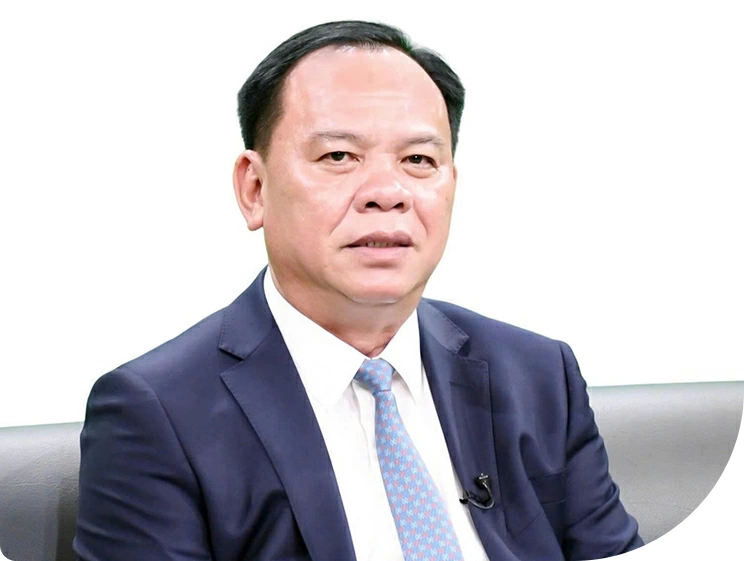
With its strategic location and development potential, Dong Nai City is evolving from a regional gateway into one of the country’s key logistics and infrastructure hubs. Aspiring to elevate the locality into a key growth pole, Vo Tan Duc, Deputy Secretary of the City Party Committee and Head of the Steering Committee for Key Projects in the City, shared with Dong Nai Newspaper and Radio, Television the solutions aimed at completing Dong Nai’s multimodal transport ecosystem.
 |
These orientations and strategic decisions are expected to pave the way for Dong Nai to transform its advantage as a “gateway” into one that supports settlement and production, attracting multinational corporations to establish headquarters and high-tech manufacturing facilities, thereby reinforcing its role as one of the country’s major growth engines.
Infrastructure as a foundational “lever”
Dong Nai’s official transition to city status is not only an administrative milestone but also the beginning of a new development phase. In this roadmap, how does the City shape its infrastructure development strategy so that it serves both as an economic “lever” and as the “backbone” for a modern urban space?
Dong Nai’s elevation to city status is a major event carrying profound significance for the locality. It is not merely an administrative change, but also a greater responsibility in contributing to the country’s socio-economic development. In this new era of growth, Dong Nai has embraced a new development identity.
The City Party Committee has identified the development of synchronized, modern and highly connected strategic infrastructure as the backbone organizing the City’s development space. Priority is being given to transport, logistics and urban infrastructure projects linked to growth zones and development corridors. The city also aims to strengthen connectivity with Ho Chi Minh City, the Southeast region, the South Central Coast, the Central Highlands and major economic hubs nationwide, as well as international connections.
 |
| Construction of the interchange between the Ben Luc – Long Thanh Expressway and National Highway 51. Photo: Pham Tung |
According to the city leadership, infrastructure must be planned and invested in systematically, with connectivity serving as a key principle. Infrastructure will help reshape development space, enabling economic centers to transition from extensive growth to deeper development, closely linked to higher value added.
Transport infrastructure, in particular, has been identified as one of the city’s major breakthroughs. Dong Nai will focus on mobilizing and efficiently utilizing all resources to build a diversified, synchronized and modern infrastructure system, ensuring close regional and inter-regional connectivity. A key task is to complete strategic infrastructure and strengthen multimodal transport links in order to fundamentally resolve existing traffic bottlenecks, thereby creating momentum for expanding development space and accelerating socio-economic growth.
To match its new status, what breakthroughs does the current transport infrastructure strategy offer in terms of scale and sustainability compared to previous stages?
Regarding strategic transport infrastructure, the City Party Committee has directed the implementation of major projects with strong determination. Priority projects include extending the Ben Thanh – Suoi Tien metro line to the city administrative center and Long Thanh International Airport, developing Ho Chi Minh City Ring Road No. 4, and constructing the North–South high-speed railway section passing through the locality.
In terms of road infrastructure, Dong Nai plans to develop new transport axes connecting the northern region, including Hoa Lu International Border Gate Economic Zone, urban centers and industrial parks, with key Southern areas such as Long Thanh Airport, Phuoc An Port, free trade zones and new urban areas. For waterway infrastructure and services, the city will focus on upgrading and expanding seaport and inland waterway systems while forming high-quality logistics and commercial-service centers to optimize transport and trade capacity.
 |
| The Ben Thanh – Suoi Tien metro line will be extended to the Dong Nai City Administrative Center and Long Thanh International Airport. Photo: Hoang Loc |
At the same time, the city will promote green, smart and modern urban development associated with transit-oriented development (TOD), ensuring synchronized connectivity between technical and social infrastructure inside and outside the locality. Mechanisms will also be introduced to effectively utilize underground, low-rise, peripheral and elevated urban spaces in order to maximize land-use efficiency.
Urban restructuring and redevelopment will also be accelerated, with a focus on upgrading old urban areas and zones with weak infrastructure. Policies will be developed to encourage riverside urban areas and multifunctional, multi-purpose urban zones.
The City Party Committee has also identified the development of a modern urban economy linked with more efficient land use and higher living standards. Dong Nai will proactively implement measures to reduce greenhouse gas emissions and pursue the goal of achieving net-zero emissions before 2045, prioritizing clean and renewable energy while ensuring a fair transition suited to the locality’s natural conditions and advantages.
Dong Nai serves as an international trade gateway and modern logistics hub
Long Thanh Airport and the expressway network are turning Dong Nai City into a national focal point. How do you assess Dong Nai’s position within the Southern key economic region?
It can be said that Dong Nai has never before faced such a historic opportunity. The locality is not only a newly established city with new mechanisms, but also home to a series of national key projects currently under implementation.
The simultaneous development of projects such as Long Thanh International Airport, the Bien Hoa – Vung Tau Expressway, Dau Giay – Lien Khuong Expressway, Dau Giay – Phan Thiet Expressway, and Ho Chi Minh City Ring Roads No. 3 and No. 4 has positioned Dong Nai as the transportation hub of the Southern key economic region.
 |
| A series of strategic transport infrastructure projects are being implemented in Dong Nai to promote socio-economic development and effectively utilize land resources. In the photo: A corner of Nhon Trach Ward. Photo: Hoang Loc |
From the perspective of the city’s leadership, this is not only an advantage for Dong Nai itself, but also for the entire country. Once connectivity infrastructure is completed, Dong Nai will serve as an international trade gateway and a modern logistics center for Southeast Asia. This will elevate the city’s political and economic role in driving regional development.
We are striving to transform the ‘gateway’ advantage into one that supports settlement and production, attracting multinational corporations to establish headquarters and high-tech factories, thereby affirming Dong Nai’s role as a key growth pole of the country.
Alongside transport infrastructure, building a modern and livable city is also a top priority. How will Dong Nai shape its identity through the two pillars of sustainable green urban development and smart digital infrastructure?
In our development orientation, we define Dong Nai’s infrastructure as “sustainable infrastructure.” Alongside economic development, protecting the natural ecosystem must remain a consistent principle.
Dong Nai possesses major ecological resources such as the Dong Nai River, Tri An Lake, Thac Mo Lake, Cat Tien National Park, Bu Gia Map National Park, Chua Chan Mountain and Ba Ra Mountain. These areas not only hold environmental significance but also form the city’s unique landscape identity. During the development process, green corridors and ecological belts must be preserved to maintain balance between urban growth and environmental protection.
 |
| Urban development must not only aim for economic growth but also ensure social factors and quality of living environment. In the photo: A corner of Tran Bien Ward, Dong Nai City. Photo: Cong Nghia |
Another important requirement is improving residents’ quality of life. Public spaces, urban parks and riverside areas must receive greater investment to create a favorable and community-friendly living environment. Urban development should not focus solely on economic indicators but also on social well-being and environmental quality.
Regarding digital infrastructure, this is considered an indispensable element for operating a smart city. Dong Nai will focus on completing a synchronized and modern digital infrastructure system, while strengthening investment in science and technology capacity and infrastructure innovation.
The city will also implement planning for an innovation hub and develop a comprehensive startup and innovation ecosystem.
 |
| VNPT Dong Nai information technology specialists operate the control system at the Dong Nai City Intelligent Operations Center in Tran Bien Ward. Photo: Hai Quan |
At the same time, Dong Nai will accelerate 5G coverage, build an Intelligent Operations Center (IOC) and digitize the entire technical infrastructure management system. City leader believe big data will play a central role in managing urban issues ranging from traffic congestion and flooding to public security.
Becoming Vietnam’s seventh city marks a long journey of determination and aspiration shared by the Party Committee, authorities and people of Dong Nai. In this historic transformation period, what message would you like to send to officials, Party members and residents to jointly realize Dong Nai’s new opportunities?
As I have emphasized, Dong Nai’s transition to city status is a major milestone with profound significance. It is not only the result of persistent efforts but also an affirmation of Dong Nai’s position in the nation’s new development era.
The workload ahead remains enormous. I hope every official and Party member will uphold the spirit of dedication, dare to think, dare to act and dare to take responsibility in order to match the city’s new position. We cannot continue thinking in old ways when standing in a new position.
Infrastructure and economic development are not merely about growth figures. Ultimately, the goal is to improve people’s quality of life. Every policy decision must place residents at the center, transforming the “gateway” advantage into one that supports both sustainable settlement for families and production activities for businesses and investors.
Above all, the strength of great national unity bloc remains the greatest resource. I hope residents from all walks of life will continue to show consensus and support in implementing key projects, joining hands to build Dong Nai into a civilized, modern and livable city.
With the determination of the Party Committee, authorities and the companionship of the people, I believe Dong Nai’s infrastructure landscape will soon be completed, turning the city into a modern logistics heart worthy of its role as a key national growth pole.
By K.Gioi, Ha Le – Translated by M.Nguyet, Thu Ha


Thông tin bạn đọc
Đóng Lưu thông tin