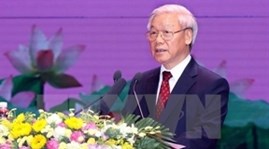
Party General Secretary Nguyen Phu Trong has pinned high hopes on Vietnamese journalists in the national "doi moi" (renewal), development, and protection in his article on celebration of the 90th Revolutionary Press Day (June 21).
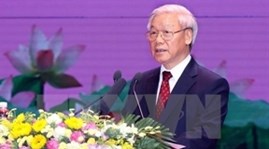 |
Party General Secretary Nguyen Phu Trong has pinned high hopes on Vietnamese journalists in the national “doi moi” (renewal), development, and protection in his article on celebration of the 90th Revolutionary Press Day (June 21).
He wrote that the more developed society is, the more important the press is, which is both a great honour and an enormous responsibility of the sector.
To prepare for the establishment of a political party to lead the revolution, President Ho Chi Minh published the first issue of the Thanh nien (Young People) newspaper on June 21, 1925.
The late leader, who went by the name Nguyen Ai Quoc at the time, believed it was vital to disseminate Marxism-Leninism and gather resources to start a revolution and that the press served as a salient tool to do so. The revolutionary press is also an effective means to promote social development, General Secretary Nguyen Phu Trong noted.
Over the past 90 years, Vietnam’s revolutionary press has continually been at the Party and people’s side during struggles for national independence and socialism.
It has greatly contributed to “doi moi” for almost three decades by reflecting every aspect of life from all corners of the country; fighting against corruption, wastefulness, and negative phenomena; supporting the protection of national sovereignty; refuting distorted arguments; and providing feedback on Party guidelines and State policies and laws.
The press has also played a critical role in promoting Vietnam to the international community and helping local people gain a better view on regional and global situations, the Party chief added.
He highlighted the comprehensive development of the press, citing a report of the Ministry of Information and Communications that Vietnam currently houses 849 print newspapers, 67 radio-television stations, 98 online newspapers and magazines, and one national news agency. The number of people working in the press sector increased from 31,000 in 2009 to 35,000, including nearly 18,000 journalists, and almost 96 percent of the staff holds bachelor’s degrees or higher.
In his piece, General Secretary Nguyen Phu Trong asked each journalist and press outlet to uphold the sector’s glorious 90-year tradition and build on their political firmness, sense of social responsibility, obligations to citizens and job morality to fulfil their missions.
He also urged them to be steadfast in the contemporary era of heavy information flows to ensure properly-oriented reports while meeting the public demand as well as possible.
“Revolutionary journalists must have revolutionary spirit to fight the bad and protect the good for the sake of the entire nation and people. It is also the spirit to fuel self-renovation and self-improvement”, the General Secretary wrote.
To prepare for the establishment of a political party to lead the revolution, President Ho Chi Minh published the first issue of the Thanh nien (Young People) newspaper on June 21, 1925.
The late leader, who went by the name Nguyen Ai Quoc at the time, believed it was vital to disseminate Marxism-Leninism and gather resources to start a revolution and that the press served as a salient tool to do so. The revolutionary press is also an effective means to promote social development, General Secretary Nguyen Phu Trong noted.
Over the past 90 years, Vietnam’s revolutionary press has continually been at the Party and people’s side during struggles for national independence and socialism.
It has greatly contributed to “doi moi” for almost three decades by reflecting every aspect of life from all corners of the country; fighting against corruption, wastefulness, and negative phenomena; supporting the protection of national sovereignty; refuting distorted arguments; and providing feedback on Party guidelines and State policies and laws.
The press has also played a critical role in promoting Vietnam to the international community and helping local people gain a better view on regional and global situations, the Party chief added.
He highlighted the comprehensive development of the press, citing a report of the Ministry of Information and Communications that Vietnam currently houses 849 print newspapers, 67 radio-television stations, 98 online newspapers and magazines, and one national news agency. The number of people working in the press sector increased from 31,000 in 2009 to 35,000, including nearly 18,000 journalists, and almost 96 percent of the staff holds bachelor’s degrees or higher.
In his piece, General Secretary Nguyen Phu Trong asked each journalist and press outlet to uphold the sector’s glorious 90-year tradition and build on their political firmness, sense of social responsibility, obligations to citizens and job morality to fulfil their missions.
He also urged them to be steadfast in the contemporary era of heavy information flows to ensure properly-oriented reports while meeting the public demand as well as possible.
“Revolutionary journalists must have revolutionary spirit to fight the bad and protect the good for the sake of the entire nation and people. It is also the spirit to fuel self-renovation and self-improvement”, the General Secretary wrote.
(Source:VNA)