
With a modern, integrated multimodal transport infrastructure network under development, Dong Nai City is opening up new development spaces for socio-economic growth.
The expanding transport infrastructure is expected not only to improve connectivity but also to unlock new growth areas that will contribute to the city's long-term development.
Transport infrastructure lays the foundation for growth
During an inspection of preparations for the groundbreaking ceremony of Component Project 1-2 under the Ho Chi Minh City’s Ring Road 4 Project in late May 2026, Nguyen Van Ut, Deputy Secretary of the City Party Committee and Chairman of Dong Nai People's Committee, instructed local authorities along the route to review planning schemes and identify land areas with strong development potential along the route to maximise the project's investment efficiency.
 |
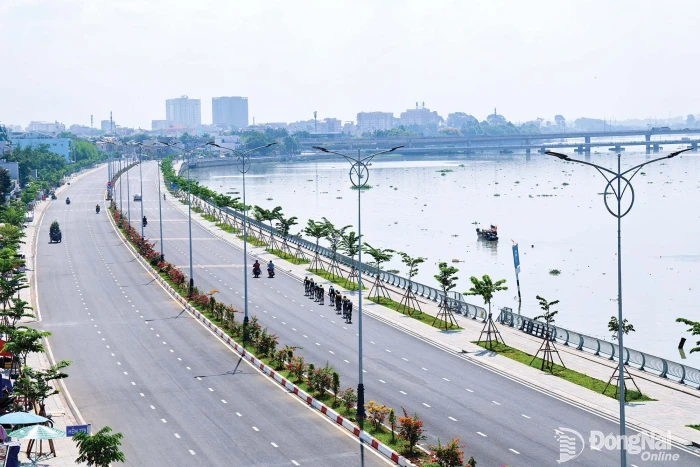
| Strong investment in transport infrastructure is creating favourable conditions for Dong Nai to expand new development spaces. |
The Ho Chi Minh City’s Ring Road 4 is only one of many major transport infrastructure projects being implemented across Dong Nai. With a series of strategic transport projects underway, Dong Nai is well positioned to open up new development spaces across the city.
Dong Nai is home to nine expressway projects that have been completed or are under construction. Of these, the Ho Chi Minh City–Long Thanh–Dau Giay Expressway and the Phan Thiet–Dau Giay Expressway are already fully operational. Meanwhile, sections of the Bien Hoa–Vung Tau Expressway, the Ben Luc–Long Thanh Expressway, and the Ho Chi Minh City’s Ring Road 3 have also been partially opened to traffic, including their mainline sections. Several additional expressway projects are expected to be completed and put into operation over the next one to two years.
At the same time, Dong Nai is working with neighbouring localities and relevant agencies to develop urban metro lines and high-speed railway projects to strengthen transport connectivity.
According to Ho Van Ha, Vice Chairman of the City People's Committee, Dong Nai has identified transport infrastructure development as a strategic priority to drive the city's growth. Transport infrastructure projects not only improve regional connectivity but also create the conditions necessary for the formation of new development spaces.
Reshaping the city's development landscape
According to Prof. Dr. Vo Xuan Vinh, Director of the Institute of Business Research at the Ho Chi Minh City University of Economics, Dong Nai's strategic location presents it with great opportunities to mobilise resources, establish development mechanisms, attract investment and develop infrastructure, particularly transport infrastructure.
In recent years, Dong Nai has witnessed rapid investment in transport infrastructure. Alongside regional connectivity projects, the city has also invested heavily in improving its urban transport network.
According to Huynh Ho Dai Nghia, a public policy expert from the University of Social Sciences and Humanities under the Vietnam National University Ho Chi Minh City, Dong Nai's infrastructure development should not be viewed simply as a series of individual transport projects but as part of a broader restructuring of the city's development landscape.
"While Dong Nai's growth was once driven primarily by industrial parks, national highways, links with Ho Chi Minh City and traditional manufacturing corridors, the emergence of Long Thanh International Airport, together with expressways, ring roads, Phuoc An Port, as well as its connection with the Cai Mep–Thi Vai Port complex, and planned railway and metro networks, is paving the way for a development model built on strategic infrastructure," he said.
According to Nghia, the significance of infrastructure extends well beyond reducing travel time. More importantly, it creates entirely new economic spaces for Dong Nai. The area surrounding Long Thanh International Airport has the potential to develop into an airport urban area featuring an aviation logistics hub, international trade centre, aviation financial services, transit services, hotels, convention facilities, healthcare, education and aerospace engineering industries. These advantages could form the basis of a globally competitive aviation economy ecosystem.
At the same time, stronger connectivity among Long Thanh International Airport, Phuoc An Port, the Cai Mep–Thi Vai Port complex, expressways, ring roads, railways and inland container depots (ICDs) is expected to position Dong Nai as a multimodal logistics hub for Southern Vietnam.
The city's expressway and ring road network will also create new opportunities for integrated industrial, urban and service development. However, the expansion should be carefully planned to avoid uncontrolled urban sprawl and piecemeal land development, with development organized into clearly defined functional zones.
"The transit-oriented development (TOD) model offers four key opportunities for Dong Nai. First, it enables the development of compact, mixed-use urban centres integrating housing, offices, commercial, educational, healthcare and public facilities around transport stations. Second, it helps improve connectivity between residential areas, workplaces and public services, particularly as the city's industrial, logistics, airport-related and service sectors continue to expand. Third, rising land values around stations can generate funding for infrastructure development through land auctions and land development. Ultimately, the TOD model enhances urban liveability and strengthens Dong Nai's competitiveness in attracting investors, experts and highly skilled workers."
Huynh Ho Dai Nghia, a public policy expert, University of Social Sciences and Humanities, Vietnam National University Ho Chi Minh City
As transport infrastructure continues to expand, the TOD model around metro stations, railway stations and major public transport hubs is expected to support compact, mixed-use urban development, reduce reliance on private vehicles and strengthen links between residential areas, workplaces and public services. Unlike Ho Chi Minh City, where urban development has become increasingly dense, Dong Nai still possesses substantial land reserves and a unique opportunity to build a new generation of urban areas. The city can proactively plan TOD urban centres around strategic locations such as Long Thanh, Nhon Trach, Bien Hoa, ring roads, railway stations and future metro corridors.
Such planning would help Dong Nai avoid many of the challenges faced by larger cities, including traffic congestion, urban sprawl, inadequate public spaces and poor connectivity between residential and employment areas.
By P.Tung – Translated by M.Nguyet, Thu Ha


Thông tin bạn đọc
Đóng Lưu thông tin