
The Ministry of Health on January 5 announced the top ten notable events of the sector in 2015 which have contributed to giving a facelift to the sector.
The Ministry of Health on January 5 announced the top ten notable events of the sector in 2015 which have contributed to giving a facelift to the sector.
1. Changing health workers’ attitude and behaviours for patients’ greater satisfaction.
On June 4, 2015, the Health Minister signed Decision No. 2151/QĐ-BYT issuing a renovation plan on providing services and health workers’ attitude towards patients' satisfaction. The plan has been implemented uniformly and comprehensively, resulting in remarkable changes that received support and warm responses from people and communities.
2. Successfully conducting surrogacy in line with the revised Marriage and Family Law.
On January 28, 2015, the Government issued Decree No. 10/2015/NĐ-CP on in vitro fertilisation and surrogacy conditions for humanitarian purposes.
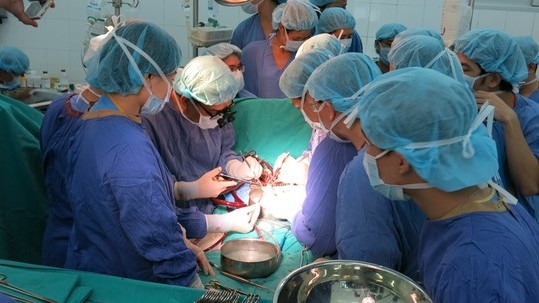 |
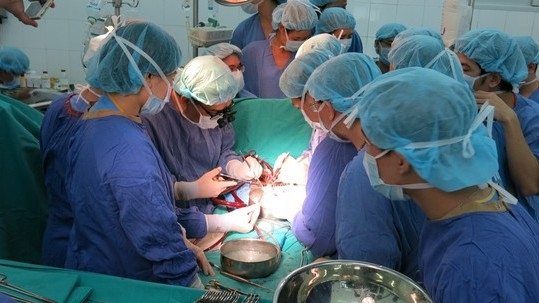
| Doctors at Hanoi-based Vietnam-Germany Hospital conduct a heart transplant right after receiving a heart that traveled 1,700km from Ho Chi Minh City to Hanoi. (Credit: nld.com.vn) |
The revised Marriage and Family Law allows surrogacy for humanitarian purposes, applicable for married couples that do not have children, when the woman is not able to get pregnant and give birth due to heart, kidney, liver, and lung diseases, and gynecology pathology, such as no uterus, undergoing hysterectomy, repeated miscarriages of unknown causes, and failing in carrying out embryo transfer for in vitro fertilisation.
As of early 2015, there are three hospitals allowed to perform the technique - Central Maternity Hospital, Hue Central General Hospital and Ho Chi Minh City-based Tu Du Hospital. The Central Maternity Hospital has approved 60 cases, of which 46 have been performed with the first child expected to be born this January. Tu Du Hospital has 33 profiles approved, and doctors have carried out the technique on 19 patients.
3. The first successful trans-national multiple-organ transplant and the formation of the Vietnam Society for Encouraging Organ Donation.
The trans-national multiple-organ transplant took place on the night of September 4, 2015 with the co-ordination of Cho Ray Hospital in Ho Chi Minh City, Vietnam-Germany Friendship Hospital in Hanoi, and the National Co-ordinating Centre for Human Organ Transplants.
The Minister of Health and the General Secretary of the Central Committee of the Vietnam Fatherland Front were among the first people to sign up to donate tissue/organs after brain death. The ‘Together for Life 2015’ festival was held on December 19, 2015 at the Military Medical Academy, with more than 1,400 participants registered to donate tissue or organs after brain death to support patients and scientific research.
On June 26, the Vietnam Society for Encouraging Organ Donation and the Vietnam Organ Transplant Association were founded and conducted the First Congress. The Vietnam Society for Encouraging Organ Donation, first tenure (2015-2020 term) is headed by the Minister of Health as Chairwoman.
4. The World Health Organisation (WHO) granted the National Regulatory Authority (NRA) certificate to Vietnam, recognising that made-in-Vietnam vaccines meet international standards.
 |
Made-in-Vietnam vaccines have been recognised by the WHO as meeting international standards, opening up export opportunities for the products.
After 14 years of preparation, Vietnam has officially become the 39th member recognised by the WHO for reaching NRA standard for its vaccines among 43 countries capable of producing vaccines around the world. The UN highly praised the NRA management system of Vietnamese vaccines, with all functions of Vietnam’s NRA meet 90% of requirements and three functions meeting 100%. On average, six functional NRA reaches 95%, which shows the quality of Vietnam vaccines has truly reached international standards.
With this recognition, Vietnam can produce vaccines for domestic use and export as there are not many countries that can produce vaccines. More importantly, with domestically-made vaccines reaching international standards, the expanded immunisation programme implementation will have more and more opportunities for further success.
5. Preventing newly-emerging diseases like Ebola, H7N9, MERS-CoV from entering Vietnam
Vietnam was one of the first countries to successfully control SARS, influenza A (H5N1), and influenza A (H1N1) pandemics, while successfully preventing dangerous emerging diseases from entering Vietnam such as influenza A (H7N9), Ebola, and MERS-CoV, contributing greatly to social security in the context of increasing tourism and trade exchanges.
6. Implementing a comprehensive overhaul of the medical system at the communal, district and provincial levels for integration and development.
The Government issued Decree No. 117/2014/NĐ-CP dated December 8, 2014 on healthcare regulations in communes, wards and towns. The Ministry of Health issued Circular No. 33/2015/TT-BYT dated October 27, 2015 guiding functions and duties for clinics in communes, wards and townships. After years, the functions, tasks and organisation structure of medical facilities have been identified and specified.
7. The Health Ministry actualised the project on easing hospital overload and building satellite hospitals.
The sector has resolved 80% of overcrowding at central hospitals and hospitals of major cities. Satellite hospital models operated effectively to provide treatment for patients with special techniques transferred from central hospitals.
Over 4,500 additional beds were added at central hospitals and the number of beds in local medical facilities also increased significantly.
8. Many modern medical establishments put into service.
Construction started on several major healthcare facilities at central level such as Bach Mai Hospital, Vietnam-Germany Hospital base 2 in Liem Tuyen, Ha Nam province, 175 Orthopaedic Hospital, Ho Chi Minh City Pediatric Hospital, and Hanoi Pediatric Hospital. In addition, a range of clinics and medical treatment facilities at both central and provincial levels were also put into use including the Central Paediatrics Hospital, Central Hospital of Dermatology, Geriatrics Central Hospital, National Hospital of Endocrinology, and numerous local hospitals in Quang Tri, Bac Ninh, Bac Lieu, Dong Nai, and Nghe An.
9. At the end of 2015, health insurance covered 75% of the population after amendments and supplements to the Law on Health Insurance took effect on January 1, 2015.
New provisions in the law facilitate health insurance coverage, as well as encouraging positive changes in providing medical services and ensuring medical quality, especially at the grassroots.
10. The Vietnamese health sector followed Uncle Ho’s teachings for 60 years and received the Independence Order, first class.
 |
Deputy Prime Minister Vu Duc Dam presents the Independence Order, first class to the Ministry of Health at a ceremony to celebrate Vietnam Doctor's Day on February 27. (Credit: VNA)
A range of activities were held by the health sector nationwide to celebrate the 60th anniversary of Vietnam Doctor's Day (February 27), with a focus on the media campaign ‘Vietnam’s health sector – 60 years to follow teachings of Uncle Ho’. The sector was conferred the Independence Order, first class for the second time on Vietnam Doctor's Day.
(Source:Nhan Dan)


