
After nearly a year of operating under the new administrative model, the digital workplace has become an integral part of grassroots staff's daily work.
This adaptation is reflected not only in their ability to use digital platforms effectively but also in a shift in mindset regarding management, governance, and public service delivery.
Technology skills reshape public service delivery
In Trang Bom ward, artificial intelligence (AI) has become a familiar support tool for many young staff members. Nguyen Van Tuan, a specialist at the ward's Public Administrative Service Center, said that in advisory and synthesis tasks, most staff use AI to assist in drafting documents, searching for information, and summarizing data. "Technology helps reduce repetitive tasks, giving staff more time to directly guide and support citizens, especially the elderly who are less familiar with digital technology," said Tuan.
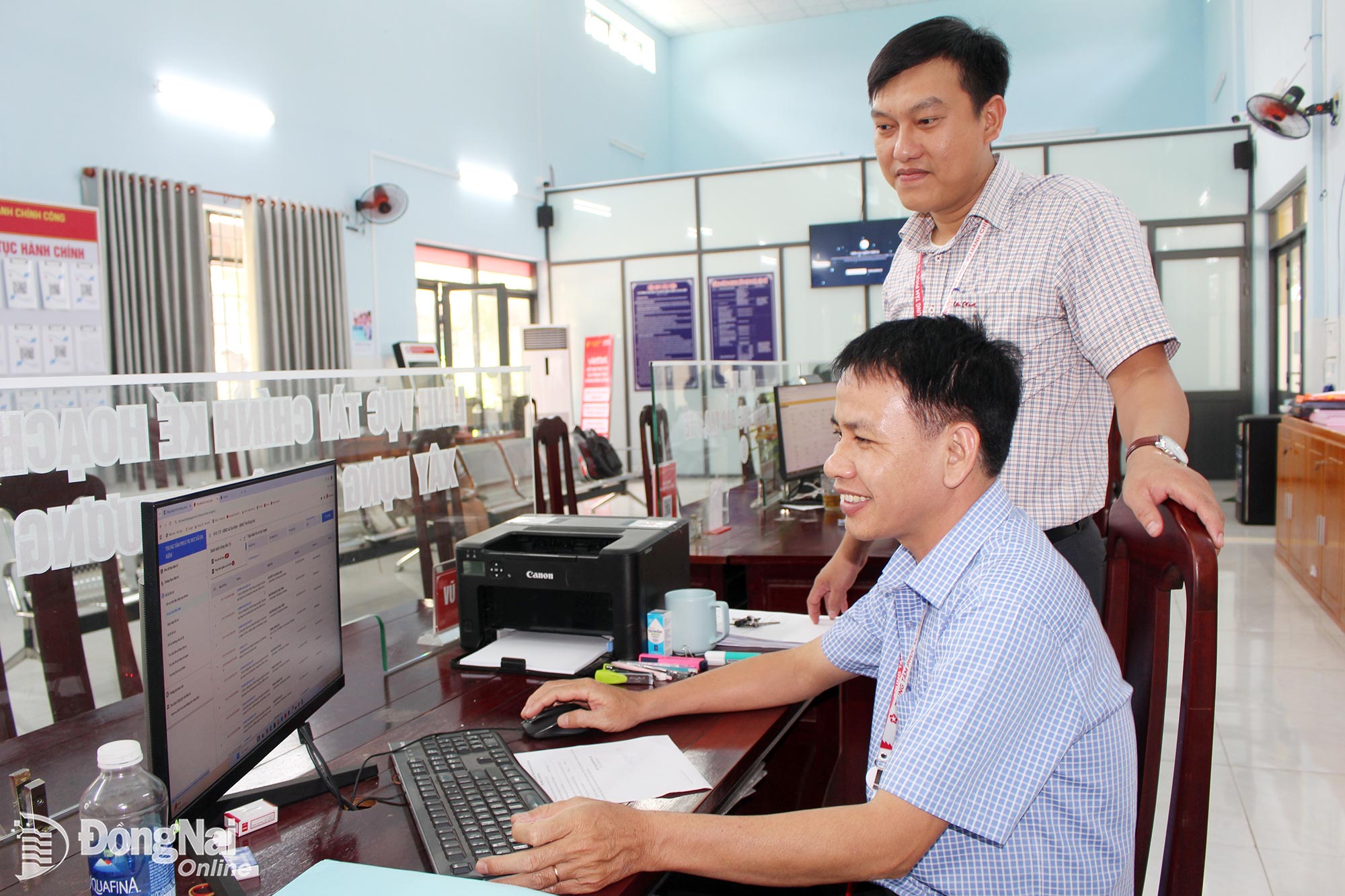 |
| Cadres and civil servants in Gia Kiem commune integrate digital tools into their daily work. |
Beyond supporting internal workflows, AI is gradually playing a deeper role in serving the public. Trang Bom ward has proactively proposed the implementation of an AI-integrated Public Administrative Smart Kiosk system to help citizens access and complete administrative procedures more conveniently. According to Tuan, the current requirement for staff is not only to master technology but also to change their service mindset. "As the city transitions to a new level of governance, if each staff member does not proactively improve their professional qualifications and digital skills, they risk being left behind," said Tuan.
While AI helps staff process work more quickly in Trang Bom, digital transformation in An Vien commune is clearly demonstrated by the way data is effectively used. Luu Thi Bich Huyen, a civil status specialist at the An Vien commune People's Committee, said that during the process of resolving administrative procedures, staff prioritize using information already available in data systems instead of requiring citizens to resubmit documents. "Only when data is incomplete or inaccurate do we ask citizens to provide additional information. At the same time, we also guide citizens to update and adjust their information to complete databases in accordance with regulations," explained Huyen.
According to Huyen, each time data is accurately updated, it not only helps resolve a specific case but also contributes to improving the quality of shared data systemwide. This process also provides the foundation for administrative procedures to be carried out more quickly and efficiently.
These changes are clearly felt by citizens during the administrative procedure process. Instead of having to carry many types of documents as before, in many cases they only need to provide basic information for staff to retrieve from the shared data system. Reducing paperwork and the number of trips not only helps citizens save time and costs but also creates a more convenient experience when accessing public services.
Transformation at the grassroots
From the changes in staff working methods, the effectiveness of digital transformation is gradually reflected in concrete results at the grassroots level. In Binh Long ward, AI is applied in searching for legal normative documents, standardizing data, reviewing internal administrative procedures, and drafting documents. Notably, the AI system also supports citizens in performing end-to-end online public services. Consequently, processing and synthesizing professional information now takes 20-30% less time.
In Nha Bich commune, digital transformation has become integral part of the local administration's routine operations. To date, 100% of cadres and civil servants have been issued and use digital signatures, while 100% of outgoing documents, excluding confidential documents, are processed in an electronic environment. From July 1, 2025, to April 30, 2026, the commune's Public Administrative Service Center received and processed 5,898 administrative applications. The rate of on-time and early resolution reached 99.9%, the online payment rate reached 100%, and overdue files accounted for only 0.08%, mainly due to technical errors during system interconnection.
At the conference reviewing the results of administrative reform in 2025 and the first quarter of 2026, Deputy Director of the Department of Science and Technology Vo Hoang Khai stated that one of the notable results of the recent digital transformation process is that basic digital infrastructure has been completed down to the commune level, while platform systems serving management and administrative procedure resolution have been rolled out uniformly citywide.
Along with operating the new local government model, the leadership of Dong Nai city has repeatedly requested that grassroots cadres and civil servants proactively adapt to the requirements of modern governance, innovate their thinking, and change their working methods. In the context of increasing workloads, a broader management scope, and increasingly high demands for public service, each staff member needs not only to be proficient in their own profession but also to master technology, effectively use data, and apply digital transformation in practical work to improve the quality of service and the efficiency of management and governance.
In the coming period, the city will continue to improve digital infrastructure and shared platforms and expand the application of AI in data management, grassroots governance, neighborhood and hamlet management, and the development of smart cities. At the same time, it will enhance digital capacity among staff members and citizens through digital skills training programs, the Digital Literacy Program, and the promotion of Community Digital Technology Groups’ role.
From the application of AI in work processing and the use of data in place of paper documents to the resolution of administrative procedures in an electronic environment, it is evident that digital transformation is changing every specific task at the grassroots level. The noteworthy aspect lies not in the new software or technologies being put into use, but in the proactive adaptation of cadres and civil servants. As they change the way they work to better serve the public, the benefits of digital government are also gradually becoming visible in daily life.
By Ho Thao – Translated by Minh Hong, Thu Ha



Thông tin bạn đọc
Đóng Lưu thông tin